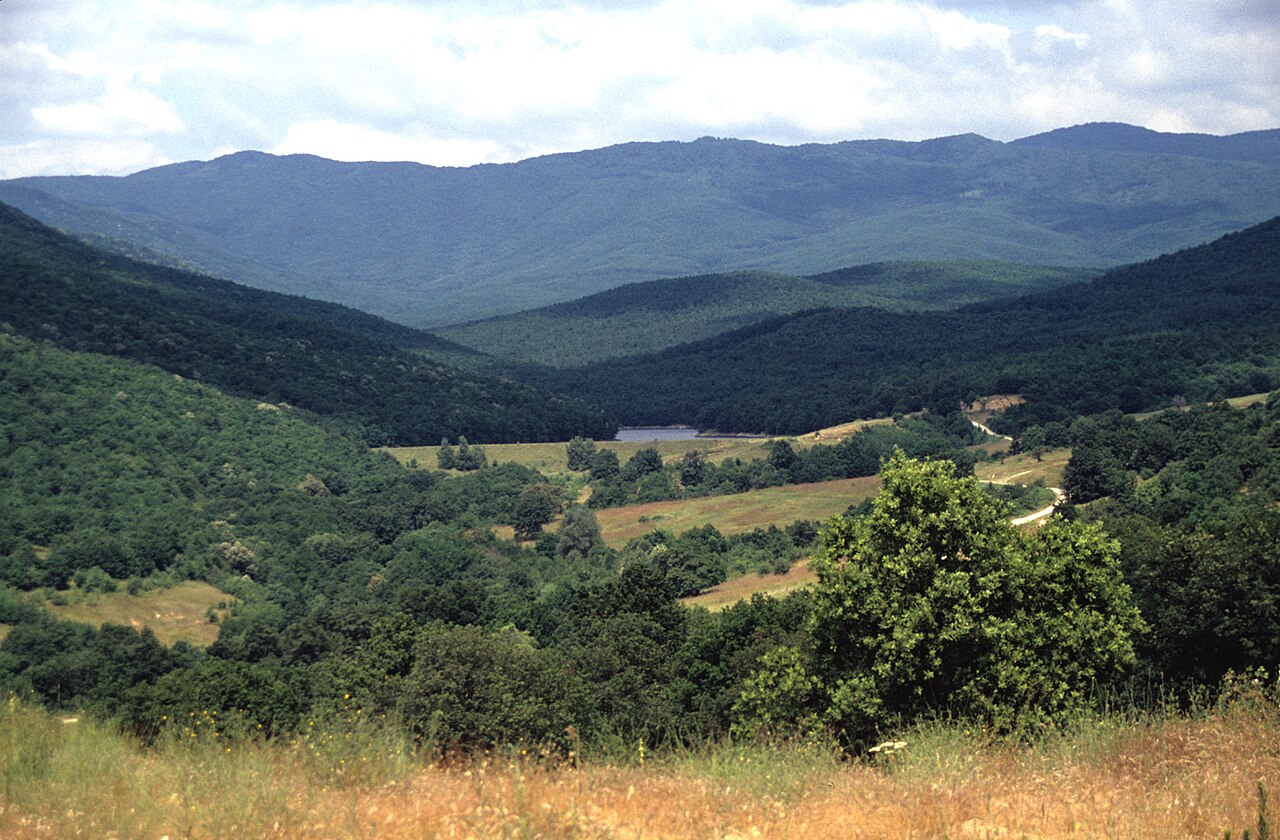
The Thracian temple of Starosel is the largest royal cult complex the ancient Thracians ever built, hidden inside an artificial mound in the Sredna Gora mountains of central Bulgaria. The archaeologist Georgi Kitov uncovered it in 2000, dating its dressed-stone sanctuary to the late 5th and early 4th centuries BC. Built for the Odrysian dynasty that ruled much of Thrace, it brought together a tomb, a temple and a stage for royal ritual on a scale unmatched anywhere among the ancient civilizations of south-eastern Europe.
A royal complex hidden in the Chetinyova mound
The heart of the site is the Chetinyova mound (Chetinyova Mogila), an earthen tumulus roughly four kilometres from the village of Starosel. When Kitov’s team began digging in 2000 they found not a simple grave but a monumental building sealed inside the hill — the oldest royal Thracian mausoleum complex yet discovered, and the largest ancient structure of its type known in the region. The wider complex spreads across the surrounding hills and is thought to contain around six sub-mound temples, four of them architecturally unique, together with several royal burials.
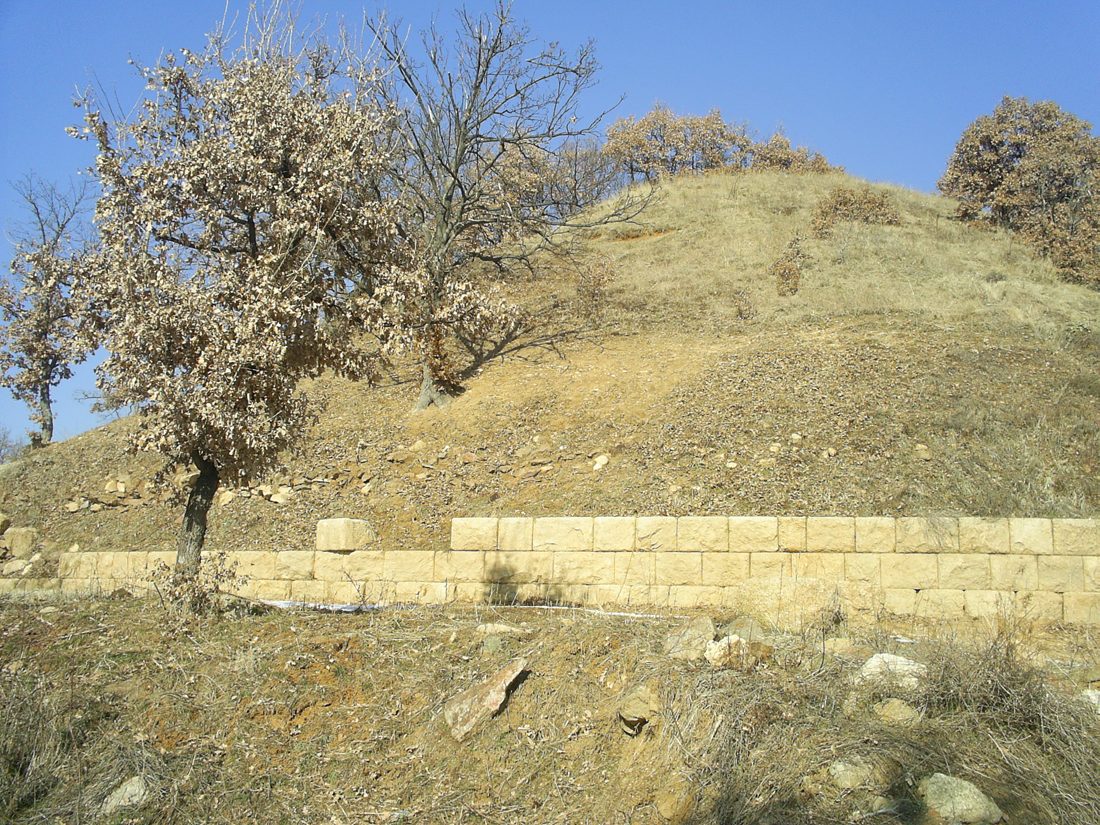
The 241-metre stone crepis
What makes the Chetinyova mound unmistakable is the wall around its foot. The base is ringed by a crepis — a dressed-stone retaining wall — about 241 metres long and 3.5 metres high, built from large granite blocks fitted without mortar. This krepis both held the mound in place and turned it into a piece of monumental architecture, a stone drum announcing the rank of whoever lay inside. The same dry-stone mastery shows in the burial mounds of other steppe and Balkan peoples, from the Thracians to the Pazyryk burial mounds of the Altai.
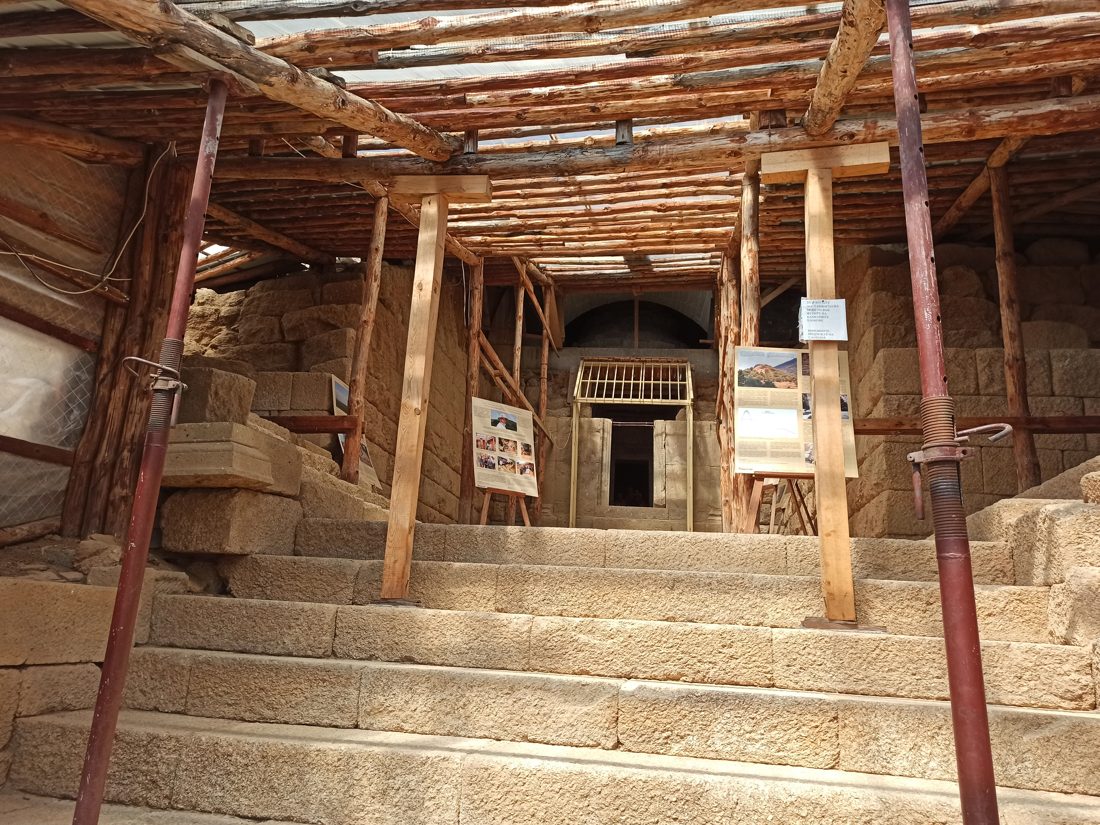
Inside the temple: nine steps to a domed sanctuary
A flight of nine stone steps, once flanked by a pair of carved stone lions, climbs to the temple facade. Beyond it lie a ritual platform, a corridor about ten metres long and an ornamented doorway, then a rectangular antechamber. Only after passing through these does the visitor reach the innermost space: a circular chamber roughly 5.4 metres across, roofed by a corbelled stone dome.
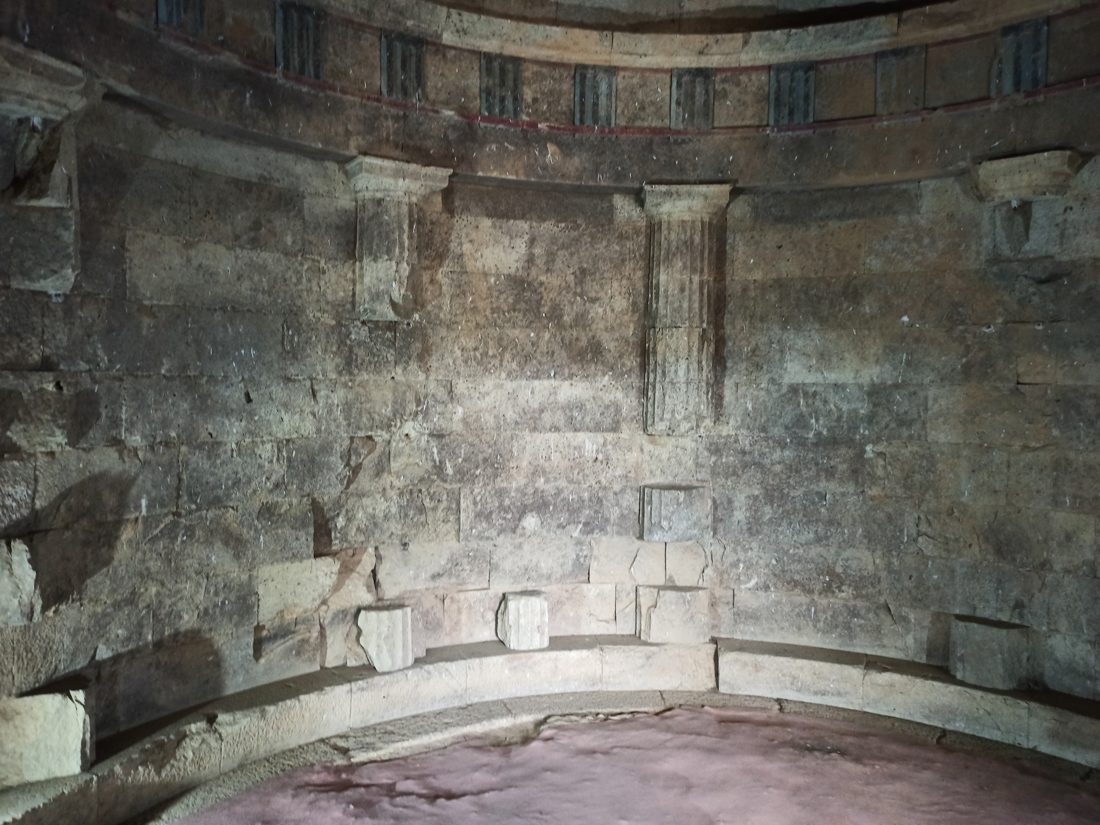
The round sanctuary is the showpiece. Ten engaged Doric half-columns stand against its curving wall, carrying a band of painted decoration in red and dark pigment beneath the dome. The whole interior is cut and laid from precisely dressed blocks set without mortar, a technique the Thracians shared with the great chamber tombs of the wider Aegean world. The result is a fusion of Greek architectural language with Thracian funerary belief — the same blend of borrowed form and local power seen in monumental tombs from the Mausoleum at Halicarnassus to the royal mounds of Thrace itself.
Who was buried at Starosel?
The Chetinyova temple served a high-ranking member of the Odrysian dynasty, the most powerful Thracian royal house. Gold and silver grave goods point to a king or great noble, and several scholars, following Georgi Kitov, have linked the monument to Sitalces, the Odrysian ruler who died around 424 BC. That identification remains a hypothesis rather than a proven fact, but the scale of the tomb leaves little doubt that it honoured Thracian royalty. The Odrysian kingdom was the dominant Thracian state of the period, and Starosel sits at the western edge of the heartland later celebrated in the Valley of the Thracian Rulers, where the tombs of kings such as Seuthes III were raised. Whether or not Sitalces himself rested here, the gold and silver objects recovered from the complex mark it firmly as a monument of the Thracian aristocracy.
The cult of the Mother Goddess, the Sun and Orpheus
Starosel was never only a grave. The ceremonies staged here centred on the Thracian cult of the Great Mother Goddess, her son the Sun, and Orpheus — the mythical singer whose worship was woven through Thracian religion. The platform before the entrance and the round chamber within served these rites, in which a dead ruler could be honoured as a hero who joined the divine. On the northern side of the temple, archaeologists also found an elliptical basin cut into the rock for the making and storing of wine, a reminder that ritual drinking was central to Thracian ceremony rather than mere feasting.
The Horizont temple and a Thracian-Greek style
In 2002 Kitov opened a second temple in the nearby Horizont mound — named for the Dutch Stichting Horizon foundation that funded the dig. Uniquely among Thracian temples, it had a built colonnade: parts of six front and two side columns survive in an early Doric style. With its ranks of columns the Horizont temple is a textbook case of the symbiosis between Greek architecture and the tastes of the Thracian aristocracy, who hired or imitated Greek masons to dress their tombs in the prestige of the Mediterranean world while keeping a thoroughly Thracian purpose.
Visiting Starosel today
The complex lies near the village of Starosel in Hisarya municipality, Plovdiv Province, and is one of the headline stops on Bulgaria’s Thracian heritage trail. A modern shelter protects the Chetinyova mound, letting visitors climb the staircase and stand inside the domed chamber. Many travellers pair it with the Roman and Thracian remains of nearby Plovdiv, including the Ancient Theatre of Philippopolis, and with the other ancient sites and historical places in Bulgaria that trace the Thracian past.
Starosel Thracian temple: frequently asked questions
When was the Thracian temple of Starosel discovered?
The temple was found in 2000 by the Bulgarian archaeologist Georgi Kitov, who excavated the Chetinyova mound about four kilometres from the village of Starosel in the Sredna Gora mountains. Two years later, in 2002, his team uncovered a second, colonnaded temple in the nearby Horizont mound. Together the finds revealed the largest Thracian royal cult complex known in south-eastern Europe, built in the late 5th and early 4th centuries BC.
Who was buried in the Starosel temple?
The Chetinyova temple served a high-ranking member of the Odrysian dynasty, the most powerful Thracian royal house. Gold and silver grave goods point to a king or great noble, and several scholars, following Georgi Kitov, have linked the monument to Sitalces, the Odrysian ruler who died around 424 BC. That identification remains a hypothesis rather than a proven fact, but the scale of the tomb leaves little doubt that it honoured Thracian royalty.
Can you visit the Thracian temple of Starosel?
Yes. The cult complex sits near the village of Starosel in Hisarya municipality, Plovdiv Province, central Bulgaria, and is open to visitors as part of the country’s Thracian heritage trail. A protective shelter now covers the Chetinyova mound, so visitors can climb the monumental staircase and enter the domed sanctuary. The site is often combined with trips to the Valley of the Thracian Rulers and the Roman and Thracian remains around nearby Plovdiv.
Sources and further reading
- Wikipedia — Starosel (village and Thracian cult complex)
- Encyclopædia Britannica — Odrysian kingdom
- World History Encyclopedia — Thrace
- Ancient Bulgaria — Starosel Thracian Cult Complex
- Bulgarian Ministry of Tourism — Thracian Temple Complex, Starosel

Neural Pathways is a collective of seasoned experts and researchers with a profound passion for unraveling the enigmas of ancient history and artifacts. With a wealth of combined experience spanning decades, Neural Pathways has established itself as a leading voice in the realm of archaeological exploration and interpretation.