The Pazyryk burial mounds are a cluster of Iron Age kurgans high in the Altai Mountains of southern Siberia, built by a nomadic Scythian people between roughly the 6th and 3rd centuries BCE. A freak of geology turned them into time capsules: meltwater seeped into the log tomb chambers, froze into a permanent lens of ice, and sealed the dead away from decay for some 2,400 years. When archaeologists finally cut through, they found not bones but mummies with intact skin and tattoos, felt wall-hangings, a four-wheeled wagon, sacrificed horses in full harness, and the oldest knotted-pile carpet ever found.
Who Were the Pazyryk People?
The Pazyryk were a horse-riding nomadic culture of the eastern Eurasian steppe, part of the wider Scythian (or Saka) world that stretched from the Black Sea to Mongolia. They left no writing, so everything we know about them comes from what they buried. Their economy rested on herds of horses, sheep and cattle, and their art is dominated by the “animal style” shared across the steppe — stags, big cats, eagles and griffins locked in stylised combat.
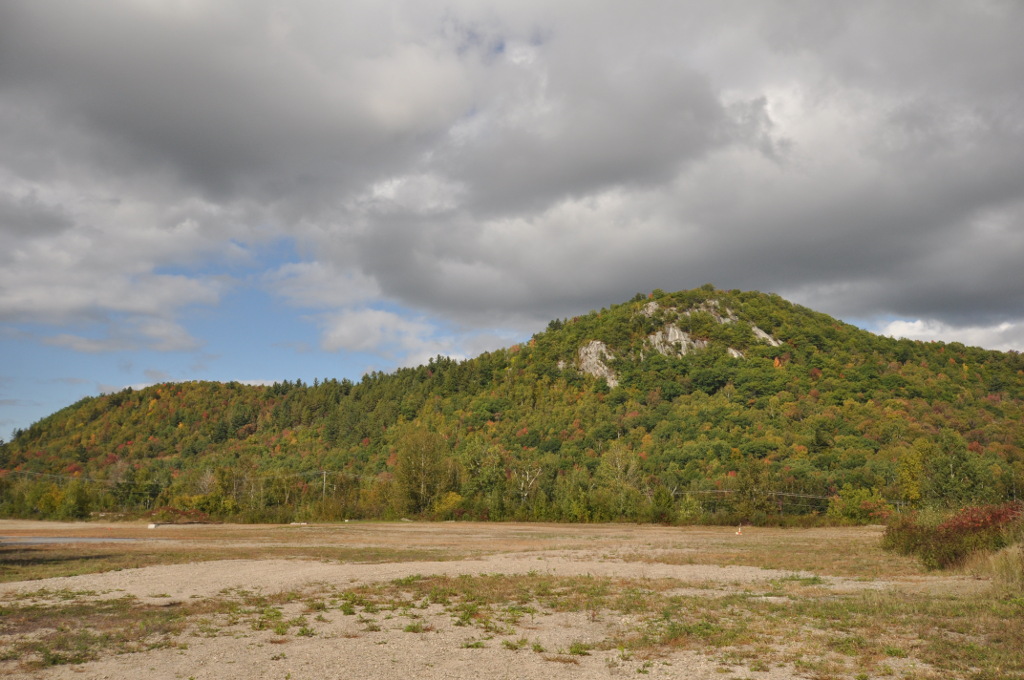
Their elite were buried in kurgans, the mounded tombs that dot the steppe from Ukraine to the Altai. The Pazyryk graves belong to the same tradition as the great royal kurgans found elsewhere: the early Tuvan mound at Arzhan, the enormous Salbyk kurgan in the Minusinsk basin, the “Golden Man” grave at Issyk Kurgan in Kazakhstan, and the gold-rich Solokha Kurgan on the Pontic steppe. What sets Pazyryk apart is not the structure but the cold that preserved its contents.
How Were the Frozen Tombs Discovered?
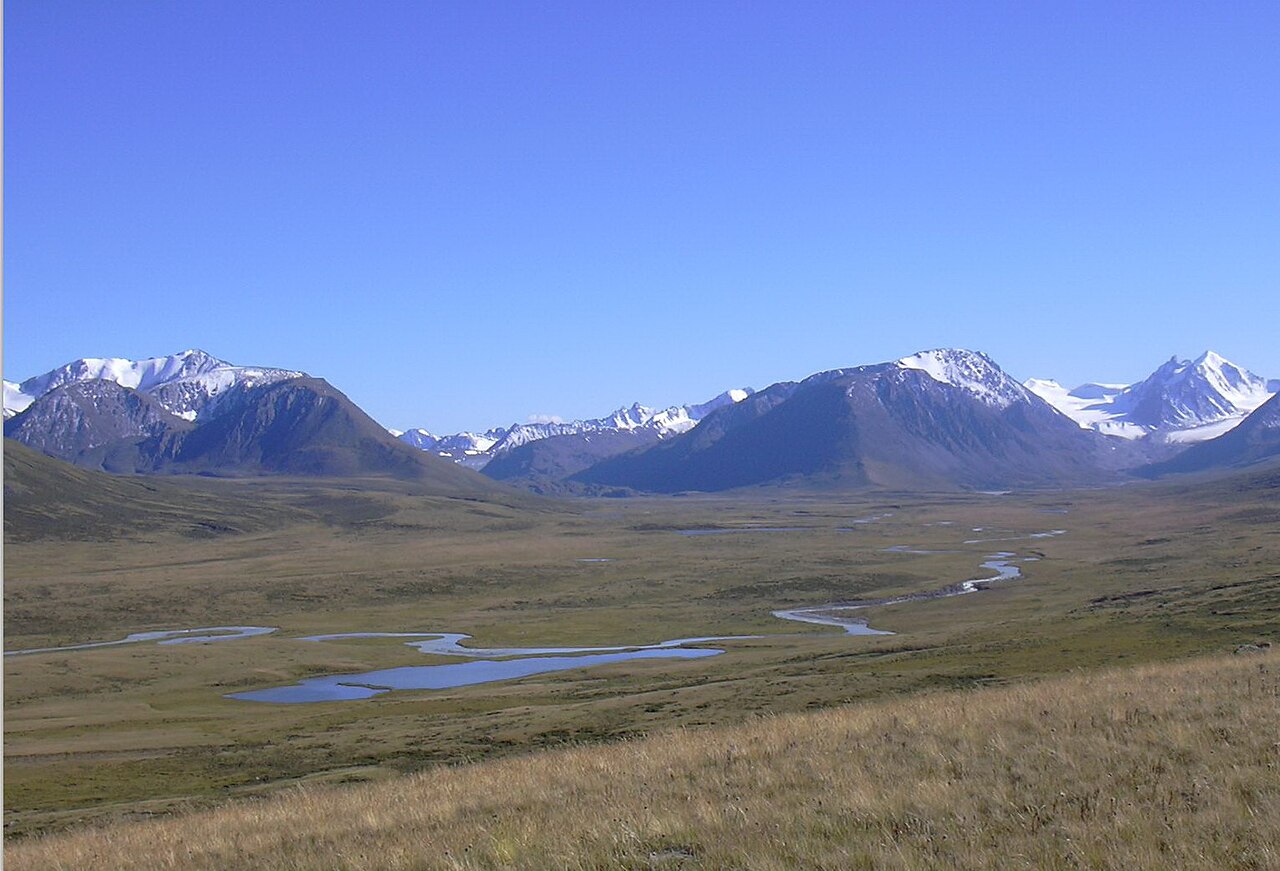
The first Pazyryk barrow, Barrow 1, was excavated in 1929 by the Soviet archaeologist Mikhail P. Gryaznov. The richest tombs — Barrows 2 through 5 in the Pazyryk valley itself — were opened by Sergei Ivanovich Rudenko between 1947 and 1949. Rudenko’s team found that ancient looters had broken into most of the chambers in antiquity, but in doing so had let in water that froze solid, ironically protecting whatever the robbers left behind.
Why the Permafrost Mattered
Each kurgan was a heat sink. The heavy cairn of boulders piled over the grave shaded the ground and trapped cold air, while rainwater that trickled into the chamber froze and never fully thawed. This artificial permafrost preserved organic material that crumbles to dust at almost every other steppe site — wood, leather, fur, felt, textile and human flesh. It is the reason Pazyryk is studied alongside places like other great ancient civilizations despite its people leaving no cities and no books.
What Was Inside the Kurgans?
Beneath the stone cairns, the Pazyryk dug a deep pit and built a chamber of squared larch logs, sometimes a double-walled “room” lined with felt. The dead were laid in hollowed log coffins, accompanied by the goods they would need in the next world: clothing, tools, food vessels, weapons and ornaments carved from wood and covered in gold or tin foil. Barrow 5 even contained a dismantled four-wheeled wooden wagon roughly three metres high.
Outside the human chamber, in the northern part of the pit, the mourners buried horses — up to a dozen or more in the larger tombs — killed by a blow to the skull and laid out in full tack. Their saddles, bridles and elaborate wooden headpieces (some shaped like antlers or birds) survived intact, giving an unmatched picture of steppe horsemanship.
The Pazyryk Carpet and the Frozen Textiles
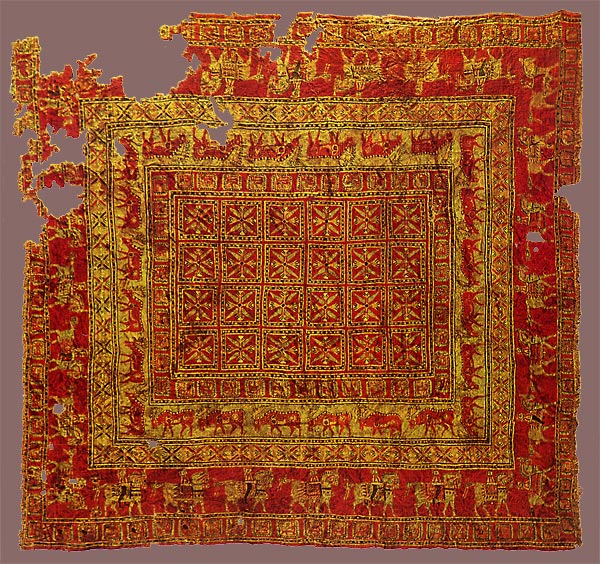
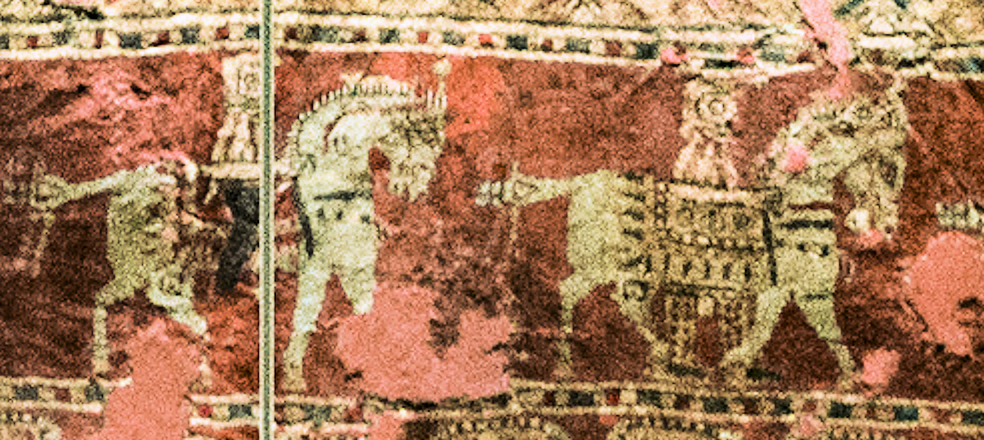
The single most famous find came out of Barrow 5 in 1949: a knotted-pile wool carpet about two metres square, woven in the 4th–3rd centuries BCE. The Pazyryk Carpet is the oldest surviving pile carpet in the world. It is tied with the dense symmetrical (“Turkish”) knot at roughly 3,600 knots per square decimetre, and its borders show a procession of grazing deer and mounted horsemen. It is now one of the treasures of the Hermitage Museum in St Petersburg.
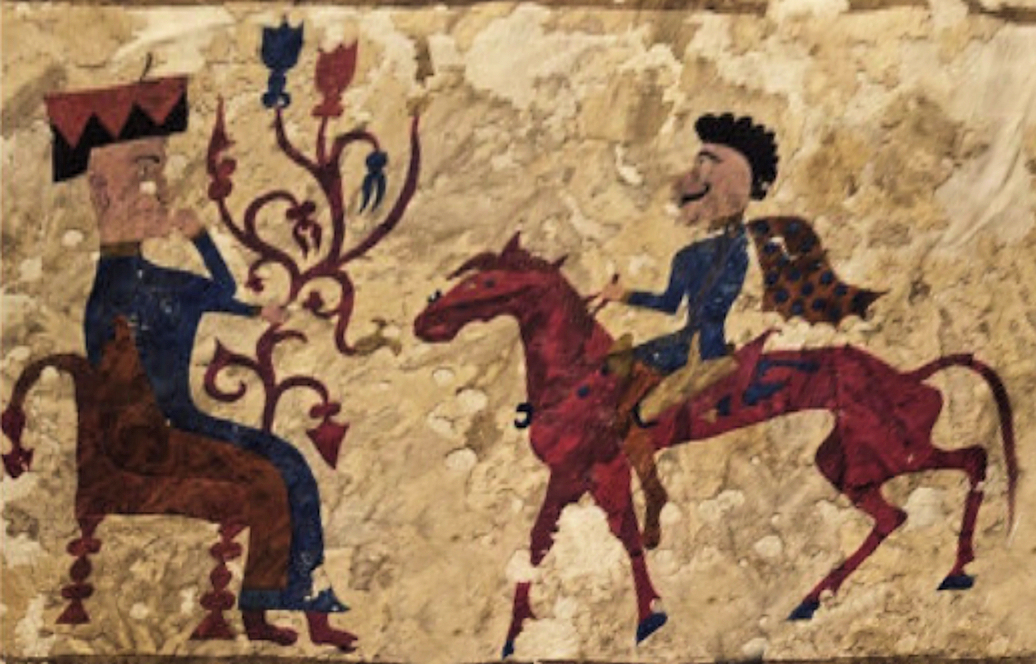
The carpet was not alone. The tombs preserved felt wall-hangings several metres long, including a celebrated scene of a horseman riding up to a seated goddess, along with appliqué saddle covers, woven fabrics and the earliest surviving examples of steppe embroidery. Some materials — a Persian-style pile weave, Chinese silk — show that the Pazyryk traded across the early networks that would later become the Silk Road.
Tattoos, Mummies and the Ukok Princess
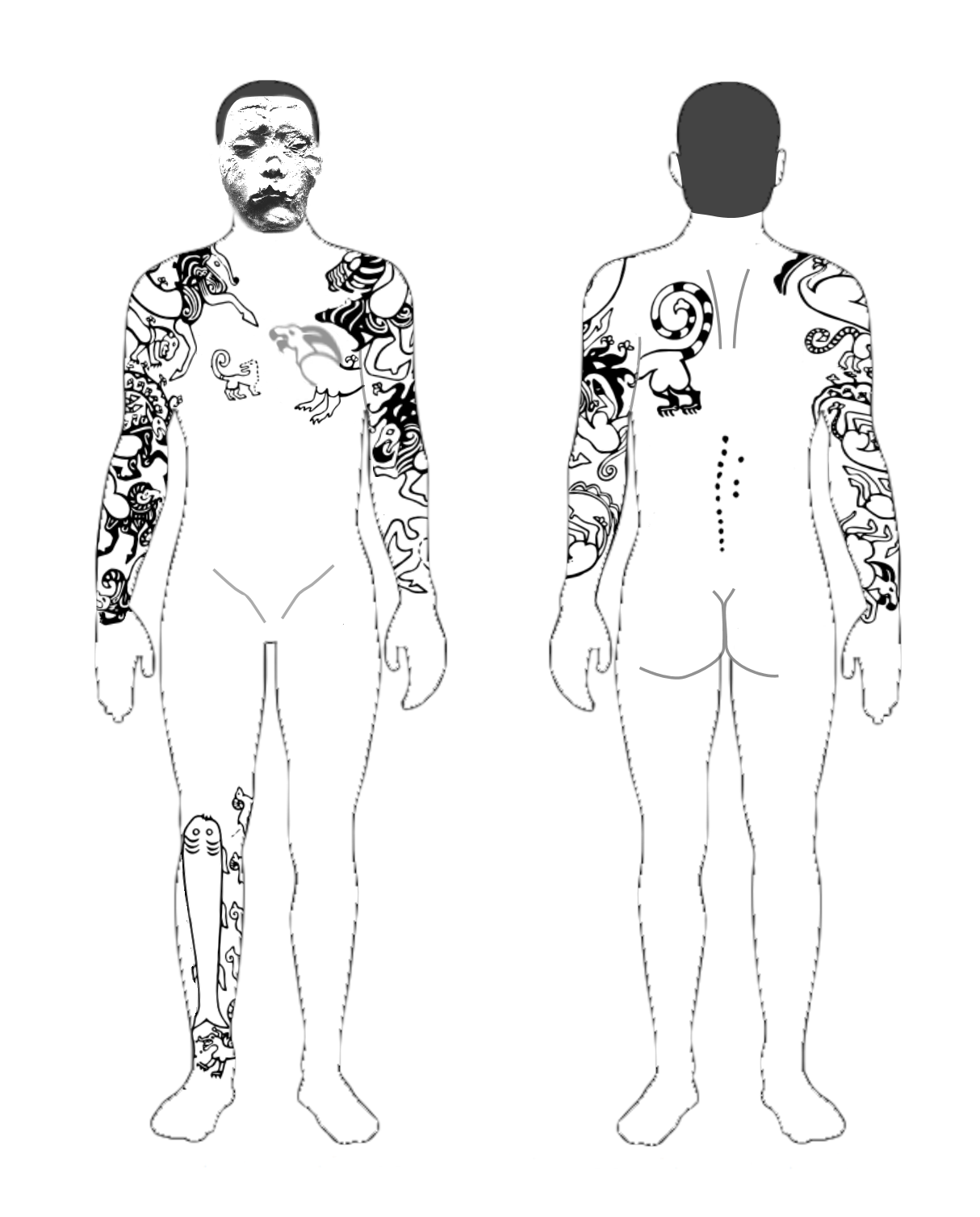
Because skin survived, Pazyryk gives us the oldest well-preserved tattoos in the archaeological record. The chieftain from Barrow 2 — a powerfully built man who died around the age of 50 — was covered from shoulder to wrist in interlocking beasts: a mountain ram, a donkey, deer with impossibly long antlers, and a coiled imaginary carnivore. The designs were pricked into the skin in the same animal style as the metalwork and felt.
The most famous Pazyryk mummy was found much later. In 1993 the Russian archaeologist Natalia Polosmak excavated a frozen kurgan at Ak-Alakha on the Ukok Plateau, near the Mongolian border, and recovered the body of a young woman buried around the 5th century BCE with six horses and her own tattoos. Known as the Ukok Princess or the Siberian Ice Maiden, she became one of the defining discoveries of late-20th-century steppe archaeology — and a focus of dispute between scientists and the Indigenous Altai people over her reburial.
Why Do the Pazyryk Mounds Still Matter?
Pazyryk is the closest thing we have to a colour photograph of life on the Iron Age steppe. The frozen tombs preserved the things archaeology almost never keeps — what people wore, how they decorated their bodies, how they tacked their horses, what they traded — and so they anchor almost everything we say about Scythian-era nomads. The “Treasures of the Pazyryk Culture” sit on UNESCO’s World Heritage Tentative List in recognition of that value.
The same ice that saved them now threatens them. As the Altai permafrost warms, the protective lenses inside surviving, unexcavated kurgans are beginning to thaw, and the organic treasures that make Pazyryk unique could rot before they are ever recorded. The race to document the frozen tombs has become one of the clearest archaeological casualties of a changing climate.
Frequently Asked Questions
How old are the Pazyryk burial mounds?
The Pazyryk culture flourished from roughly the 6th to the 3rd centuries BCE, and the famous frozen kurgans in the Pazyryk valley date mainly to the 5th–3rd centuries BCE — about 2,400 years ago. Barrow 1 was excavated in 1929 and Barrows 2–5 between 1947 and 1949. Radiocarbon and tree-ring studies on the larch logs continue to refine the dates of individual tombs.
What is the Pazyryk Carpet?
The Pazyryk Carpet is a knotted wool pile carpet recovered from Barrow 5 in 1949, woven in the 4th–3rd centuries BCE. About two metres square and tied at roughly 3,600 symmetrical knots per square decimetre, it is the oldest surviving pile carpet in the world. Its borders depict grazing deer and mounted horsemen, and it is now held in the Hermitage Museum in St Petersburg.
Who was the Ukok Princess?
The Ukok Princess, also called the Siberian Ice Maiden, is a tattooed female mummy excavated by Natalia Polosmak in 1993 from a frozen kurgan at Ak-Alakha on the Altai’s Ukok Plateau. Buried around the 5th century BCE with six horses and fine clothing, she is one of the best-preserved Pazyryk burials and the subject of an ongoing debate over scientific study versus reburial by the Altai community.
Sources and Further Reading
- Wikipedia — Pazyryk burials
- Wikipedia — Pazyryk carpet
- Wikipedia — Siberian Ice Maiden (Ukok Princess)
- World History Encyclopedia — Scythians
- World History Encyclopedia — The Pazyryk Carpet
- Antiquity (Cambridge) — High-resolution near-infrared data reveal Pazyryk tattooing methods

Neural Pathways is a collective of seasoned experts and researchers with a profound passion for unraveling the enigmas of ancient history and artifacts. With a wealth of combined experience spanning decades, Neural Pathways has established itself as a leading voice in the realm of archaeological exploration and interpretation.