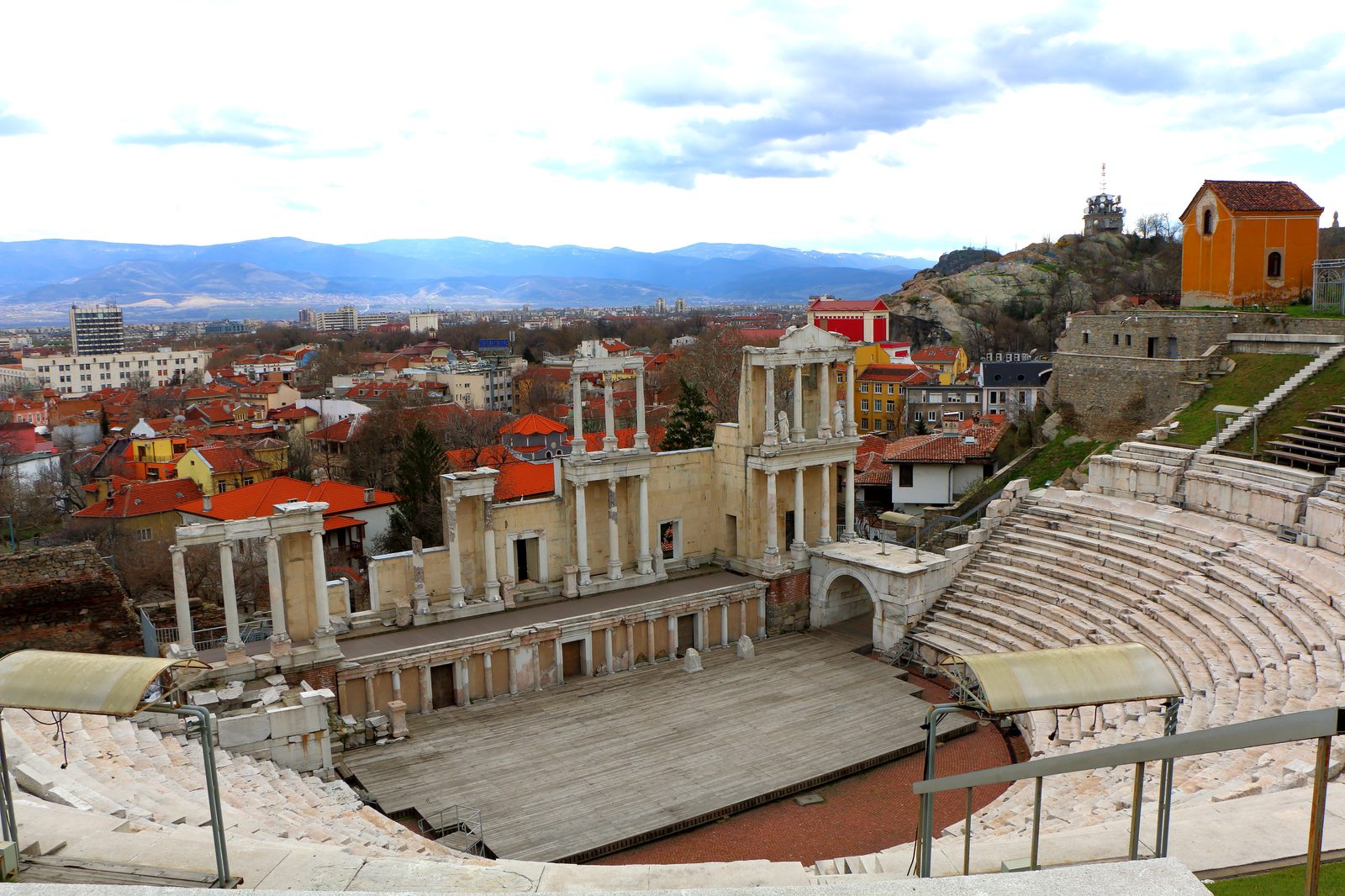
The Roman theatre of Philippopolis is one of the best-preserved ancient theatres anywhere in the Roman world, hidden in plain sight in the centre of Plovdiv, Bulgaria. Cut into the saddle between two of the city’s Three Hills late in the 1st century AD, it once seated as many as 7,000 people for drama, civic assemblies and, in time, the blood sports of the arena. Wrecked at the end of the 4th century AD and then buried for roughly 1,500 years, it was found again only after a landslide in the early 1970s — and today it is once more a working stage.
A theatre cut into the Three Hills of Trimontium
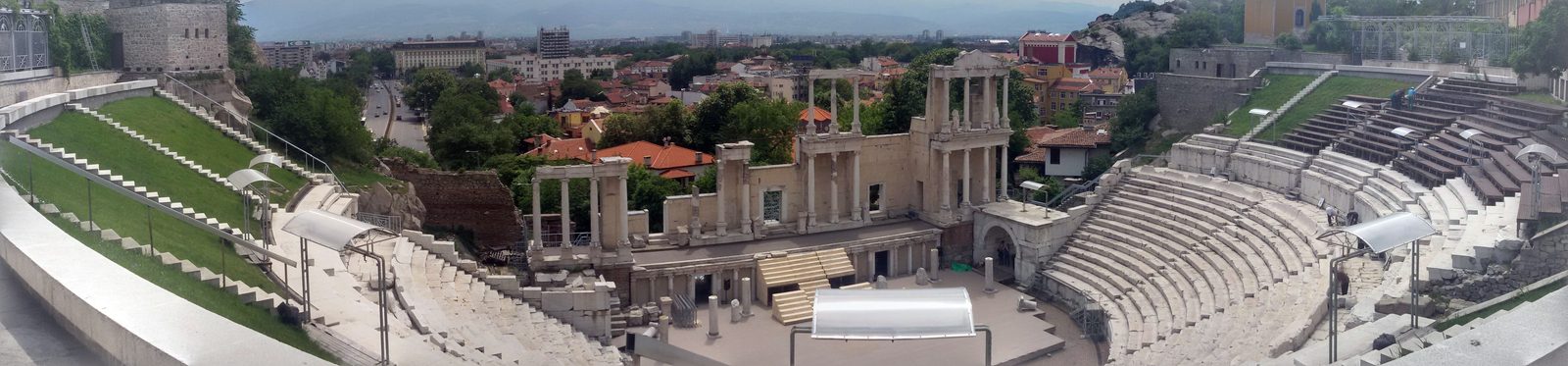
Modern Plovdiv sits on the ancient city the Greeks called Philippopolis and the Romans knew as Trimontium, “the city of three hills.” The theatre was built into the natural dip between two of those hills, Taksim Tepe and Dzhambaz Tepe, so that the tiered seating could be hollowed straight out of the slope while the spectators looked south across the lower town toward the Rhodope Mountains. It is a true Roman theatre — a semicircle rather than the full oval of an amphitheatre — and Plovdiv keeps its Roman arena traditions in a separate monument, the partly excavated ancient stadium under the modern main street.
In outline the auditorium is a semicircle about 82 metres in diameter. Because part of the cavea overran the natural slope, the outer seats had to be carried on solid retaining walls and vaulted substructures — the kind of engineering that let Roman builders raise theatres on level ground across the empire, from Hispania to Thrace.
The marble cavea and the horseshoe orchestra
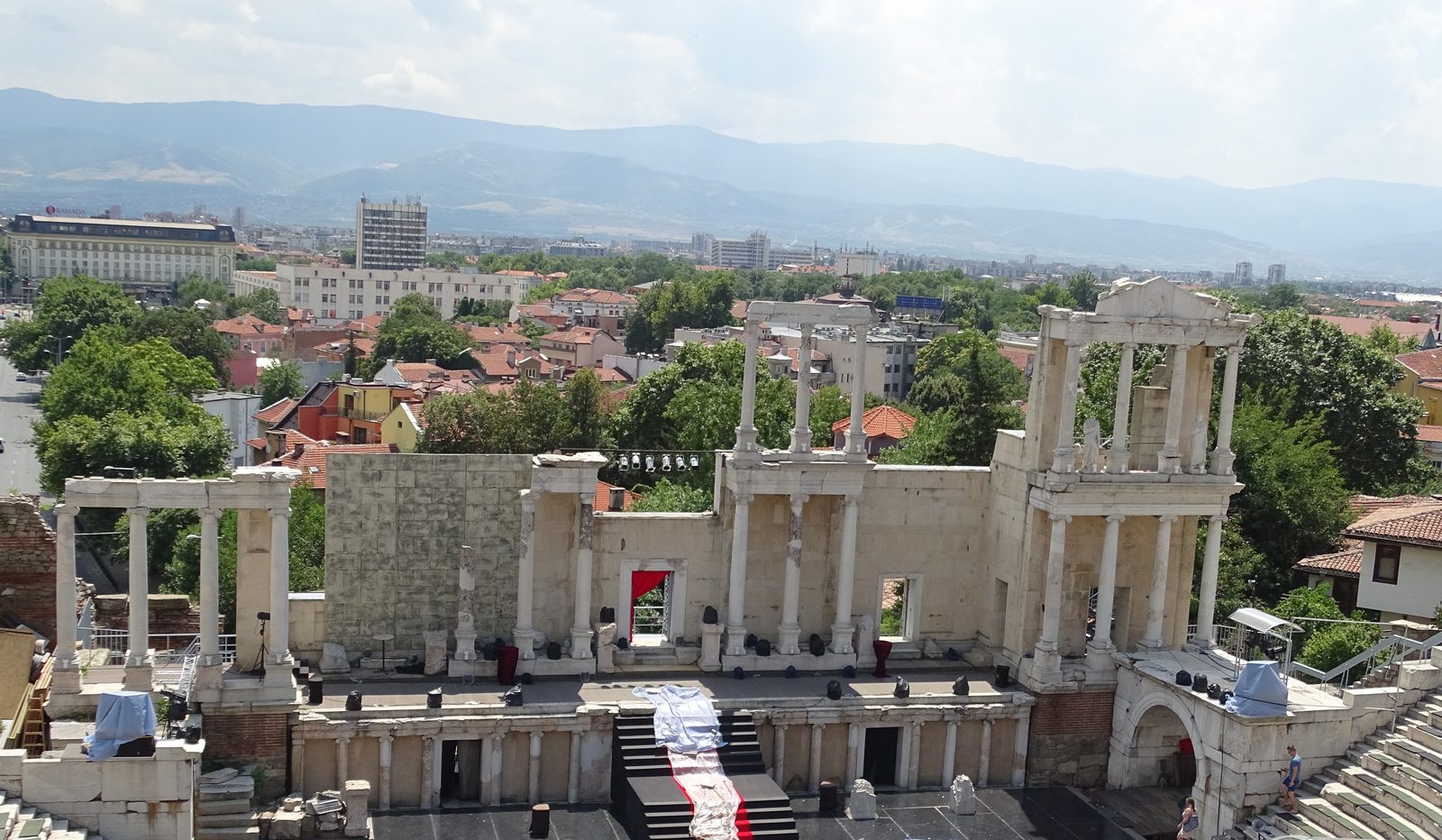
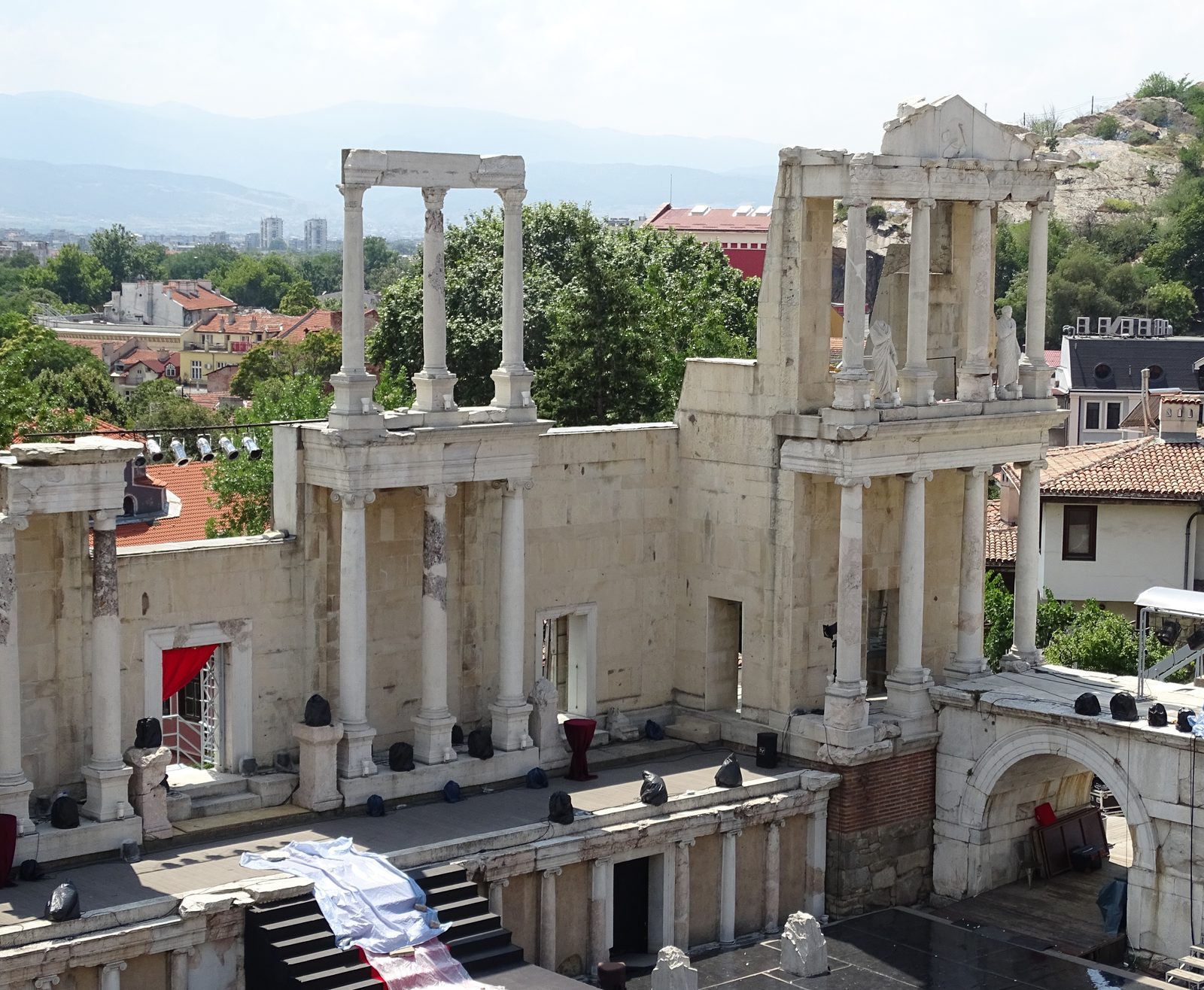
The seating bank, or cavea, wraps around a horseshoe-shaped orchestra 26.64 metres across. Twenty-eight concentric rows of white marble seats climb the hillside, split into a lower and an upper block by a horizontal walkway called the diazoma, with narrow radial stairways dividing the rows into wedge-shaped sectors (kerkides). The draft description of “pink granite” is a myth: the benches are marble, and it is the marble that has let so many honorary inscriptions survive. Facing the audience stood the scaenae frons — a three-storey stage wall faced with two tiers of columns, the lower in the Roman Ionic order and the upper Corinthian, pierced by three ceremonial doorways and decorated with statues.
Who built the theatre — Domitian, Trajan and a Thracian aristocrat
Older guidebooks — and the earlier version of this article — flatly credited the theatre to Emperor Trajan in the 2nd century AD. The picture from the inscriptions is more interesting. An inscription on a statue base names a local grandee, Titus Flavius Cotys, a descendant of the Thracian royal house who served Rome, and points to construction in the 90s AD, under the emperor Domitian. A monumental building inscription of Trajan’s reign, around 114 AD, records a major phase of work and is why the emperor’s name — Marcus Ulpius Traianus — is still attached to the monument. Either way, this was a public theatre for a rising provincial capital in the decades either side of AD 100.
That municipal pride runs right through the building. Philippopolis was the leading city of Roman Thrace, and its theatre was as much a civic statement as an entertainment venue — a place to advertise the standing of the council, the magistrates and the city’s friends in Rome.
Plays, the Thracian assembly and Caracalla’s beast-fights
Like every Roman theatre, this one carried inscriptions on the honorific front seats — reserved places for members of the city council, magistrates and “friends of the emperor.” Others record that the building doubled as the meeting place of the provincial assembly of the Thracian cities, the koinon that coordinated the imperial cult and inter-city business across the province. Each block of seating even had the name of a city quarter carved on the benches, so citizens knew exactly where they belonged — an ancient seating plan literally written in stone.
Drama and music were the core of the programme, but the theatre was also adapted for the Roman taste in spectacle. Archaeologists found the remains of protective barriers in front of the lowest rows, added so that staged hunts and gladiatorial combats with animals could be held safely. Those additions are linked to the visit of the emperor Caracalla to Trimontium in 214 AD, when the city laid on games in his honour.
How was the Roman theatre of Philippopolis rediscovered?
The theatre went out of use at the end of the 4th century AD, when a large part of it was destroyed by fire or earthquake; the damage is traditionally connected with the raids of Attila the Hun in the following century. Over the centuries the ruin vanished under 4.5 to 15 metres of soil as the medieval and modern town grew over it, until it was effectively forgotten.
It resurfaced by accident. A landslide on the southern slope of the old town in the early 1970s exposed ancient walls, triggering a major dig by the staff of the Plovdiv Archaeological Museum between 1968 and 1979. Restorers then rebuilt the monument by anastylosis — re-erecting the original marble elements and marking new material so that it is honestly distinguishable from the ancient — an approach regarded as one of the finest achievements of the Bulgarian conservation school. The theatre reopened as both a monument and a stage in the early 1980s. This careful, evidence-led rebuild has more in common with the reconstruction of the Roman theatre of Mérida in Spain than with the guesswork that mars many older restorations.
The ancient theatre as a living stage
Today the theatre is the signature image of Plovdiv, folded into the “Ancient Plovdiv” architectural reserve alongside the Roman forum, odeon and stadium. Restored to hold about 3,500 spectators, it runs a full season of opera, drama and concerts, including the long-running Opera Open and the International Folklore Festival, and the acoustics that served Roman audiences still carry an unamplified voice to the back rows.
It also sits inside one of the richest concentrations of Thracian and Roman heritage in Europe. Visitors working outward from Plovdiv can reach the royal Thracian temple complex at Starosel, the painted Thracian tomb of Kazanlak and the rock-cut sanctuary of Perperikon — while the theatre’s own imperial-Roman story runs parallel to great provincial centres such as the provincial capital of Tarraco in Spain. It is one of the standout entries in our historical places archive.
Frequently asked questions
When was the Ancient Theatre of Philippopolis built?
The theatre was built late in the 1st century AD. An inscription on a statue base names the Thracian-Roman aristocrat Titus Flavius Cotys and points to the 90s AD, during the reign of Domitian, while a monumental building inscription of about 114 AD records a major phase under Trajan. That is why the monument is popularly dated to the reign of Trajan even though the first construction is a little earlier. It remained in use until the end of the 4th century AD.
How many people did the theatre hold?
In antiquity the cavea’s 28 marble rows could seat an estimated 5,000 to 7,000 spectators, with sources most often citing around 7,000. After its modern restoration the seating was limited to roughly 3,500 people for safety and conservation reasons. The theatre is still used for performances today, so those 3,500 seats fill regularly for opera, drama and concerts during the summer season.
Is the Plovdiv monument a theatre or an amphitheatre?
It is a theatre, not an amphitheatre. Its seating forms a semicircle facing a single stage building (the scaenae frons), which is the classic Roman theatre plan for drama and music. Amphitheatres are fully oval arenas built for gladiatorial games. Travel sites sometimes call the Plovdiv monument an “amphitheatre,” but that is inaccurate — the city’s arena-style venue is the separate ancient stadium of Philippopolis beneath the main shopping street.
Sources and further reading
- Wikipedia — Roman theatre of Philippopolis
- World History Encyclopedia — Domitian
- World History Encyclopedia — Trajan
- World History Encyclopedia — Caracalla
- Visit Plovdiv (municipal tourism) — Ancient Theatre
- Ancient Theatre of Plovdiv — official monument site