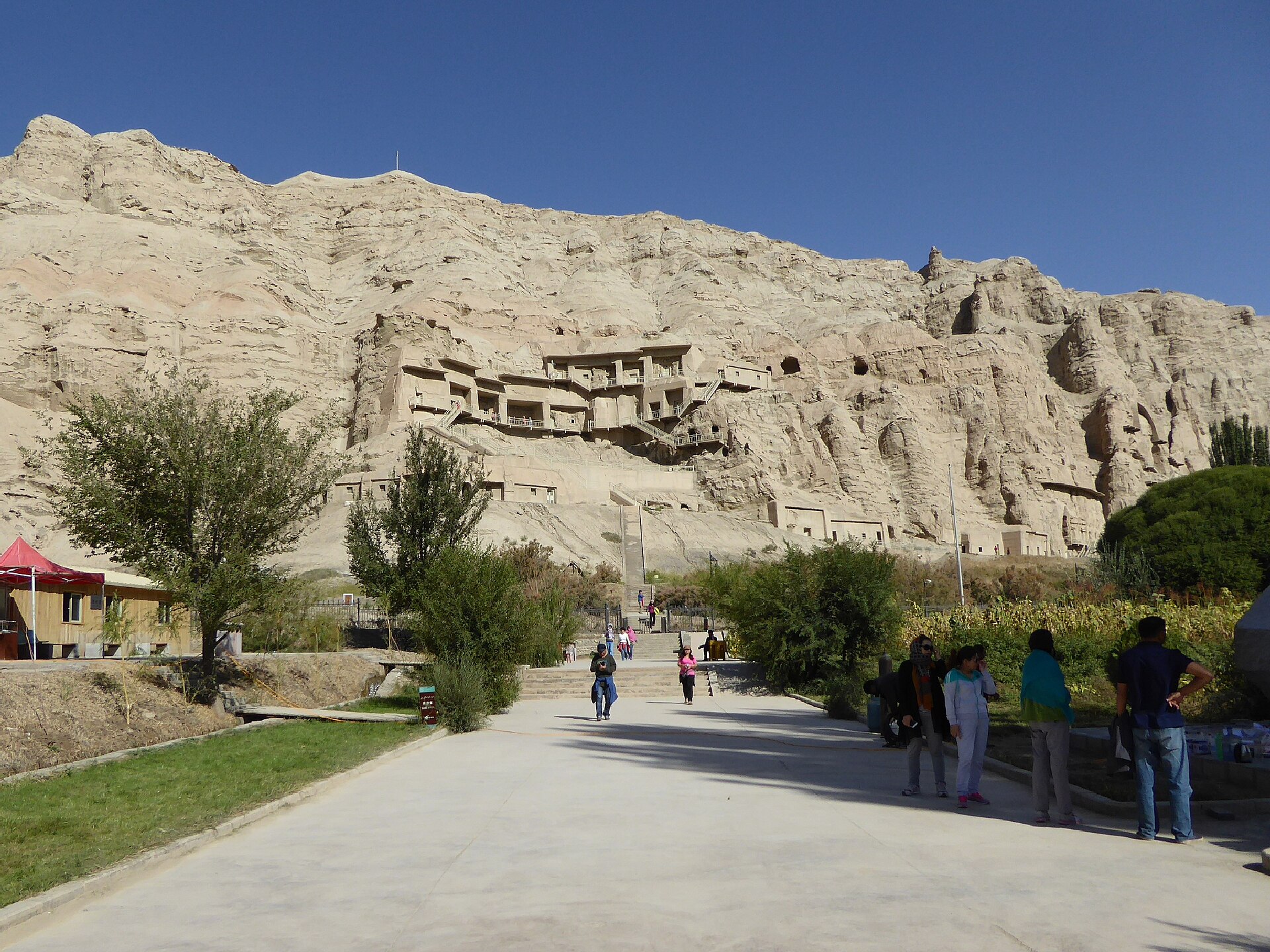
The Kizil Caves are a complex of 236 rock-cut Buddhist cave temples cut into a cliff on the northern bank of the Muzat River in Baicheng County, Xinjiang, China. Built by the Tocharian-speaking kingdom of Kucha, they are the earliest major Buddhist grotto complex in China, with the oldest caves carbon-dated to around 300 CE and the site in use into the eighth century. That start date puts Kizil roughly two and a half centuries ahead of the far more famous Mogao Caves at Dunhuang, and makes it the prototype from which the whole Chinese cave-temple tradition descends.
Where the Kizil Caves Stand on the Northern Silk Road
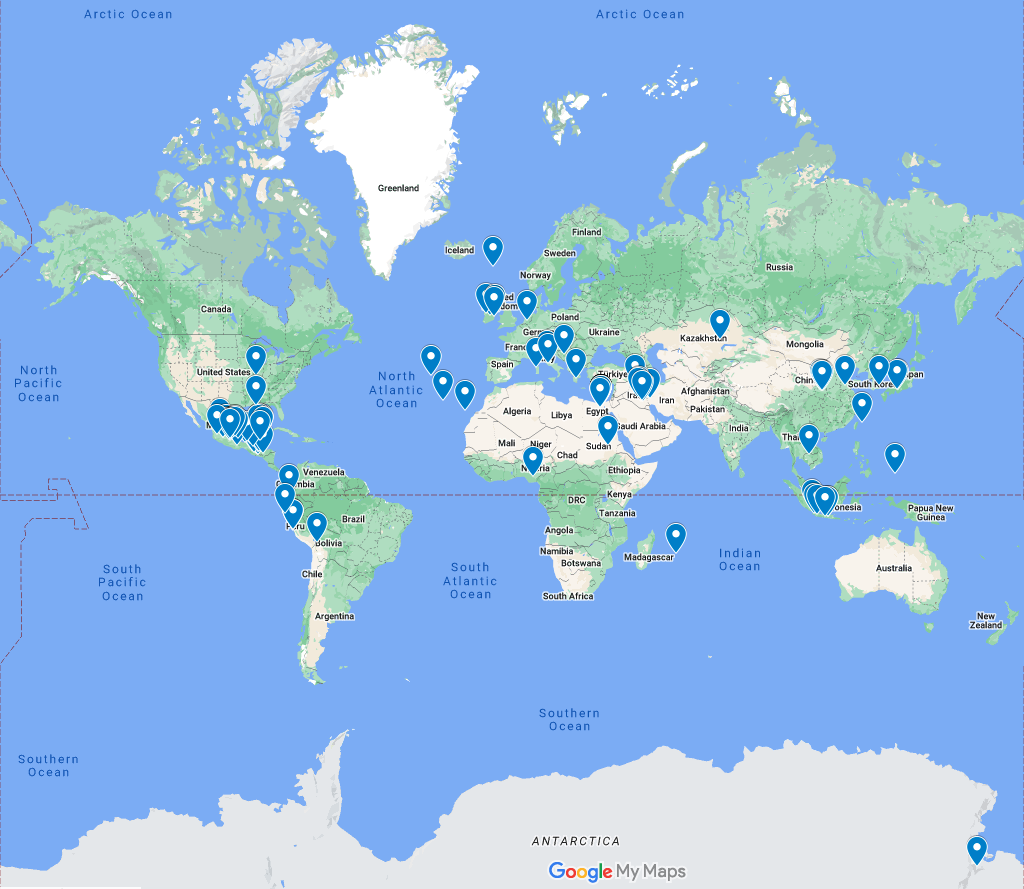
The site lies about 65 kilometres (40 miles) west of Kucha, wealthiest of the oasis states on the northern branch of the Silk Road where it skirts the Tian Shan and the northern rim of the Taklamakan.
The Uyghur name means “the thousand red houses”; the Chinese name, 克孜尔千佛洞, means “Kizil Caves of the Thousand Buddhas”. Older Western literature also calls the site Ming-oi, a term now applied mainly to Shorchuk further east.
A cliff face worked over five centuries
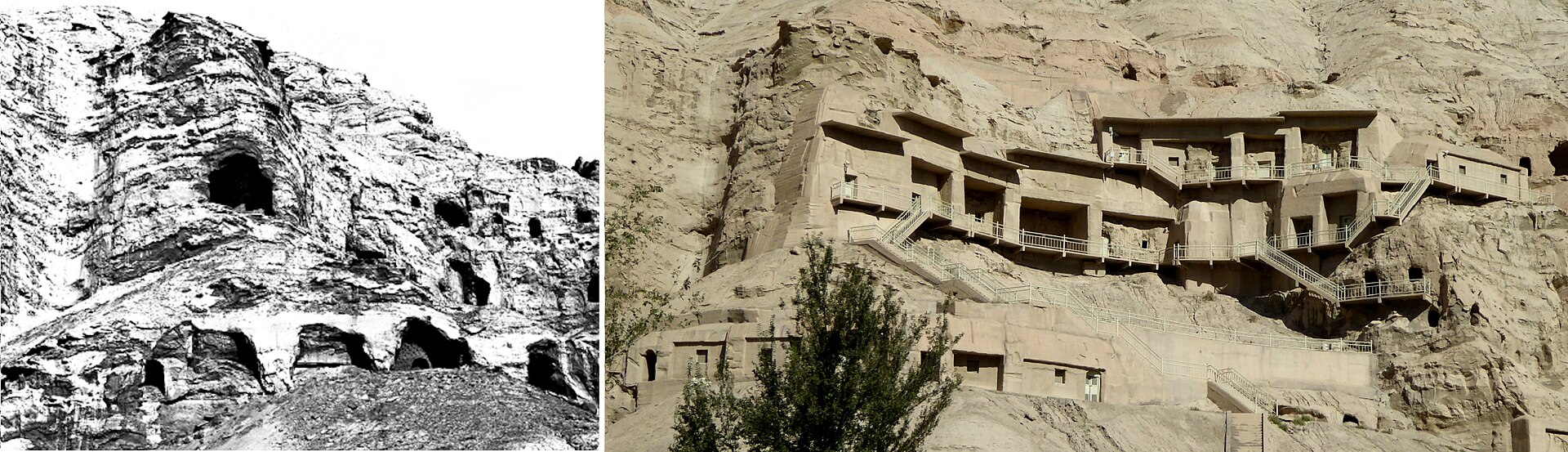
The 236 numbered cave temples run along an east-west stretch of about two kilometres, and around 135 remain reasonably intact. Chinese heritage publications sometimes give a higher count near 339 because they fold in outlying groups and unnumbered cavities. Surviving painted surface is usually put at 4,000 to 5,000 square metres, though tourist literature repeats a much larger 10,000-square-metre figure that counts areas long since lost or removed.
Kizil is the largest cave site of the Kucha oasis and the largest in Xinjiang, but it does not stand alone: the Kumtura Caves, Kizilgaha, Simsim and the ruined Subashi Temple share the same system.
Why Are the Kizil Caves Older Than the Mogao Caves?
Because Buddhism reached Kucha first. The faith travelled east out of Gandhara and Bactria along the trade roads, and Kucha, on the northern route, received it well before the garrison towns of the Hexi Corridor. Kuchean patrons were carving and painting cave shrines from about 300 CE, while the first dated cave at Mogao belongs to the mid-fourth century and that site’s real expansion is later still.
Influence then ran the opposite way to the popular assumption. Kizil’s plans, above all the central stupa-pillar hall with a circumambulation corridor cut around it, were carried east and adopted at the Yungang Grottoes and later the Longmen Grottoes. Kizil is not a provincial offshoot of Chinese Buddhist art; it is one of its sources.
The community followed the orthodox Sarvastivadin school, with an early minority Dharmagupta presence also detected. Scholars link the simpler square caves to a Dharmagupta phase from the fourth century or earlier, and the central-pillar caves, which flourish from the mid-sixth century, to the Sarvastivadins.
Kucha, the Tocharians and Kumarajiva
The builders spoke Tocharian, an Indo-European family of the northern Tarim Basin whose documents were recovered from the site. Several caves carry Tocharian and Sanskrit inscriptions, some naming rulers, and one first-period painting is signed in Tocharian B: “the Buddha was painted by the hand of Ratna…”. Fragments of the second-century Spitzer Manuscript, among the oldest Sanskrit manuscripts anywhere, also came from Kizil.
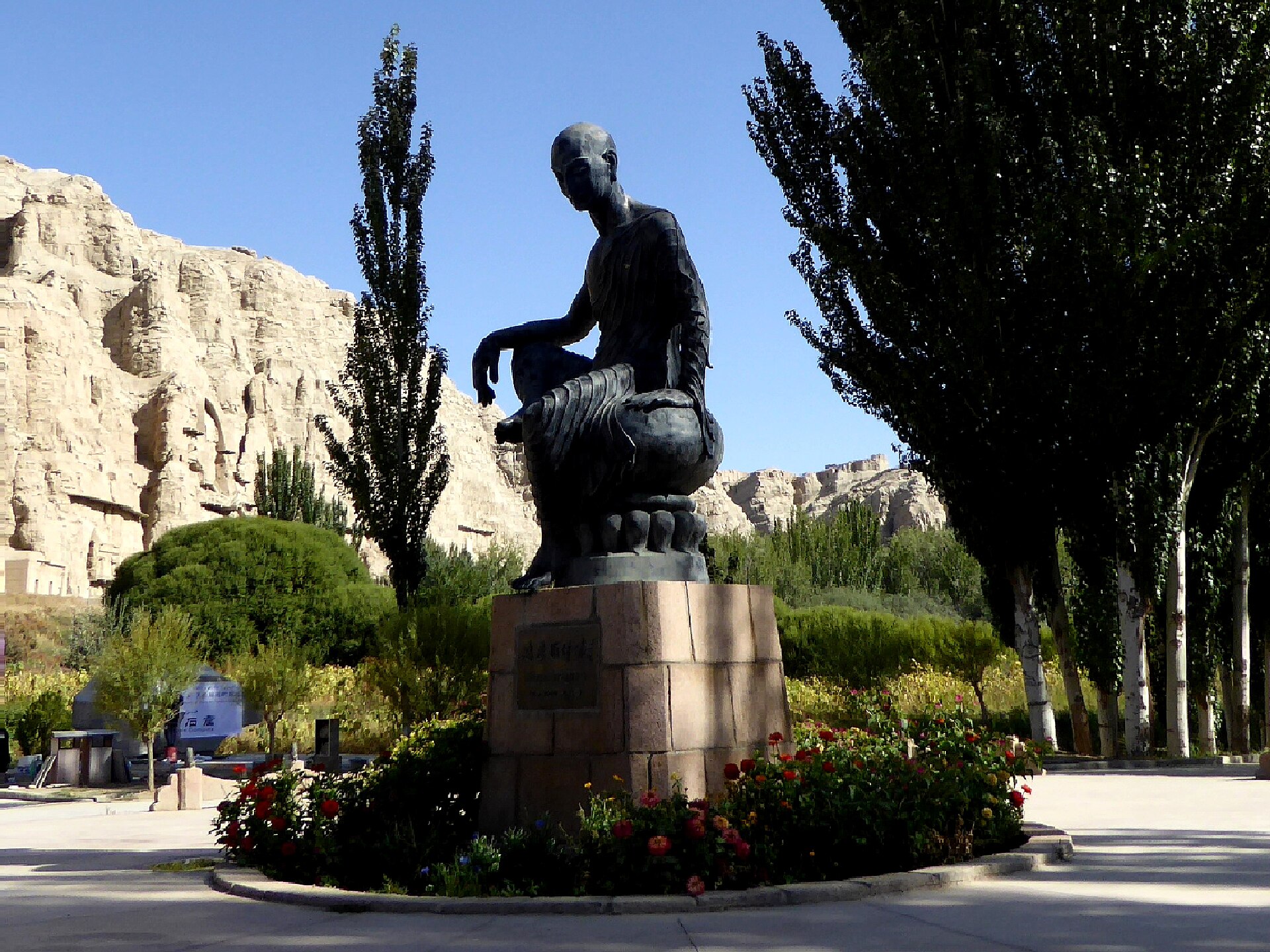
Kucha’s most famous son is Kumarajiva (c. 344–413), whose Chinese translations of the Lotus, Diamond and Vimalakirti sutras shaped East Asian Buddhism more than almost any other body of work. A seated statue of him stands at the entrance to the grottoes. Taken from Kucha as a captive in 384, he died in Chang’an, but the intellectual world that produced him is the world these caves were painted for.
Inside the Caves: Rhombus Ceilings, Jatakas and Kuchean Daily Life
The murals mostly depict jataka stories of the Buddha’s previous lives, avadana parables and episodes from his final life, set in the diamond-shaped compartments of the vaulted ceilings that are Kizil’s visual signature. Where Mogao spreads long narrative registers, Kizil compresses each tale into a single rhombus, so a ceiling reads as a grid of dozens of separate stories.
Alongside the scripture is an unusual amount of ordinary Kuchean life: farming, hunting, riding, armoured donors in their own dress. One cave carries a band of twenty Kuchean musicians, a rare record of an oasis music culture famous enough to be imported wholesale into the Tang capital.
The named caves
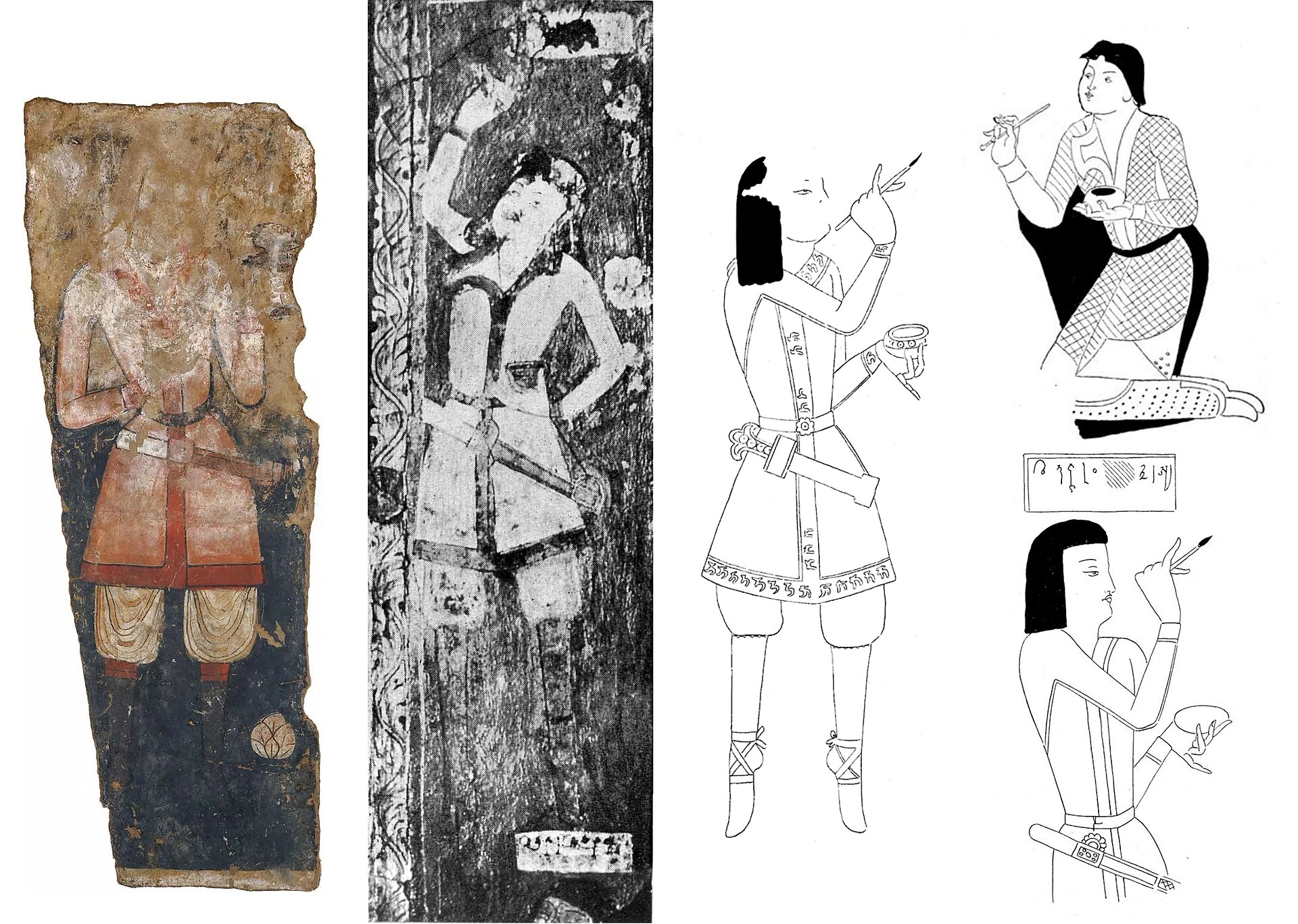
The German excavators gave the caves nicknames still used alongside the numbers. The Peacock Cave (76) has a central podium 2.18 metres wide and 70 centimetres high beneath a dome of apsaras flying among peacock feathers, its narrative panels in unusually strict chronological order. Others include the Cave of the Painters (207), the Hippocampi (118), the Musicians (38), the Statues (77), the Sixteen Sword-Bearers (8) and the Maya Cave (224).
How the Murals Were Cut Out and Scattered, 1902 to 1914
The first outside expedition to reach Kizil was Japanese, not European. Between 1902 and 1904 the Otani expedition, led in the field by Tesshin Watanabe and Kenyu Hori and financed by Count Otani, explored the Kucha area, leaving after four months when an earthquake struck. That corrects a claim repeated widely online that the caves were found by German explorers, and by Albert von Le Coq in particular.
The German work came next. The Third German Turfan Expedition ran from December 1905 to 6 July 1907 under Albert Grunwedel. Le Coq was a member of that expedition, working under Grunwedel, and left in June 1906 for British India after falling seriously ill. Writing home on 2 April 1906, Grunwedel could hardly contain himself: “What I have seen here goes beyond my wildest dreams. If only I had hands enough to copy it all.”
Grunwedel removed a great many paintings but recorded them first, tracing them onto canvas and photographing or drawing them before cutting, because he feared they would not survive removal. He was right. In the Cave of the Painters he found a striking mural of warriors, drew it carefully, then watched the painting disintegrate as it came off the wall; only fragments remain in situ. The third expedition shipped almost 120 crates to Berlin, and Grunwedel published his findings in 1912 as Altbuddhistische Kultstatten in Chinesisch-Turkistan.
Paul Pelliot and his photographer Charles Nouette arrived on 1 September 1907, shortly after the Germans, and made an outstanding photographic record. Le Coq returned in 1913–14 heading the Fourth German Expedition and removed a great deal more, including material Grunwedel had deliberately left in place, with markedly less documentation.
What Berlin kept, sold and lost
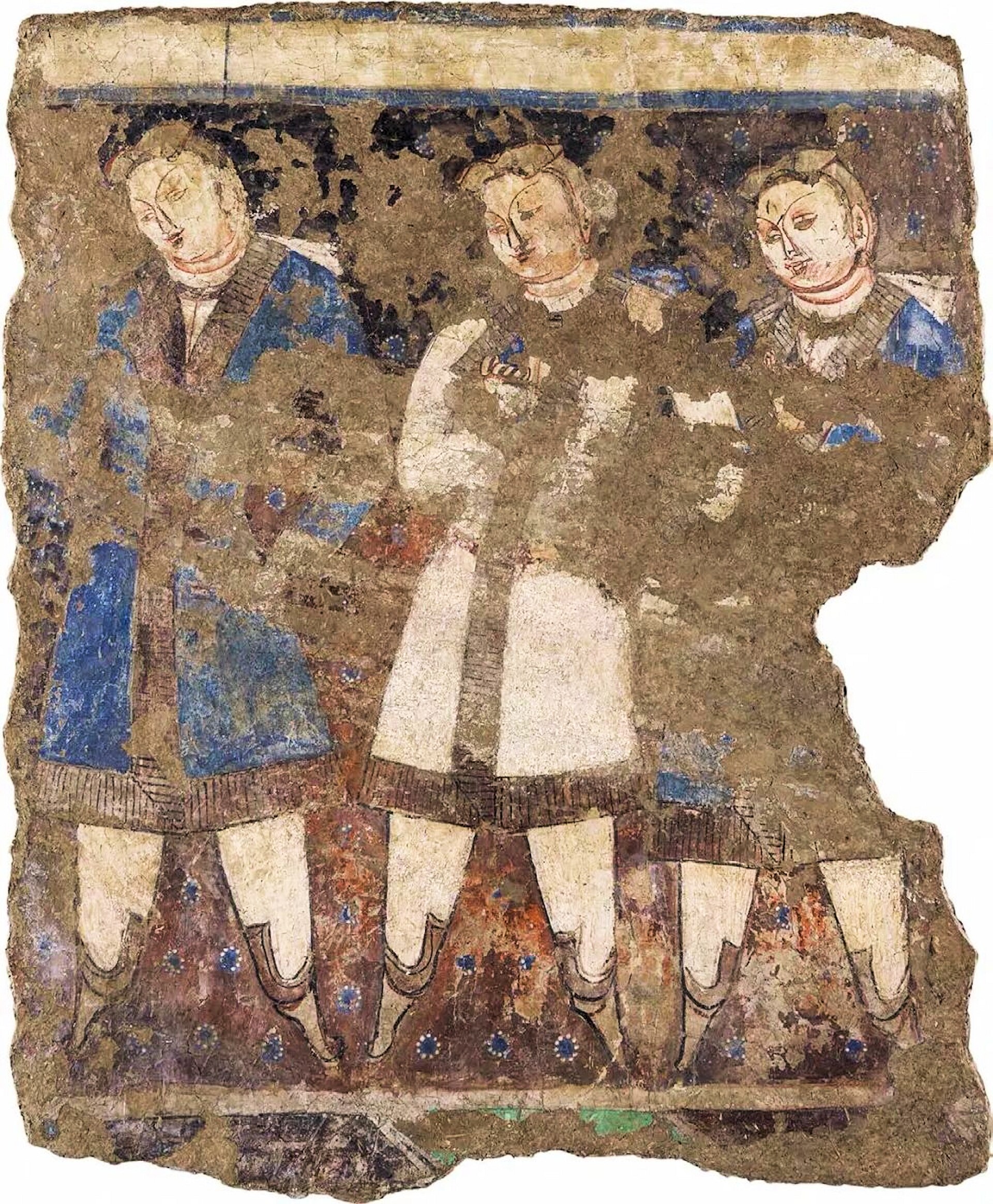
Roughly 328 square metres of murals and 395 separate fragments were archived in Berlin. The museum sold pieces in 1923 and again in 1928 to raise funds. Bombing in the Second World War destroyed part of what remained, and a Vajrapani panel from Cave 4 was seized by Soviet forces at the end of the war and is now in the Hermitage. Further fragments reached Russia, Japan, Korea, the United States and Britain; a three-heads fragment sits in the Victoria and Albert Museum. Studying Kizil today means reassembling a monument from photographs, tracings and scattered fragments on three continents.
Dating the Caves: From Grunwedel’s Styles to Radiocarbon
Grunwedel’s two-style scheme of 1912 dominated the field for most of the twentieth century. Style I, which he called Indo-Iranian, derives from Gandhara: dark cinnabar grounds, green and orange schemes, naturalistic shading, squarish caves with cupola ceilings. Style II draws on Sasanian art, contrasting brilliant green and blue pigments around a central stupa-pillar ringed by a circumambulation corridor. Le Coq and Ernst Waldschmidt refined the dates in 1933 to 500–600 CE and 600–650 CE; those brackets held until the 1980s.
Radiocarbon overturned them. Chinese testing from 1979 and, above all, Su Bai’s 1979–81 campaign at Peking University on caves 47, 3, 38, 6, 171, 17, 190 and 8 pushed the earliest phase back to around 300 CE, two centuries earlier than the German chronology allowed. Su Bai proposed three stages: initial, 310 ± 80 to 350 ± 60 CE; flourishing, 395 ± 65 to 465 ± 65; decline, 545 ± 75 to 685 ± 65. Huo and Wang, for the Chinese Academy of Social Sciences (1989–93), sampled some forty caves and produced a competing scheme of 200–350, 350–500 and 500–700 CE. Nagoya University teams tested further caves in 1995, 1997, 1998 and 2011.
The honest position is that results are often inconclusive and sometimes contradictory. Most narrow dates quoted for Kizil sit at 68 per cent confidence; at the 95 per cent level archaeology requires, the spans widen to two or three centuries, making cave-by-cave comparison largely meaningless. Since Marylin Martin Rhie’s work of 2001, most researchers combine stylistic and architectural analysis with carbon dates rather than trusting either alone.
Abandonment, UNESCO Status and Kizil Today
Most researchers think the caves were abandoned around the start of the eighth century, as Tang authority tightened over the Tarim oases and the Kuchean Buddhist establishment lost its patrons. The site then passed centuries in the dry desert air that has done more than any conservator to preserve what survives.
On 22 June 2014 the Kizil Caves were inscribed on the UNESCO World Heritage List within Silk Roads: the Routes Network of Chang’an-Tianshan Corridor, a transnational serial property of 33 sites across China, Kazakhstan and Kyrgyzstan along some 5,000 kilometres of route. The site is open to visitors, with a rotating selection of caves accessible and photography inside prohibited to protect the pigments. For the tradition Kizil began, see the Bingling Temple grottoes, the Yulin Caves and the nearby Ah’ai Grotto, or browse more historical places.
At a Glance
- Location: Kizil Township, Baicheng County, Aksu Prefecture, Xinjiang, China
- Setting: north bank of the Muzat River, c. 65 km west of Kucha
- Caves: 236 numbered cave temples over c. 2 km of cliff; c. 135 relatively intact
- Dates: earliest caves c. 300 CE; active use to the early 8th century CE
- Culture: Tocharian kingdom of Kucha; Sarvastivadin Buddhism
- Status: UNESCO World Heritage, inscribed 22 June 2014 (Silk Roads: Chang’an-Tianshan Corridor, ref. 1442)
Sources
- UNESCO — Chang’an-Tianshan Corridor
- World History Encyclopedia — Silk Road
- Wikipedia — Kizil Caves
- V&A — Kizil wall-painting fragment
Fact-check: Every date, name and measurement here was checked against the sources above. Last fact-checked: 12 August 2026. Spotted an error? Write to hello@thebrainchamber.com and we will correct it.