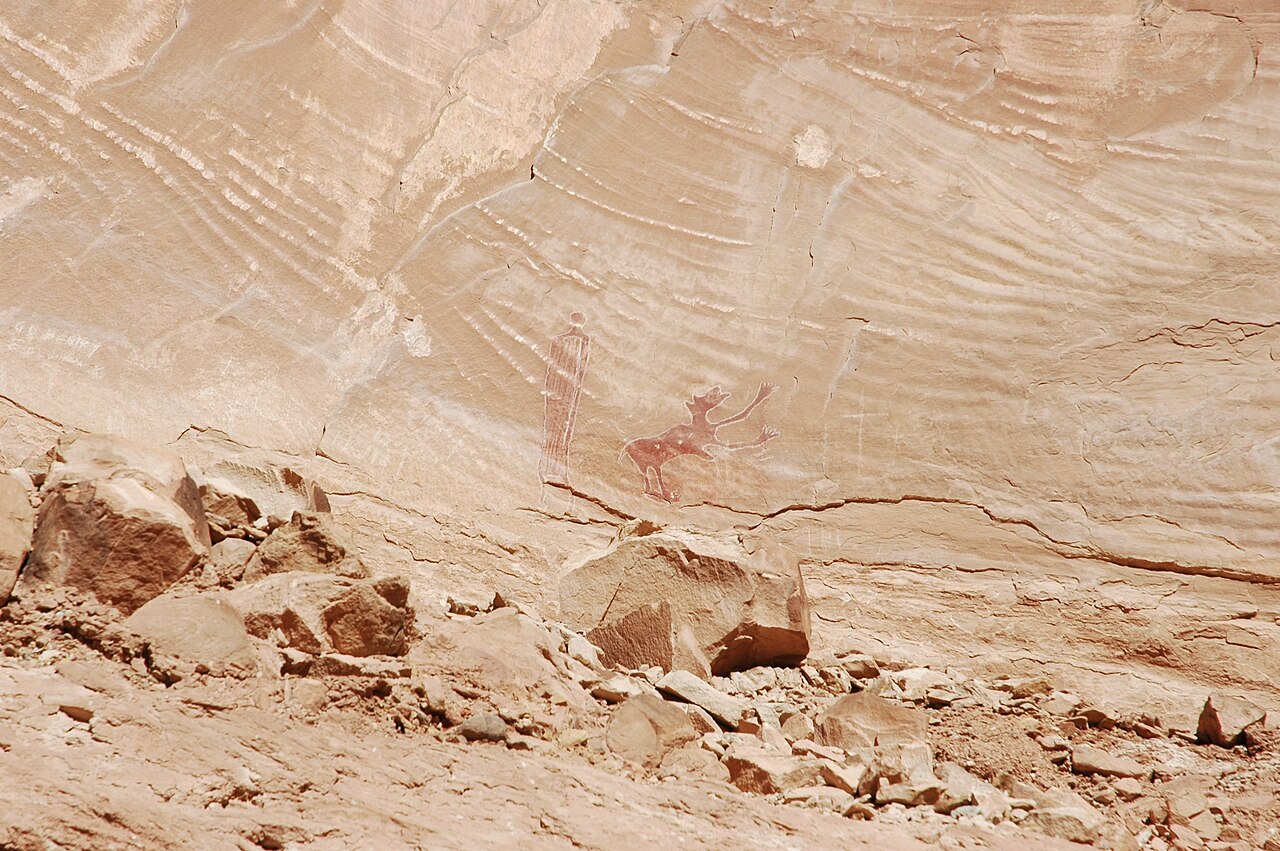
The Black Dragon Canyon pictographs are a panel of red-pigment rock paintings on a sandstone wall in the San Rafael Swell of east-central Utah, just off Interstate 70 west of Green River. For most of the 20th century the panel was famous for what people thought they saw on it: a single, long, winged figure read by some as a pterodactyl — proof, the argument went, that ancient peoples had seen flying reptiles. A 2015 reanalysis using DStretch image enhancement and X-ray fluorescence, published in the journal Antiquity, settled the question. The “dragon” was never a single figure. It is five separate paintings in the Barrier Canyon Style, carved together into one outline only because somebody in the early 20th century chalked over them to make them photograph better.

Where and What It Is
The site is in Black Dragon Wash, a narrow canyon cutting through the western flank of the San Rafael Swell. Access is from a turnout on Interstate 70 followed by a short walking trail; the panel sits inside a fenced enclosure managed by the Bureau of Land Management. The pictographs are painted in red ochre on a sandstone alcove wall, with the main figures arranged roughly horizontally over about six metres. A separate group of stylistically different Fremont-era petroglyphs is incised on adjacent rock — these are not the “dragon” panel and post-date the painted figures by centuries.
How old are the Black Dragon Canyon paintings?
All five painted figures are characteristic of the Barrier Canyon Style (BCS), a regional rock-art tradition of the Colorado Plateau named after a series of panels along Barrier Creek about 45 miles to the south-east. BCS pictographs were made between roughly 4,000 and 1,500 years ago (c. 2000 BCE to 500 CE), most commonly by the archaic hunter-gatherers of the region — predecessors of the Fremont and Ancestral Puebloan farmers who followed. The exact authorship of the Black Dragon panel cannot be tied to a named culture, but stylistically it sits squarely in this archaic BCS tradition rather than in the later Fremont sequence.
The Five Figures
Read from left to right across the panel, archaeologists working from the 2015 study now identify the figures as:
- Two small four-legged animals — likely a bighorn sheep and a dog (or coyote)
- A tall, bug-eyed anthropomorph holding what appears to be a snake
- A smaller human figure bent at the waist with arms outstretched, often described as in supplication
- A large, sinuous horned serpent
None of these are unusual within Barrier Canyon Style art. Bug-eyed anthropomorphs and horned serpents in particular recur across the BCS canon from the Great Gallery in Horseshoe Canyon down to smaller panels throughout the swell.

The “Pterodactyl” Story — How the Mistake Happened
The pterodactyl claim has a specific origin. In 1928, the local rancher and amateur archaeologist John Simonton visited the panel and chalked over the pigment outlines to make the figures stand out for photography — a practice we now recognise as permanently damaging to rock art, because chalk forces a single interpretive line over what is often a complex set of overlapping images. Simonton’s chalked drawing connected the smaller and larger figures into one continuous outline that, viewed end to end, vaguely resembled a long-winged reptile. The drawing was later reproduced in popular books and, by the 1980s, was being cited by some cryptozoology and creationist writers as evidence that human beings had once witnessed living pterosaurs.
The 2015 Reanalysis
The definitive response came in 2015, when a team of researchers — Jean-Loïc Le Quellec, Paul Bahn and Marvin Rowe — published a re-examination of the panel in Antiquity. They used two complementary techniques. DStretch, a digital image-enhancement tool widely used in rock-art research, separates out faded pigment from background rock by stretching colour space so that traces invisible to the naked eye become visible. X-ray fluorescence measured the iron concentration of the red pigment directly, showing where the original paint actually sat on the rock face.
What both techniques showed
Both techniques pointed to the same conclusion: the “dragon” outline cut across multiple separate figures, the gaps between them, and even regions of bare sandstone. As Paul Bahn put it: “It is not a single figure. It is not a pterodactyl.”
Why It Matters Beyond One Panel
Two lessons come out of the Black Dragon Canyon story. First, the case is a textbook example of how imaging technology has reshaped rock-art research: DStretch in particular has revolutionised the field since the late 2000s, allowing researchers to recover faded figures and overpainting sequences that were previously invisible. Second, the case is the most-cited example of why chalking, watering, or otherwise enhancing rock-art images is now strictly prohibited at managed sites — the cost of making a panel “more photogenic” has frequently been the introduction of a permanent, misleading line that confuses interpretation for decades. The Bureau of Land Management’s fence around the Black Dragon panel exists in large part because of what happened here.

Visiting Today
Black Dragon Canyon is open year-round but rough — high-clearance vehicles are recommended for the unpaved section past the I-70 turnout. The panel sits within a Bureau of Land Management protected area; visitors must remain behind the fence, must not touch the rock face, and must not attempt to re-chalk or pour water onto the figures. The site forms part of the broader archaeological landscape of the San Rafael Swell, which also includes the Buckhorn Wash Pictograph Panel, the Head of Sinbad pictographs, and the Temple Mountain panels — all major BCS sites within an hour’s drive of Black Dragon.
Sources and Further Reading
- CBS News — Utah’s ancient “winged monster” rock art deciphered (2015)
- Archaeology Magazine — A New Interpretation of Black Dragon Canyon’s Rock Art
- Bureau of Land Management — Black Dragon Pictograph Panel (official site page)
- University of Colorado Boulder — Controversial interpretations of the Black Dragon pictograph
For a deep, datable record of early life elsewhere in the United States, see the Graham Cave shelter in Missouri, whose stratified floor documents the Dalton-to-Archaic transition.

Neural Pathways is a collective of seasoned experts and researchers with a profound passion for unraveling the enigmas of ancient history and artifacts. With a wealth of combined experience spanning decades, Neural Pathways has established itself as a leading voice in the realm of archaeological exploration and interpretation.