The Zutō pagoda is an earthen step pyramid in the Takabatake district of Nara, Japan, built in 767 CE during the Nara period. Far from being a mystery, it is one of the best-documented Buddhist monuments of the eighth century: a seven-tiered stupa of rammed earth and stone, raised by the monk Jitchū and modelled on Indian prototypes. Its pyramid-like profile — rare in Japanese architecture — has invited centuries of misunderstanding, yet the historical record is clear about who built it, when, and why.
Pyramids turn up in unexpected places and eras the world over — from this Japanese Buddhist stupa to the 1905 Dorn Pyramid, a granite Egyptian Revival tomb in San Luis Obispo, California.
- Location: Takabatake, Nara, Nara Prefecture, Japan
- Built: 767 CE (Nara period), by the monk Jitchū
- Form: seven-step earthen pyramid and Buddhist stupa, about 10 m high on a 32 m square base
- Decoration: roughly 44 stone bas-relief Buddhas
- Status: National Historic Site of Japan
Is the Zutō really a pyramid?
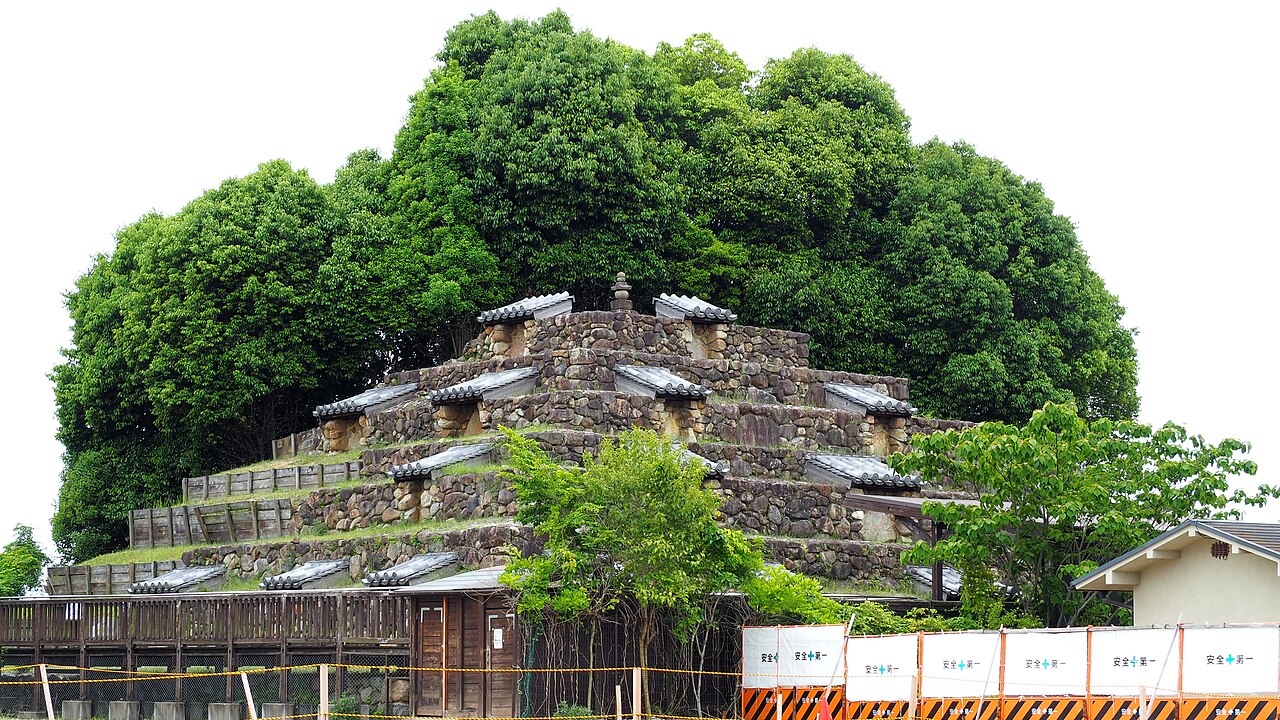
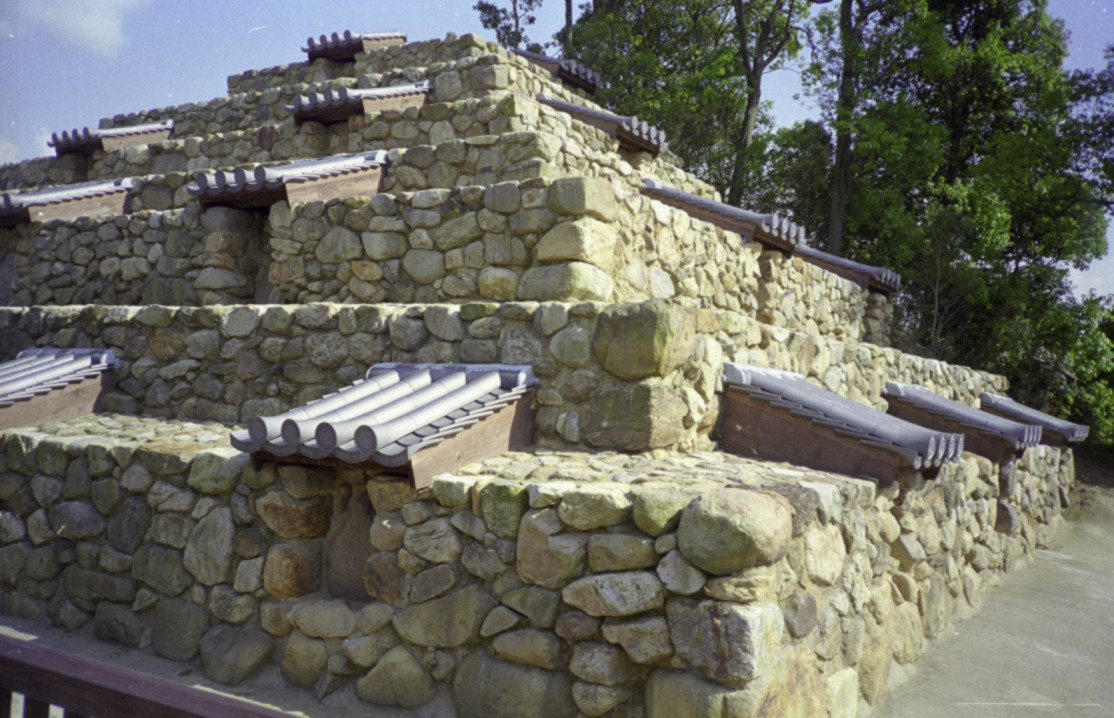
In form, yes — but not in the sense most people mean. The Zutō is genuinely a step pyramid, a series of stepped, receding tiers rising to a flat summit, but it has nothing to do with the royal tomb-pyramids of Egypt or the temple-pyramids of Mesoamerica. It is a Buddhist stupa: a reliquary monument built to house sacred objects and to accumulate spiritual merit. Its core is tamped, or rammed, earth, faced with stone slabs and originally roofed with tiles, and each of its seven square tiers carried carved images of the Buddha. The word “pyramid” describes the silhouette, not the function.
That distinction matters, because Japan has thousands of pagodas and almost none of them look like this. The familiar Japanese pagoda is a tall, slender, multi-storey tower of timber; the Zutō is a squat earthen mound. The confusion it causes is the same confusion that surrounds other so-called pyramids such as Indiana’s Pyramid Mound — a striking geometric shape that tempts onlookers to imagine lost civilizations, when the real history is both documented and more interesting.
The seven stepped tiers
The monument is a square platform of tamped earth measuring 32 metres on each side and about 1.2 metres high. Each successive stage steps back roughly three metres, so the structure tapers to a top platform around 6.2 metres square. The odd-numbered tiers stand about 1.1 metres tall and the even-numbered tiers about 0.6 metres, giving a total height of approximately 10 metres. Excavation later revealed that this seven-tier pyramid was raised directly on top of an earlier, smaller three-tier structure — so the Zutō visible today is in fact the second monument built on the same spot.
Who built the Zutō, and when?
According to the Tōdai-ji Yōroku, a medieval digest of records from the great temple of Tōdai-ji, the Zutō was built in 767 CE by Jitchū, a monk associated with Tōdai-ji, as part of a project to develop the hillside about 1.5 kilometres south of the temple’s Nandaimon gate. Jitchū did not call it the “Zutō” at all. The original name was dōtō (土塔), meaning simply “earthen pagoda.” He modelled the structure on Indian forms — the same stupa tradition that produced India’s Dhamek Stupa and, on a colossal scale, the great stupa of Borobudur in Java.
Archaeology has added a twist that Jitchū’s chroniclers never recorded. Documents later found in the Shōsōin, the imperial repository at Nara, show that an earlier three-tier mound had been raised on the site around 760 by an unknown builder, who had reshaped a sixth-century kofun burial mound to do it. Jitchū dismantled that first attempt and rebuilt the monument from the ground up, which is why the excavated foundations preserve one structure nested inside another.
From “earthen pagoda” to “head mound”: the Genbō legend
If the building began as a sober earthen pagoda, how did it acquire a name meaning “head stupa”? The answer is a case study in how quickly history can be lost. By the Heian period, only a few generations later, Jitchū’s authorship had been forgotten and the monument was absorbed into a sub-temple of Kōfuku-ji linked to the memory of Genbō, a powerful and politically controversial Hossō-school monk who had fallen from favour at court. In 1140 the courtier Ōe Chikamichi, in his pilgrimage record Shichidaiji Junrei Shiki (“Private Notes on a Pilgrimage to the Seven Great Temples”), reported a local belief that the mound was the tomb of Genbō’s severed head. The grim story spread, and the name dōtō was gradually corrupted into zutō (頭塔) — “head pagoda.” Scholars today are confident the eerie name is a folk-etymological accident, not the record of any real burial.
The 44 stone Buddhas

The Zutō’s most remarkable feature is its sculpture. Set into the faces of the tiers are stone Buddhas carved in bas relief, some with fine line engraving, arranged so that each of the four sides originally displayed eleven images — an estimated 44 in all. A number of them still carry traces of the pigment that once made them vivid. Thirteen of the statues that had remained exposed for centuries were designated National Important Cultural Properties in 1977, and nine of fourteen more recovered during later excavation were added to that list in 2002.
On the restored east, west, and north faces the carvings now shelter under small tiled roofs; on the unrestored south side, one Buddha sits directly on the ground, much as it was found. Read as a whole, the programme of images turns the entire pyramid into a built diagram of the Buddhist cosmos — an ambition comparable to painted sanctuaries such as Sittanavasal Cave in India or the gilded forms of later monuments like Myanmar’s Shwezigon Pagoda.
Excavation, restoration, and visiting today
The Zutō was studied intensively by the Nara National Research Institute for Cultural Properties in the late twentieth century, in a series of campaigns that ran until the mid-1980s and shaped the reconstruction that followed. The approach was deliberately conservative. The northern half of the monument was restored to its original stepped, stone-faced form, while the southern half was left overgrown and unexcavated, so that a visitor can see both the rebuilt pyramid and the grassy hill it had become over twelve centuries. Protected as a National Historic Site since the 1920s and re-designated under Japan’s post-war cultural-properties law, the site sits in the Takabatake neighbourhood and is open to the public. Its closest relative, the Dotō in Sakai, Osaka — an earthen pyramid-pagoda associated with the monk Gyōki — survives nearby and shows that the form, though rare, was never unique.
Why the Zutō matters
The Zutō is more than an architectural curiosity. It is one of the few places where the Indian idea of the stupa survives in Japan as an actual stepped, earthen mound rather than a soaring wooden tower, and it opens a window onto the ambitious state Buddhism of Nara-period Japan, centred on Tōdai-ji and its Great Buddha. Its tangled name is a reminder of how fragile historical memory can be — how a fully documented monument could be re-imagined within a few centuries as a severed-head tomb. Seen clearly, the Zutō belongs not to a lost civilization but to a confident, literate society at the heart of the ancient civilizations of East Asia.
Sources and further reading
- Zutō — Wikipedia
- Stupa — Encyclopædia Britannica
- The Nara Period — World History Encyclopedia
- Nara National Research Institute for Cultural Properties
Japan’s islands hold many other stone-built wonders, among them Katsuren Castle, the UNESCO-listed Ryukyuan fortress in Okinawa where archaeologists unearthed 4th-century Roman coins.

Neural Pathways is a collective of seasoned experts and researchers with a profound passion for unraveling the enigmas of ancient history and artifacts. With a wealth of combined experience spanning decades, Neural Pathways has established itself as a leading voice in the realm of archaeological exploration and interpretation.