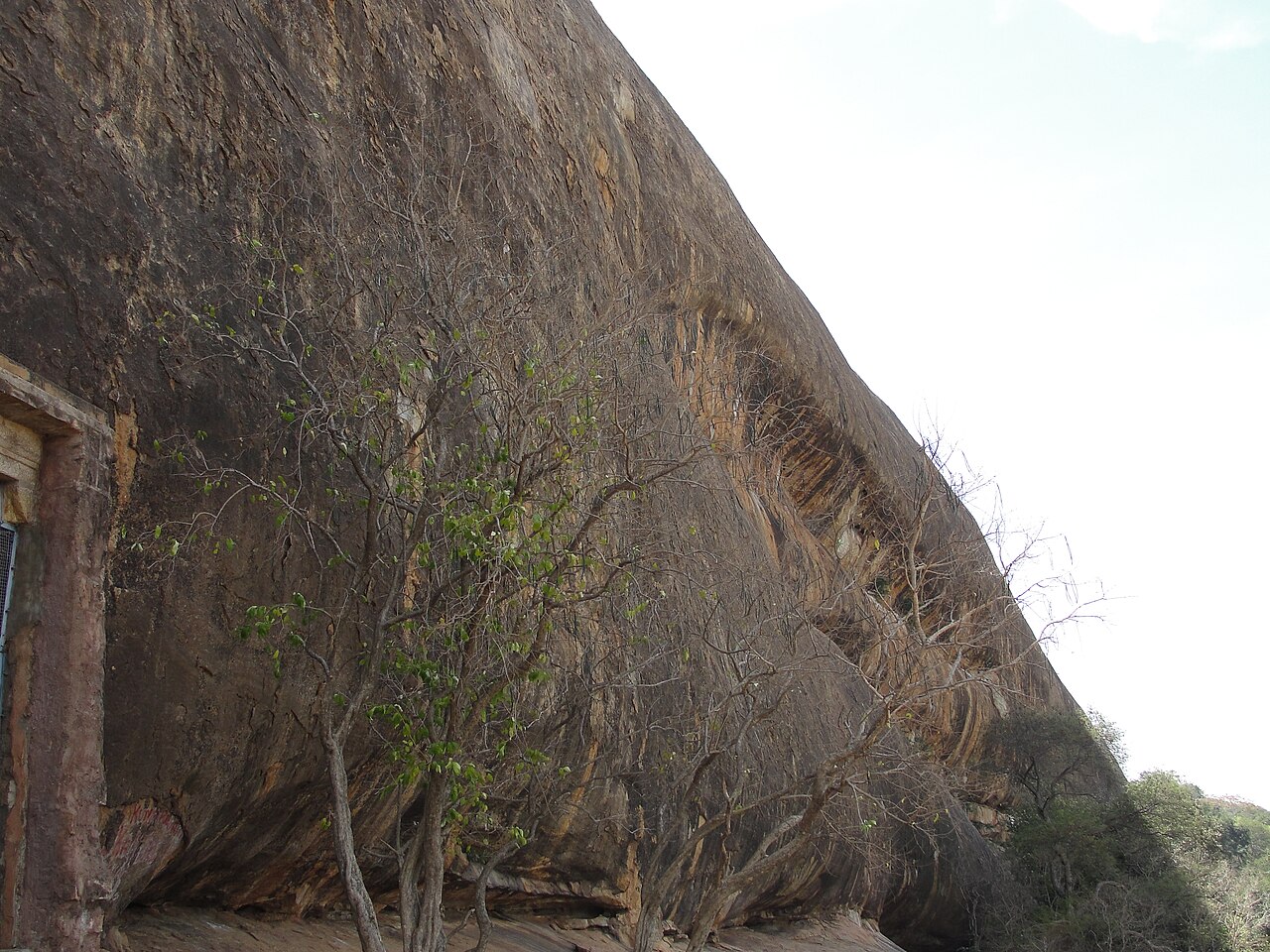
Sittanavasal Cave is a rock-cut Jain monument on a low hill in the Pudukkottai district of Tamil Nadu, in southern India. Carved and decorated between roughly the 2nd century BCE and the 9th century CE, it preserves two distinct treasures: the Arivar Koil, a small rock-cut temple of the Jain Arihants, and the Eladipattam, a cavern of polished stone beds where Jain ascetics once lived. The cave is best known for its mural paintings, which art historians rank among the finest in medieval India, second only to the murals of the Ajanta Caves and the Bagh group.
A Jain Sanctuary in the Pudukkottai Hills
The name Sittanavasal — also written Chitthannavasal — is generally read as a contraction of the Tamil Sit-tan-na-vayil or Chitra-annal-vasal, “the abode of the great or famous saints.” That title fits the site’s long history as a centre of Tamil Jainism. Inscriptions in and around the hill show that wandering Jain monks, the Tamil Śramaṇa, used the rock as a retreat from at least the 1st century BCE through to about 900 CE.
Jainism reached the Tamil country early and put down deep roots among merchant and farming communities. Royal houses patronised it before the great Bhakti revival drew the region back toward Shaivism and Vaishnavism. Sittanavasal sits within that arc: a hill sanctuary that began as a austere monastic shelter and grew, under royal patronage, into a painted temple. It lies close to other early rock-cut sites of the region, including nearby Narthamalai, which together map the spread of cave architecture across the Pudukkottai uplands.
Arivar Koil: The Rock-Cut Temple of the Arihants

The temple proper, the Arivar Koil (“temple of the knowers”), was excavated into the western slope of the hill. It is modest in scale: a pillared ardha-mandapam (front hall) opening into a small sanctum, or garbhagriha, cut straight from the living rock. The sanctum holds carved figures of Tirthankaras, the Jain ford-makers, and the innermost chamber is shaped so that it behaves as an echo chamber, a feature noted by visitors and conservators alike.
Stylistically the excavation belongs to the same family of southern rock-cut architecture as the Pallava monuments further north. The Pallava king Mahendravarman I, who pioneered pillared cave shrines such as his rock-cut shrine at Mandagapattu, was himself a Jain before his celebrated conversion to Shaivism — a biographical detail that has long tied his name to the early phases of Sittanavasal. Comparable early temple frescoes survive at the Badami cave temples in the Deccan, while the Jain rock-cut tradition reached its grandest expression at the Jain caves at Ellora.
The Eladipattam Rock Beds and Their Tamil-Brahmi Inscriptions

A short climb from the temple lies the Eladipattam, a natural cavern that served as a Jain shelter from the 1st century BCE. It contains seventeen polished stone berths — the samanar padukkai, or “beds of the Jain monks” — laid out in rows, each with a slightly raised stone “pillow.” On these unforgiving surfaces ascetics slept and performed severe austerities, including kayotsarga (motionless standing meditation) and sallekhana (ritual fasting unto death).
Reading the inscriptions
Several of the beds carry inscriptions in the Tamil-Brahmi script, naming the monks who used them — figures such as Tolakunrattu Kadavulan and Tiruchatti. The great epigraphist Iravatham Mahadevan studied these records closely, dating the earliest to around the 1st century BCE and tracing the site’s continuous use into the 10th century CE. They are among the oldest dated Jain monastic records in South India, and they anchor Sittanavasal firmly in the documented history of the region rather than in legend.
Why Are the Sittanavasal Paintings So Famous?

The murals are what draw scholars and visitors. They were executed in the fresco-secco technique — pigment laid onto a dry lime ground rather than into wet plaster — over a thin coat of lime mortar and sand only a couple of millimetres thick, brushed with a lime wash while still damp. The palette is built from mineral and vegetable dyes: black, green, yellow, orange, blue and white.
The signature panel, on the ceiling of the front hall, depicts a great lotus pond — understood as the khatika-bhumi, a tank within the Jain samavasarana or divine assembly. Among the lilies and lotuses, bhavyas (“the faithful”) wade in to gather flowers, while elephants bathe, buffaloes wallow, geese paddle and fish dart through the water, one leaping clear of the surface. Two dancing figures and bands of geometric ornament complete the scheme. Because so little South Indian painting of this age survives, these fragments are routinely described as the earliest substantial Jain frescoes in the south, and as the best medieval Indian painting outside Ajanta and Bagh.
Dating the Cave: Pallava Beginnings and Pandya Patronage

Dating Sittanavasal is a layered problem, because temple, beds and paintings belong to different centuries. The excavation of the shrine has been linked to the Pallava period and to Mahendravarman I (reigned c. 580–630 CE). An inscription attributes a later renovation to a Pandya king — probably Maran Sendan (c. 654–670 CE) or Arikesari Maravarman (c. 670–700 CE).
The paintings themselves are firmly Pandyan, dated to about 850 CE. A 9th-century inscription on a veranda pillar records the Pandya ruler Srimara Srivallabha and his queen paying homage to Ilam Gautaman, an acharya (preceptor) of Madurai who is credited with having the murals made. That single epigraph gives Sittanavasal something most ancient painting lacks: a named patron, a named teacher and a usable date.
Visiting Sittanavasal Today
Sittanavasal is a protected monument of national importance, maintained by the Archaeological Survey of India (ASI) as a ticketed site and listed among its Adarsh Smarak (“model monuments”). The frescoes are fragile, and access to the painted hall is controlled to limit humidity and light damage. The cave sits roughly 16 kilometres from Pudukkottai town, and the cooler, drier months from October to March are the usual season for a visit. It forms part of a wider landscape of temples, forts and cave shrines that belongs to the story of South India’s ancient civilizations.
Frequently Asked Questions
Why is Sittanavasal Cave famous?
Sittanavasal is celebrated for its 7th- to 9th-century Jain frescoes, painted in the fresco-secco technique and widely ranked second only to the murals of Ajanta and Bagh among surviving medieval Indian paintings. Its best-known panel shows a lotus pond — a depiction of the Jain samavasarana — filled with bhavyas gathering flowers among elephants, geese, fish and dancing figures. The site also preserves the Arivar Koil rock-cut temple and the Eladipattam beds where Jain ascetics performed their austerities.
What is the Eladipattam at Sittanavasal?
Eladipattam is a natural cavern on Sittanavasal hill containing seventeen polished stone berths, known locally as samanar padukkai, on which Jain monks slept and performed austerities such as kayotsarga and sallekhana. Several beds carry Tamil-Brahmi inscriptions naming individual ascetics; the epigraphist Iravatham Mahadevan dated the earliest of them to around the 1st century BCE, with the shelter remaining in use into the early medieval period. It is among South India’s oldest documented Jain monastic sites.
Who painted the Sittanavasal frescoes?
The surviving murals are attributed to the Pandya period, around 850 CE. A 9th-century inscription on a veranda pillar records the Pandya king Srimara Srivallabha and his queen honouring Ilam Gautaman, an acharya of Madurai credited with commissioning the paintings. Earlier work on the temple is linked to the Pallava king Mahendravarman I, who was a Jain before converting to Shaivism. The artists used mineral and vegetable pigments laid over a thin, dry lime-plaster ground.
At a Glance
- Location: Sittanavasal, Pudukkottai district, Tamil Nadu, India
- Tradition: Tamil Jainism (Digambara)
- Monastic beds (Eladipattam): from c. 1st century BCE
- Temple (Arivar Koil): Pallava–early Pandya, c. 7th century CE
- Frescoes: Pandya period, c. 850 CE
- Custodian: Archaeological Survey of India (Adarsh Smarak monument)
Sources and Further Reading
- Wikipedia: Sittanavasal Cave
- Encyclopaedia Britannica: Mahendravarman I
- World History Encyclopedia: Ajanta Caves
- Imp-Art (Centre for Art & Archaeology): Cave Art at Sittanavasal
- Tamil Nadu Tourism: Sittanavasal Caves

Neural Pathways is a collective of seasoned experts and researchers with a profound passion for unraveling the enigmas of ancient history and artifacts. With a wealth of combined experience spanning decades, Neural Pathways has established itself as a leading voice in the realm of archaeological exploration and interpretation.