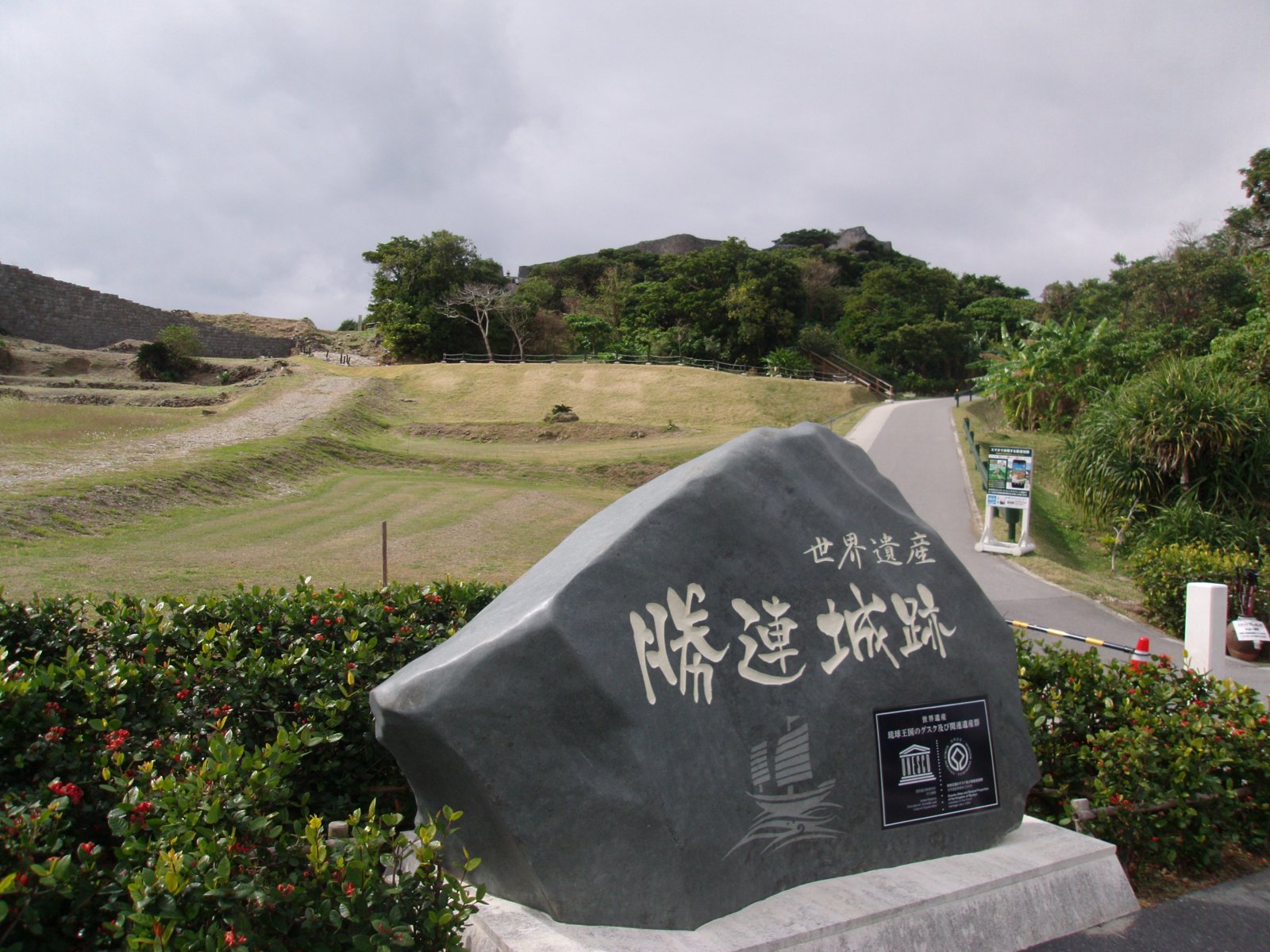
Katsuren Castle is the ruined hilltop stronghold of a Ryukyuan lord who grew rich on maritime trade and ambitious enough to defy a king. Known in Okinawan as Katsuren-jō or Katsuren gusuku, it occupies a long limestone ridge in Uruma, on the central-eastern coast of Okinawa Island, Japan, with the Pacific on one side and the East China Sea on the other. First raised during the Gusuku period of the 13th to 14th centuries, it reached its height in the 15th century before its lord, Amawari, fell in a failed revolt against the Ryūkyū royal court in 1458. Today its curving dry-stone walls are a UNESCO World Heritage Site — and the source of one of the strangest archaeological finds ever made in Japan. For a much later, purely decorative take on castle architecture, compare Cave Castle, an 1804 Gothick house in Yorkshire built to look medieval.
A Ryukyuan fortress on the trade winds
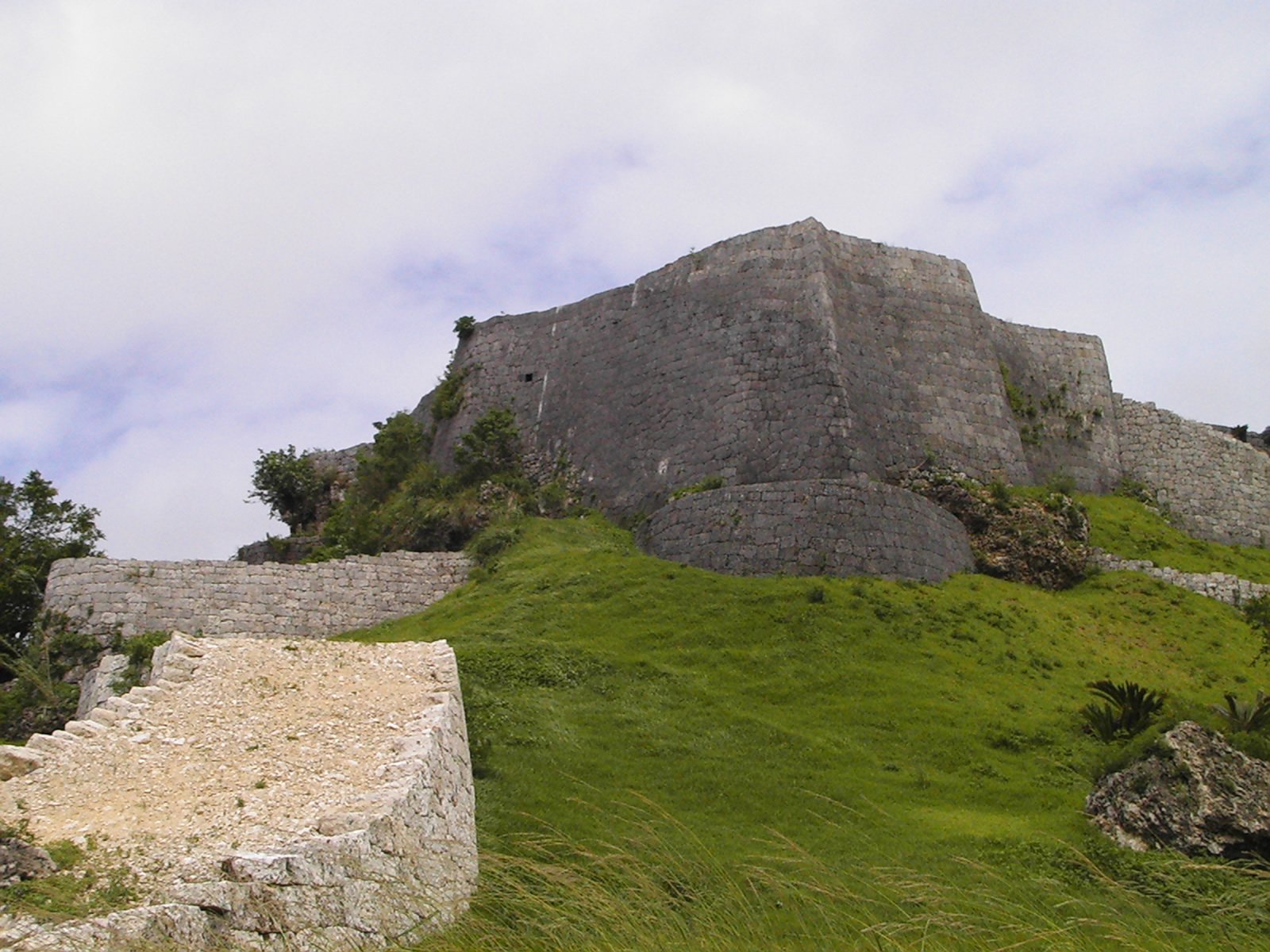
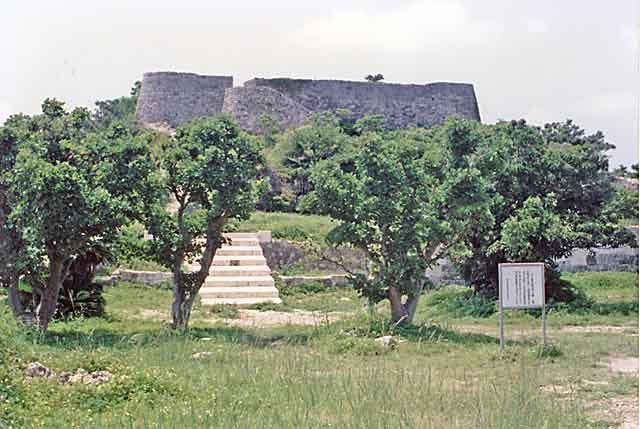
A gusuku is the Okinawan version of a castle, and Katsuren is among the oldest and most dramatically sited of them. The fortress climbs through four stepped enclosures, or kuruwa, that follow the spine of the ridge. The lowest enclosures sheltered the garrison and ordinary people; the upper baileys were reserved for the aji and his household, with the main hall crowning the summit. From the top the lord could watch every ship approaching the harbours below, a vantage that was as much about commerce as defence.
The walls themselves are the castle’s signature. Masons built them from local Ryukyu limestone using the nozura-zumi technique, fitting rough stones together without mortar. The method has proved astonishingly durable, holding the curving ramparts together through six centuries of typhoons and earthquakes. The same engineering tradition shaped the great Okinawan castles, and it is a world away from the timber keeps of mainland Japan such as those that would have sheltered the armour of Ashikaga Takauji.
The four enclosures
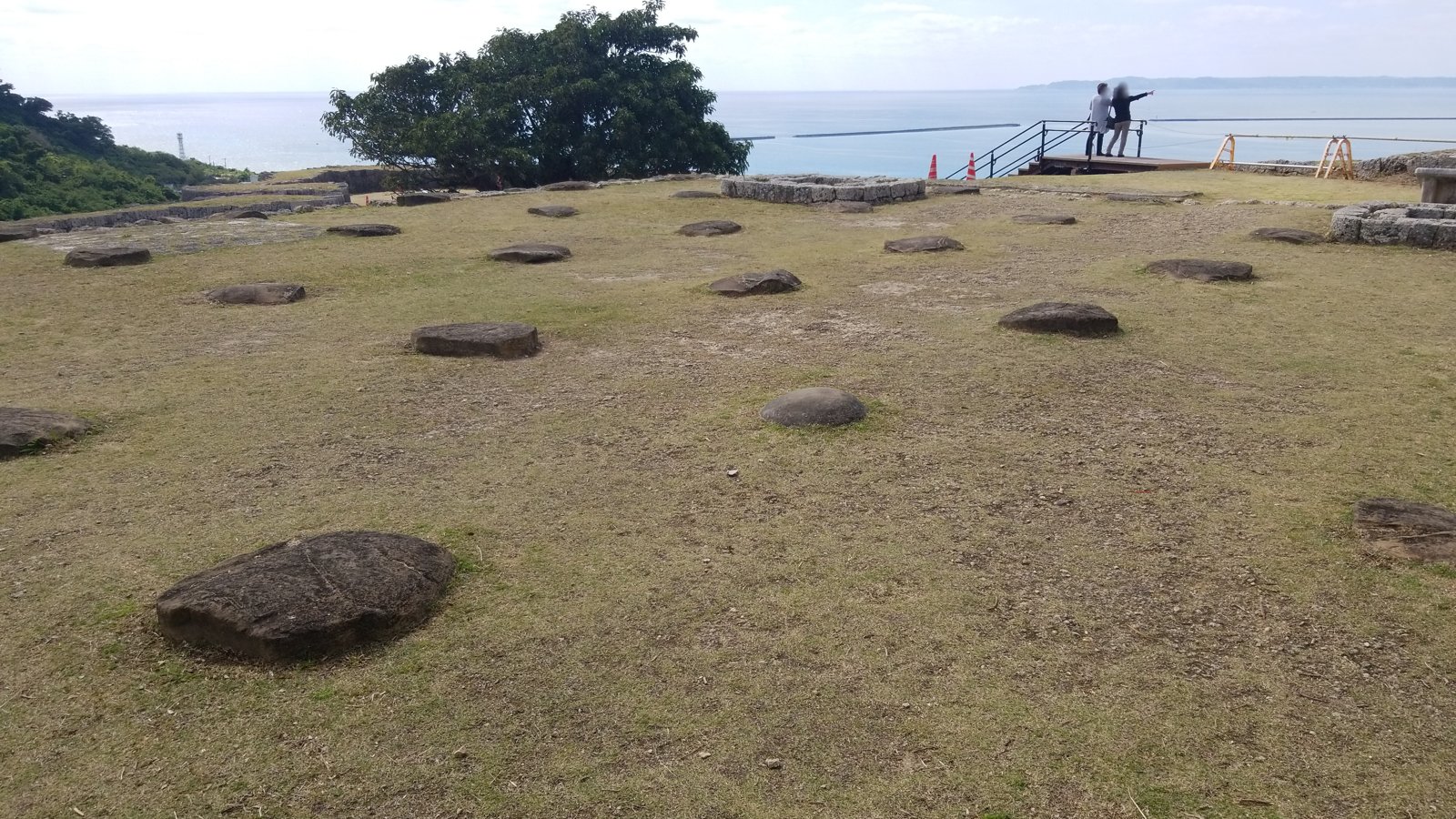
Excavation has shown how tightly the design fitted the terrain. Stone steps, paved courts and carved drainage channels link the enclosures, while the foundations and pillar-bases of the main building still mark the administrative heart of the site. Chinese ceramics, roof tiles and trade goods recovered from the soil confirm what the architecture implies: this was a wealthy, outward-looking court, plugged into the sea lanes that carried goods between China, Korea, Japan and Southeast Asia.
Amawari and the revolt of 1458
Katsuren’s golden age belonged to Amawari, the aji who ruled in the mid-15th century. He built the castle’s prosperity on overseas trade and, according to Okinawan tradition, married a daughter of the king himself. Confident and ambitious, Amawari first destroyed his great rival Gosamaru, the lord of nearby Nakagusuku, and then turned against the throne. In 1458 he marched on the royal court of King Shō Taikyū. The revolt failed: royal forces defeated and killed him, and with his death Katsuren lost its political weight. The castle was later occupied by farmers and used as a community gathering place before being abandoned to ruin.
The story of Amawari’s downfall became one of the most popular tales in Okinawan culture, retold for centuries in classical Ryūkyūan dance-drama. It is a reminder that the gusuku were not romantic relics but the stage for real power struggles — the same kind of dynastic ambition that built and broke courts from the imperial capital of Nicomedia to the warlord halls of medieval Japan.
How did Roman coins end up in an Okinawan castle?
In December 2013, during a routine excavation run by the Uruma City Board of Education, archaeologists pulled ten small, badly corroded copper coins from the Katsuren soil. When the find was announced in 2016, it made headlines around the world. X-ray analysis revealed that four of the coins were Roman, struck in the 3rd or 4th century AD. One clearly bore the image of the emperor Constantine the Great; another showed a helmeted soldier thrusting a spear behind a shield. They were the first ancient Roman coins ever discovered in Japan.
The hoard was even stranger than that. Mixed in with the Roman pieces was a coin from the Ottoman Empire inscribed with a date equivalent to 1687 — more than a thousand years younger than its neighbours. Researchers led by historian Hiroyuki Miyagi of Okinawa International University were careful to rule out any direct contact between Rome and Ryūkyū. The likeliest explanation is trade: coins minted in the Mediterranean could drift east across generations of merchants, ending up in a 15th-century Okinawan castle as curiosities or scrap metal rather than spendable money. The Uruma board called them “precious historical material suggesting a link between Okinawa and the Western world.”
For comparison, Roman coins are exactly what you would expect to find scattered across the empire’s own frontier towns, such as the Roman city of Augusta Raurica on the Rhine. Finding them on a Pacific island some 8,000 kilometres beyond Rome’s furthest border is what makes Katsuren extraordinary — a single handful of copper that traces the reach of the early-modern world’s trade routes.
Katsuren as a UNESCO World Heritage Site
In 2000, Katsuren Castle was inscribed by UNESCO as one of the nine component sites of the UNESCO Gusuku Sites inscription, the property that recognises the distinctive culture of the Ryūkyū Kingdom. The kingdom ruled the Ryūkyū Islands as an independent state from the 15th century until it was absorbed by Japan in the 19th, developing a hybrid culture shaped by Chinese, Japanese and Southeast Asian influence. Katsuren’s ruins, alongside other Okinawan wonders like the submerged Yonaguni Monument, anchor a heritage landscape that is distinct from the rest of Japan.
The site is freely open to visitors, with a modern interpretation centre at its foot displaying the famous coins and other finds. Set against the older monuments of the wider region — from Okinawan gusuku to the Zutō Pagoda in Nara — Katsuren stands out for how vividly it joins two stories: the rise and fall of a Ryukyuan lord, and the quiet, astonishing evidence of how far ancient money could travel. Explore more sites like it in our Ancient Civilizations archive.
Sources and further reading
- Smithsonian Magazine — report on the Roman coins found at Katsuren Castle.
- NPR — coverage of the discovery and its dating.
- Ancient Origins — analysis of the coins and possible trade connections.
- Wikipedia: Katsuren Castle — overview of the castle’s history, architecture and excavation.

Neural Pathways is a collective of seasoned experts and researchers with a profound passion for unraveling the enigmas of ancient history and artifacts. With a wealth of combined experience spanning decades, Neural Pathways has established itself as a leading voice in the realm of archaeological exploration and interpretation.