In September 2005, archaeologists working in the northern suburbs of Xi’an opened a modest brick tomb and found something that rewrote a small corner of Silk Road history: the grave of Li Dan (李诞), a self-described Brahmin from the Gandhara region who died in 564 CE, buried beside a woman with a Byzantine gold coin of Justinian I placed inside her mouth. Dated by its own engraved epitaph to the Northern Zhou dynasty, the Tomb of Li Dan is one of the most vivid records we have of a foreigner who made his life — and his death — in 6th-century China.
Who Was Li Dan?
According to the epitaph carved on black stone inside the tomb, Li Dan — also given the name Li Tuosuo — was a Brahmin (婆罗门, Póluómén), a member of the priestly caste of the Indian subcontinent. He came from an honourable family; his grandfather, named Feng He, had once been a tribal leader. The inscription records that Li Dan died at the age of 59 on the ninth day of the fourth month in the fourth year of the Baoding era — 564 CE, a “year of the Wood Monkey” — at his home in the Wanjili ward of the capital.
The Northern Zhou emperor granted him the posthumous title of “Prefect of Han Prefecture” (邯州刺史), an honorific rather than an office he had actually held. His elder son, Panti (槃提), commissioned the epitaph, writing that he feared “cataclysms” might one day move the mountains and erase his father’s memory, and so had the story cut into stone “so that it can be transmitted unblemished.”
A Brahmin’s Journey From Gandhara to China
Li Dan’s family were not merchants passing through. The epitaph states that between roughly 520 and 525 CE — the Zhengguang era of the preceding Northern Wei — he travelled from Jibin, a term Chinese sources used for the region of Gandhara or Kashmir on the north-western fringe of the Indian subcontinent, to the Chinese court. There he won the favour of Emperor Taizu, the powerful regent Yuwen Tai (507–556 CE), founder of the political order that became the Northern Zhou.
That a Gandharan Brahmin could migrate across Central Asia, settle in the imperial capital and be honoured by the throne is a reminder that the Silk Road moved people and beliefs, not just silk and coins. Li Dan’s grave sits in the same district of Xi’an as the tombs of other foreign residents of the era — the Sogdian officials Kangye, Anjia and Shijun — forming a small necropolis of the cosmopolitan diaspora that clustered around the Northern Dynasties court.
How Was the Tomb Discovered?
The tomb was excavated in September 2005 by the Xi’an Institute of Cultural Relics Protection and Archaeology during work in the city’s northern suburbs. Its plan was thoroughly Chinese in style: a single arc-square, brick-chambered tomb reached by a long sloping passage and tunnel, the standard form for burials of the Northern Zhou period. A brick wall enclosed the chamber, and a carved stone gateway stood in front of the stone coffin.
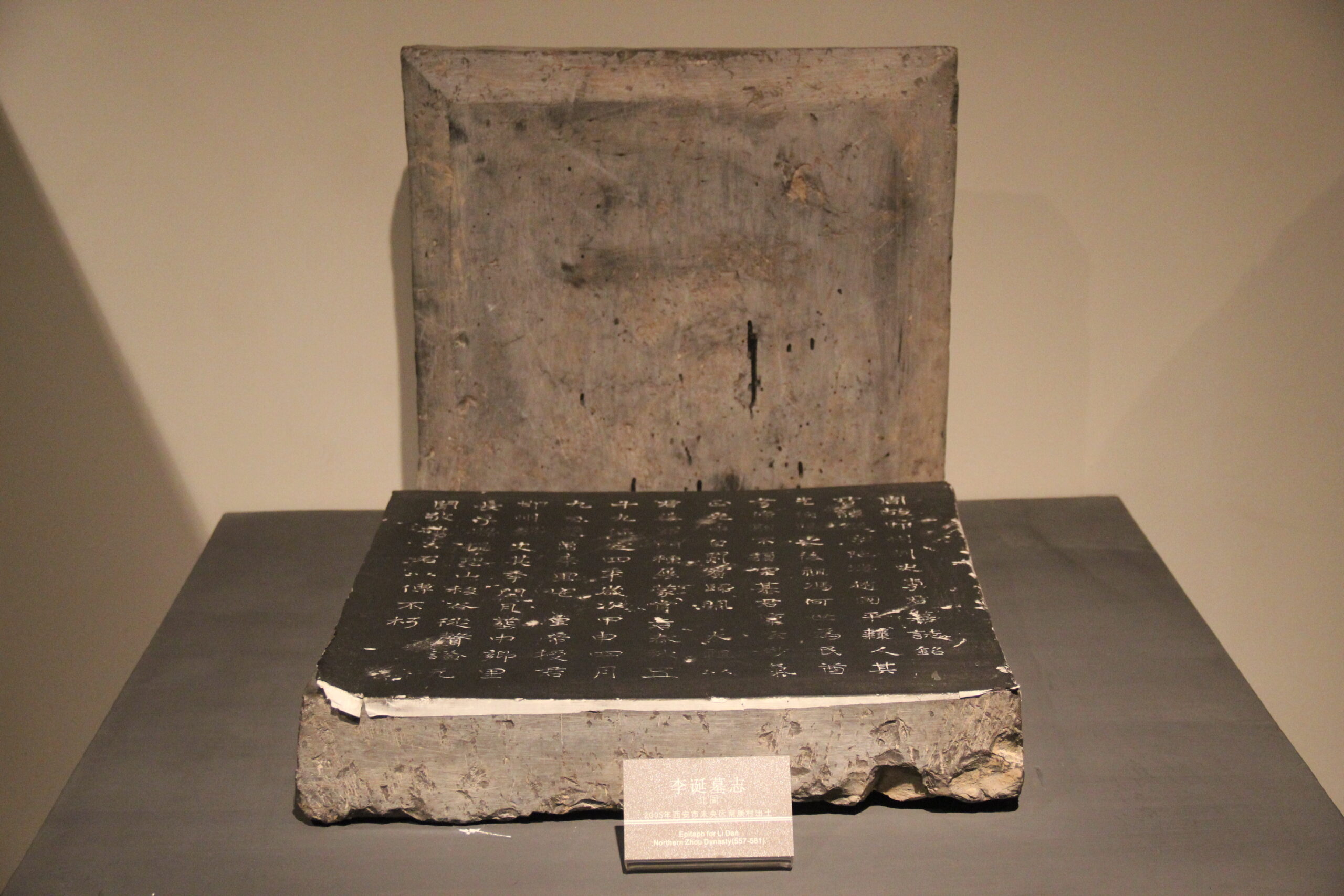
The epitaph and coffin are now held in the collections of the Xi’an City Museum, where the inscription remains the primary — and almost only — documentary source on Li Dan’s life.
What Was Inside the Tomb?
A coin in the mouth
Behind the stone gateway lay a single coffin holding two skeletons, a man and a woman, wrapped together in three layers of textiles. In the woman’s mouth was a gold coin of the Byzantine emperor Justinian I (reigned 527–565 CE) — a burial practice with deep roots in the Mediterranean world, echoing the classical custom of leaving a coin for the dead. Traces of surviving pigment show that the chamber’s inner walls had originally been painted, though little of the decoration now remains.
The presence of a Byzantine coin so far east is not unique — imitation and genuine Byzantine solidi turn up in a scatter of 6th-century tombs across northern China — but finding one in the mouth of a Gandharan Brahmin’s wife is a striking collision of Indian, Chinese and Mediterranean funerary customs in a single grave.
The Coffin’s Carvings: Chinese Cosmology and a Fire Altar
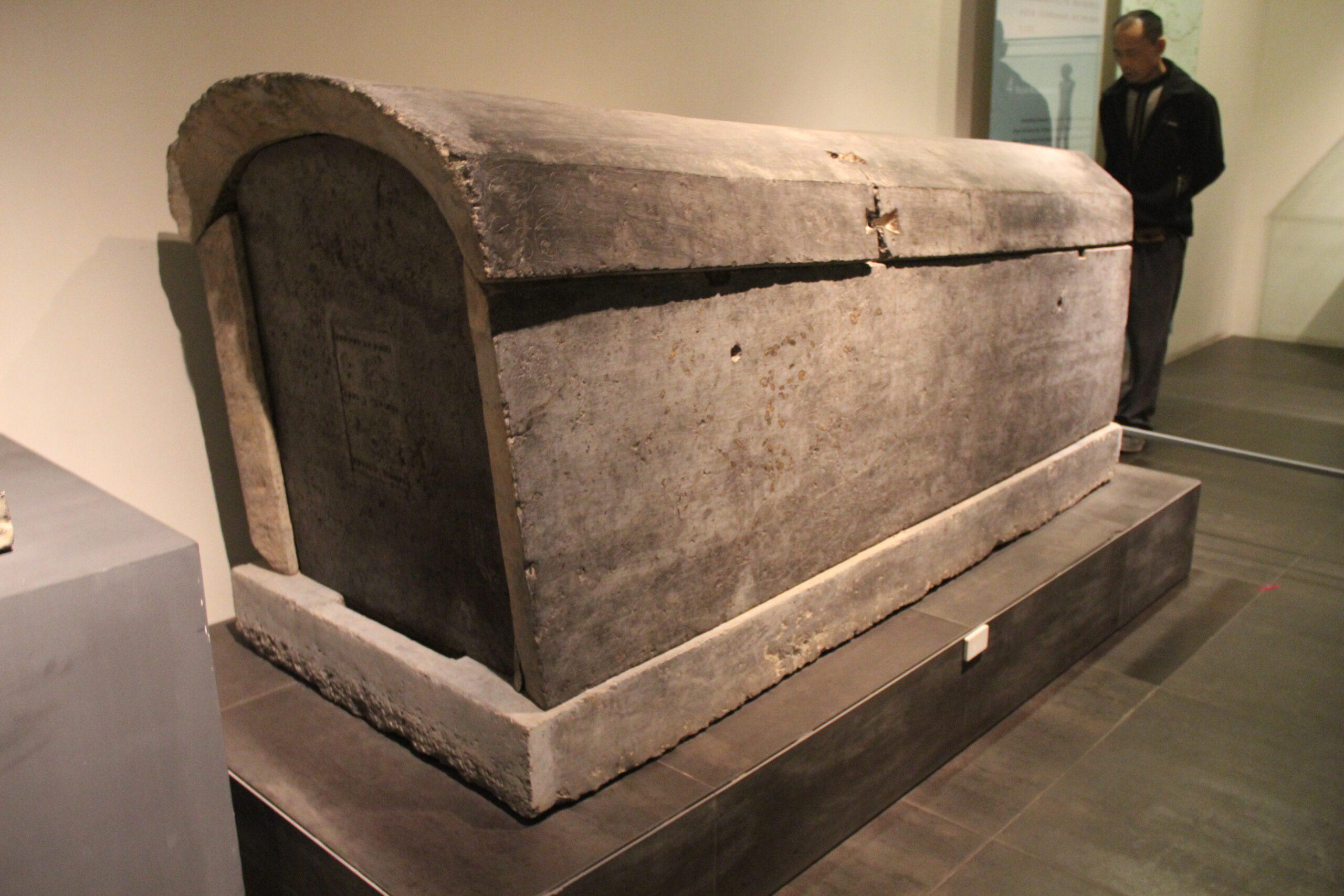
The stone coffin itself is finely decorated with incised carvings. Most of the imagery draws on traditional Chinese cosmology, including a white dragon along one side panel. But two details break the Chinese pattern: a pair of haloed guardian figures rendered in a distinctly non-Chinese style, and a fire altar of the kind associated with Zoroastrian ritual.
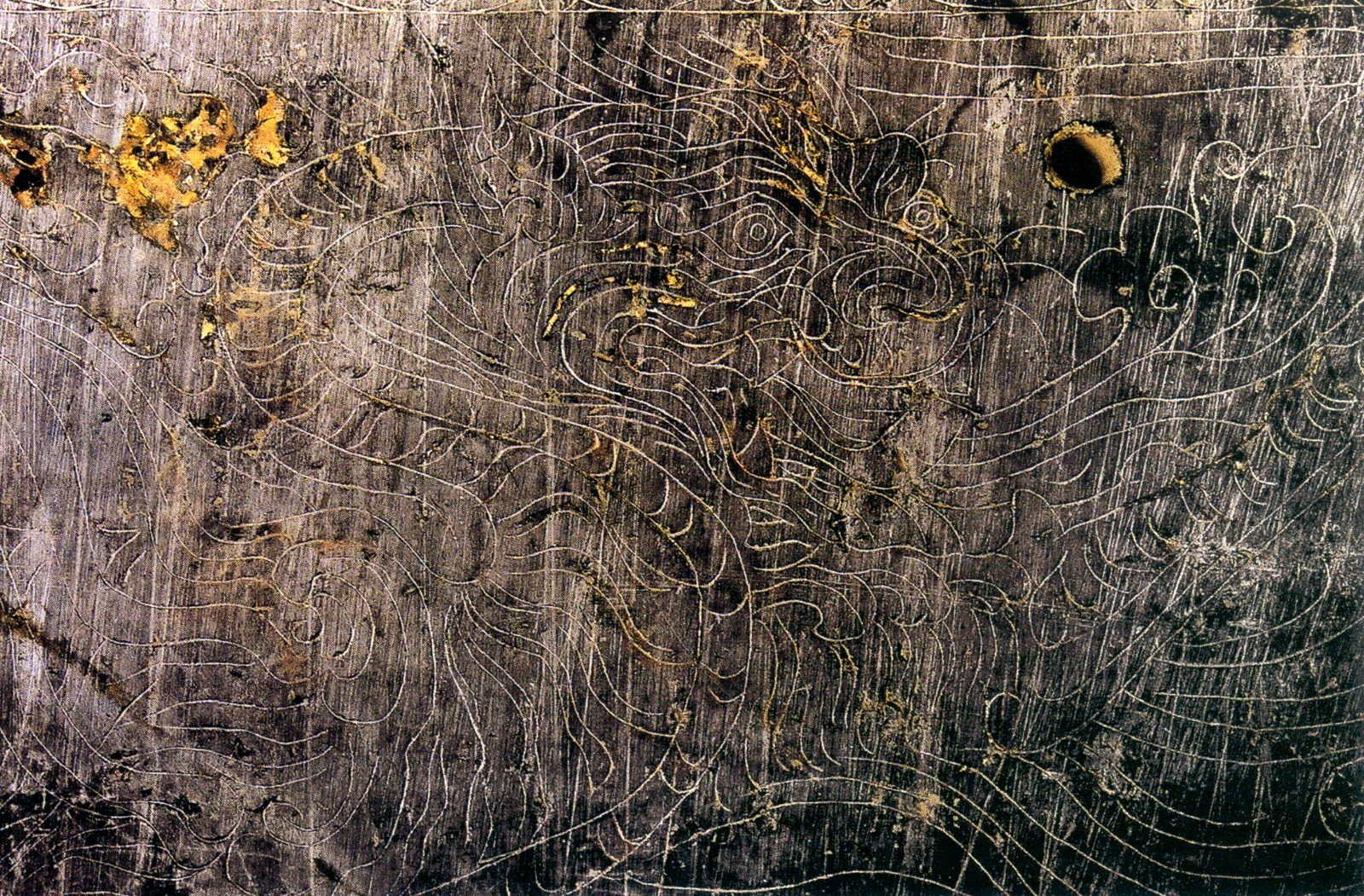
That mixture — Chinese dragons beside a fire altar and foreign guardians — mirrors the blended iconography seen on other foreign-resident coffins of the period, such as the Tomb of Wirkak and the Tomb of An Bei, both Zoroastrian Sogdian burials excavated in the same Xi’an landscape. Whether Li Dan personally practised Zoroastrian rites or simply commissioned craftsmen fluent in the visual language of the diaspora is impossible to say from the carvings alone.
Why Does the Byzantine Coin Matter?
The single coin turns a private burial into a document of trans-Eurasian contact. To place a coin struck in Constantinople into the grave of a South Asian émigré, buried according to a partly Chinese and partly Iranian visual program, is to compress the whole east–west span of the Silk Road into one coffin. It sits alongside evidence from sites such as the Sogdian trading colonies of Panjakent and the Gandharan heartland recorded in the Diamer-Basha petroglyphs, showing how thoroughly interconnected 6th-century Eurasia already was.
Li Dan’s grave also belongs to the wider story of foreign burials clustered near the imperial mausoleums of the region — the same corridor of history that later produced the vast Tang complexes such as the Qianling Mausoleum a century and a half afterwards.
A 6th-Century Cross-Border Couple
In December 2025, a team publishing in the Journal of Archaeological Science: Reports reported ancient-DNA results from the two skeletons, describing them as evidence of “a 6th-century cross-border couple between South Asia and East Asia” (Du et al., 2025). The genetic work adds a biological dimension to what the epitaph only hints at: a household in which South Asian and East Asian ancestry met, in a city that was already one of the most cosmopolitan on earth.
Comparative studies of the goldwork and burial goods from neighbouring foreign tombs, such as the analysis of jewellery from the Sogdian tomb of Shi Jun in Xi’an (Shi Jun tomb study), reinforce the picture of a tightly connected immigrant elite moving between the courts of Persia, Central Asia and China.
Conclusion
The Tomb of Li Dan is small, plain, and easy to overlook beside the monumental imperial mausoleums of Shaanxi. Yet in one brick chamber it holds a Gandharan Brahmin, his wife, a Byzantine coin, a Chinese dragon and a possible Zoroastrian fire altar — a single grave that carries the entire length of the Silk Road inside it. Written by a grieving son who feared his father would be forgotten, the epitaph did exactly what Panti hoped: fifteen centuries later, Li Dan’s story is still being read. For more graves and cities from the same world, browse our Ancient Civilizations archive.

Neural Pathways is a collective of seasoned experts and researchers with a profound passion for unraveling the enigmas of ancient history and artifacts. With a wealth of combined experience spanning decades, Neural Pathways has established itself as a leading voice in the realm of archaeological exploration and interpretation.