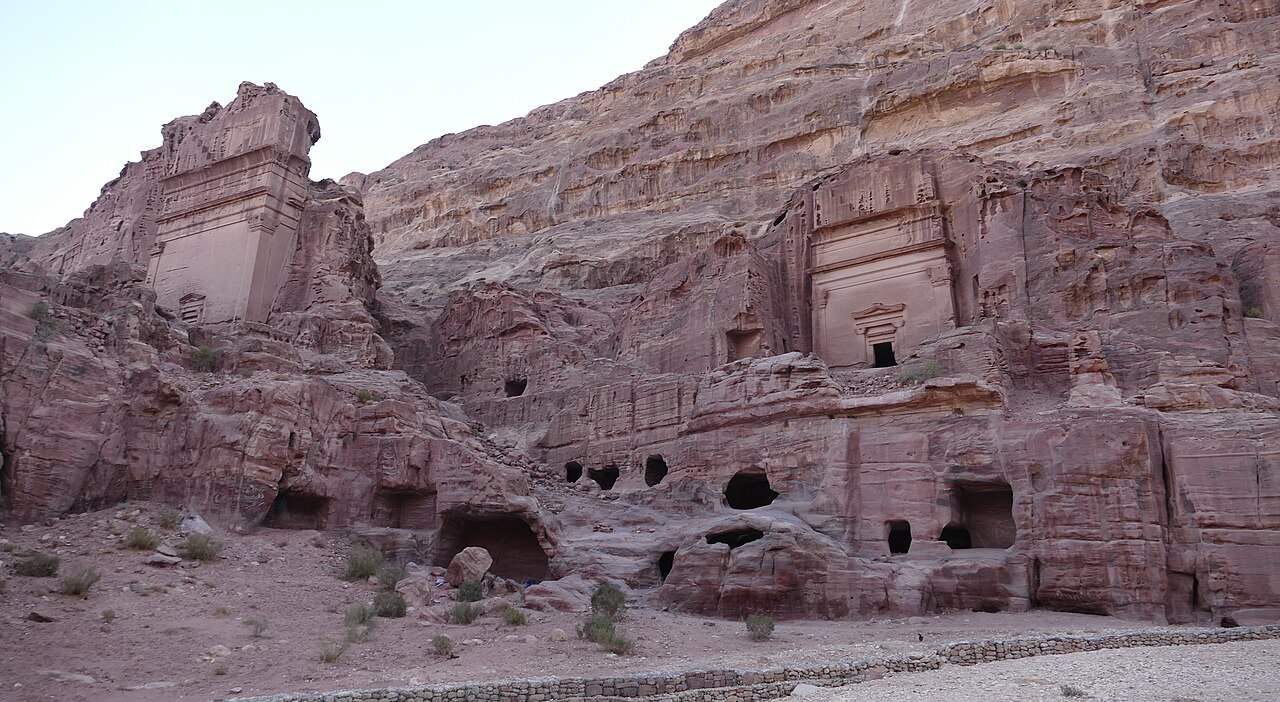
The Tomb of Unayshu — also written Uneishu or Anesho — is one of the grandest rock-cut tombs on the eastern wall of Petra, the Nabataean capital in southern Jordan. Carved into the cliff of Jabal al-Khubtha at the end of the Street of Facades, it was cut in the second half of the first century AD for a senior figure of the royal court: Unayshu, remembered in a single surviving inscription as the “brother” of Queen Shuqailat — almost certainly her chief minister. Catalogued by early explorers as Tomb BD 813, it pairs a towering 20-metre facade with an almost-square burial hall, a rock-cut banqueting room and a private forecourt.
A Royal Tomb at the End of Petra’s Street of Facades
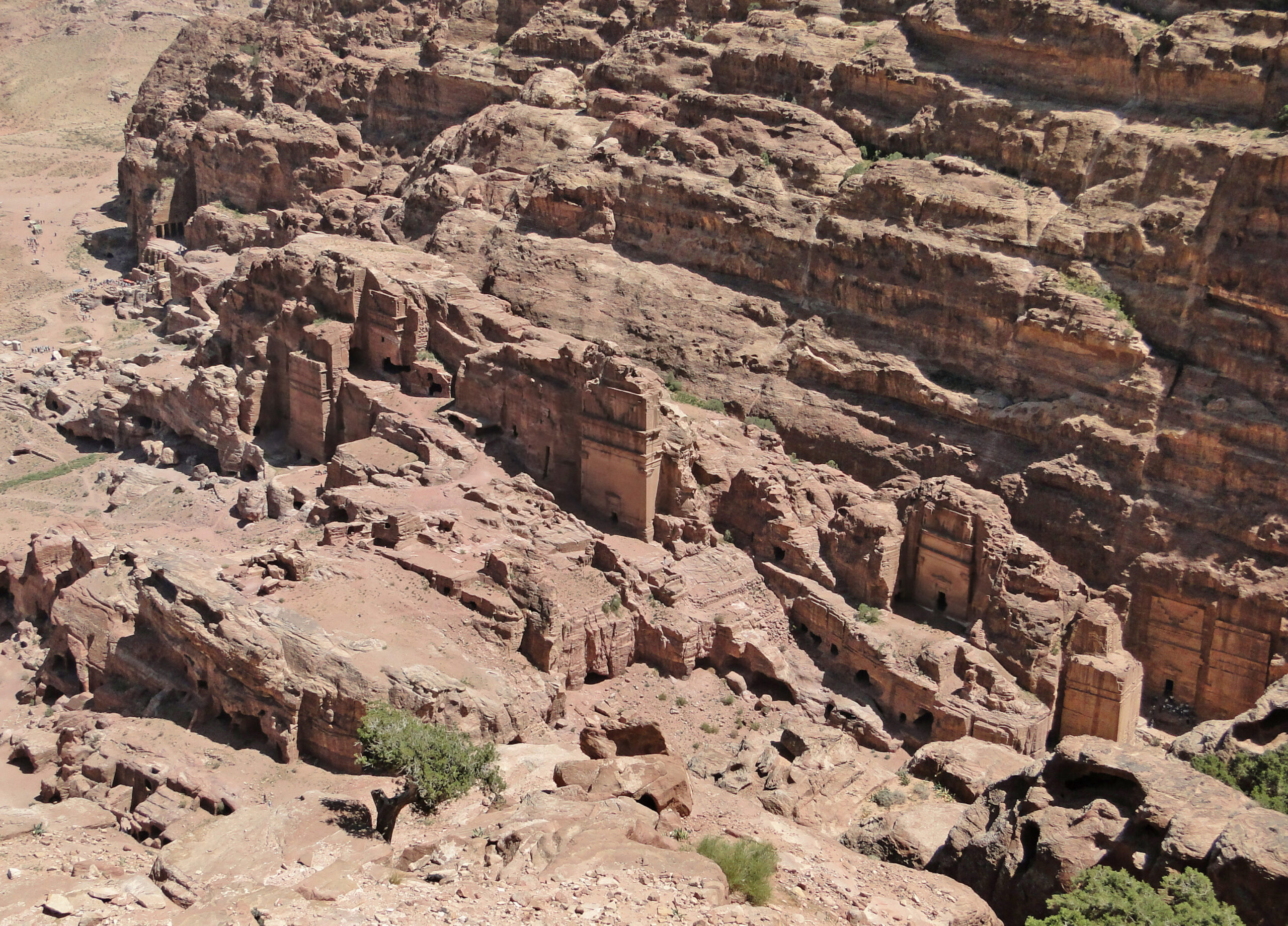
The tomb stands in the upper row of monuments on the western slope of Jabal al-Khubtha, the mountain massif that rises along the eastern edge of Petra’s city centre. It marks the far end of the Street of Facades, the corridor of tombs that opens out beyond the Treasury and the theatre. The Petra Development and Tourism Region Authority places it “on the right side and above several caves in the Jabal al-Khubtha rock massif.”
Reaching the forecourt was never casual. A broad stairway — partly hewn from the living rock, partly built up with dressed stones — climbed to the tomb from street level, beginning near the neighbouring Tomb 824. The forecourt itself was framed by two porticoes: one on the right cut directly into the cliff with four columns, and one on the left built up with three. The effect was a sheltered, semi-private court where mourners could gather before a facade designed to impress.
Who Was Unayshu?
Unayshu belonged to the inner circle of the Nabataean Kingdom in its last independent generation. He was most likely the minister of Queen Shaqilath II (Shuqailat), who governed Nabataea from AD 70/71 to 76 as regent for her young son, Rabbel II. The grave inscription calls Unayshu her “brother” — but in the protocol of the Petra court that word was an honorific for a trusted high official, not necessarily a blood relative. The Petra authority records him simply as the “Prime Minister of the Queen.”
That title carried real weight. In the 70s AD the kingdom still controlled the incense and spice routes that ran from southern Arabia toward the Mediterranean, and Petra remained a wealthy caravan city only loosely shadowed by Rome. A queen ruling as regent needed an administrator she could trust to keep that machinery running, and the scale of Unayshu’s tomb suggests he was rewarded accordingly. His monument is one of the very few at Petra that can be attached to a named person rather than an anonymous patron.
The Inscription That Gave the Tomb Its Name
The whole identification rests on a single inscribed slab measuring about 0.78 by 0.48 metres, carved with the words “Uneishu, brother of Shuqailat, son of …” The stone has a tangled history. It was first noticed by the traveller Gray Hill in the neighbouring Tomb 808 at the end of the nineteenth century, recorded by later archaeologists, and then lost.
The archaeologist Fawzi Zayadine argued that the slab must really have come from Tomb 813, because Tomb 808 had no graves sealed with slabs of that kind. He proved the point during a 1973 excavation of Tomb 813, working alongside the German scholar Manfred Lindner, when he recovered a plaster fragment whose surviving letters could be restored to read “Shuqailat” as well. On the strength of the inscriptions, Zayadine dated the tomb to the second half of the first century AD — and the name “Tomb of Unayshu” stuck.
A Hegra-Type Facade Carved From the Cliff
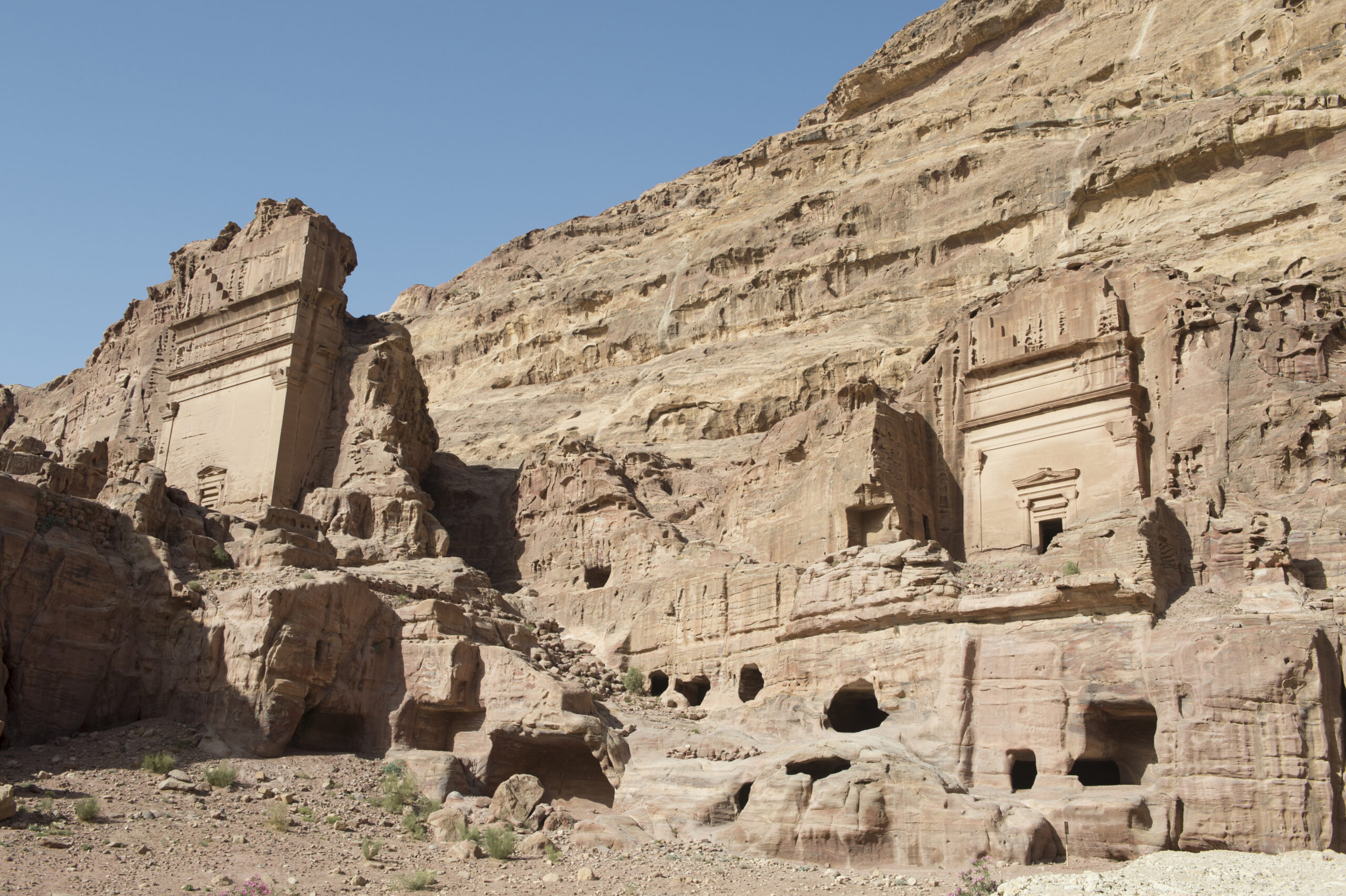
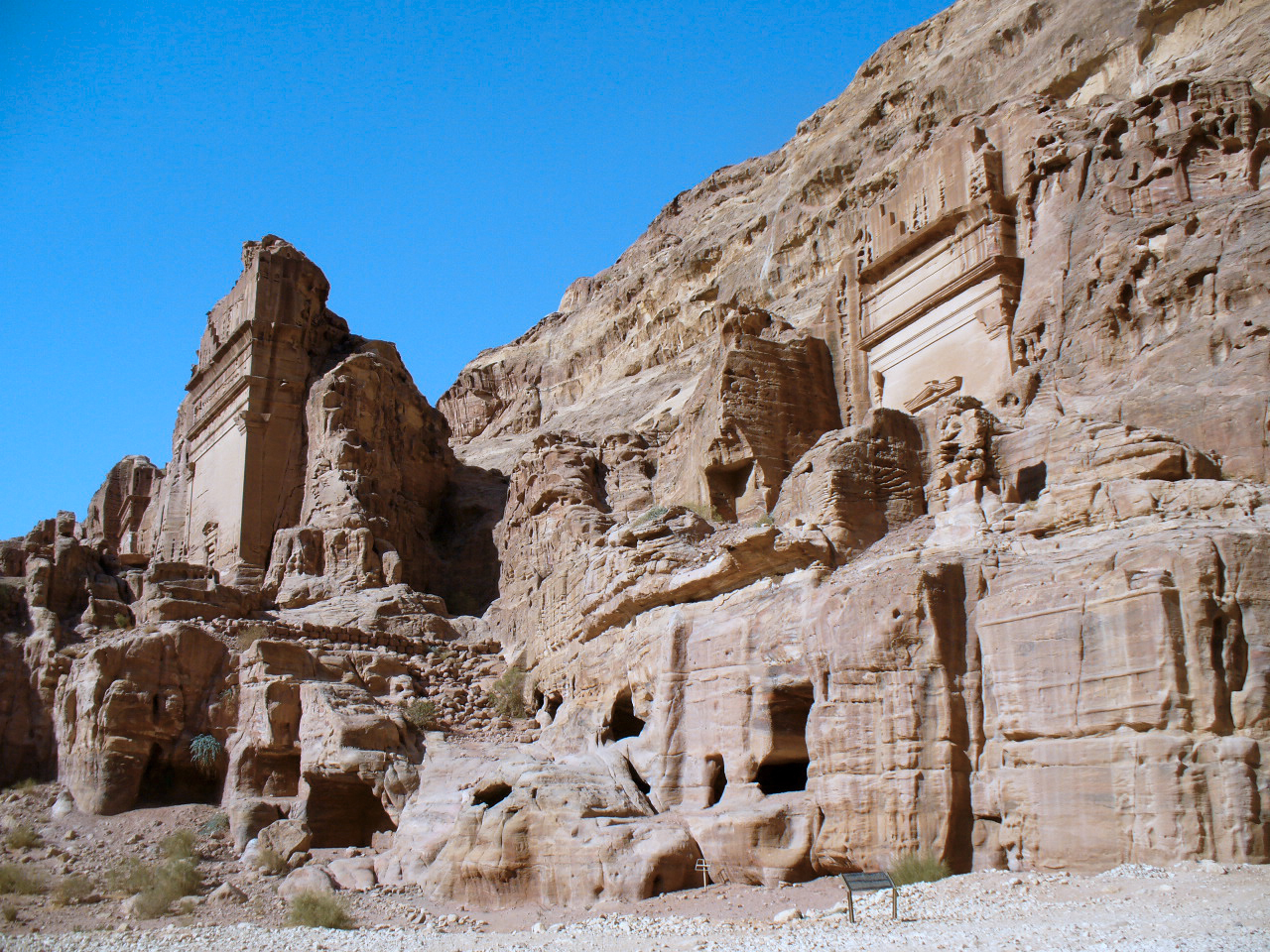
The facade rises about 20 metres high and 12 metres wide, and belongs to what scholars call the “Hegra type” — the most fully developed of the Nabataean tomb fronts. A classical principal order of entablature and plain attic is crowned by two large half-merlons, the stepped “crow-step” battlements that are a Nabataean signature, and the whole composition is carried on two pilasters topped with distinctive Nabataean capitals. The doorway, reached by three steps, is framed by narrow pillars and a second order of pilasters with engaged quarter-columns and a triangular pediment; three acroterion bases still survive along its top.
The Hegra Connection to Mada’in Salih
The label “Hegra” comes from Mada’in Salih, ancient Hegra, the kingdom’s second city in north-west Arabia, where dozens of dated tombs carry the same crow-stepped crown. The style ties Unayshu’s tomb into a shared Nabataean architectural language that stretched hundreds of kilometres across the desert — the same vocabulary that produced Petra’s celebrated Al-Khazneh and the carved tombs of nearby Dadan. Where the Treasury borrows Hellenistic theatricality, the Tomb of Unayshu keeps to the sober, monumental crow-step idiom of an elite family vault.
Inside the Burial Chamber
Behind the facade lies an almost-square funeral chamber, roughly 7.90 by 7.60 metres. Its walls are honeycombed with loculi — the deep, body-length niches in which the Nabataeans laid their dead: three in the back wall and four in each of the two side walls, with a further loculus cut surprisingly high on the exterior right side. The arrangement made the tomb a family vault rather than a single grave, with room for many burials over time.
The Triclinium and Banquets for the Dead
To the left of the forecourt the rock opens into a triclinium roughly 10 by 9 metres, a dining hall with a water basin beside its entrance and three more loculi carved into its rear wall. Triclinia like this were central to Nabataean funerary religion: relatives reclined here for ritual banquets in honour of the deceased, and more than a hundred such rooms have been recorded across Petra. In the sloping south-west corner of the court stand the remains of a pyramidal stele, perhaps a nefesh — the Semitic “soul-marker,” a freestanding memorial pillar standing in for the person it commemorated.
Why Does the Tomb of Unayshu Matter?
Most of Petra’s 600-odd tombs are silent: we admire the carving but cannot say who lay inside. The Tomb of Unayshu is one of the rare exceptions, and that is exactly why it matters. A named owner, a named queen and a tight date turn it into an anchor for Nabataean chronology, helping archaeologists calibrate the development of tomb facades across the kingdom. It also offers a glimpse of how Petra was actually governed — by a regent queen and a powerful minister — in the decades before Rome annexed Nabataea in AD 106. It is one of the most human stories among the many ancient civilizations we explore.
The tomb was logged as BD 813 in the great survey of Petra published by Rudolf-Ernst Brunnow and Alfred von Domaszewski in 1904, a catalogue compiled on the ground in 1897-1898 that researchers still cite today. That early documentation, combined with Zayadine’s later excavation, is why a monument named for one obscure official has become a small but important fixed point in the study of the whole city.
Visiting the Tomb of Unayshu
The tomb sits within the Petra Archaeological Park, a UNESCO World Heritage Site since 1985 and the centrepiece of any visit to Jordan. It lies along the Al-Khubtha trail, the stepped path that branches off the main route near the Royal Tombs and climbs the eastern massif toward the famous overlook above the Treasury. Travellers walking the Street of Facades pass directly below it. For deeper background on the city and its rediscovery by Johann Ludwig Burckhardt in 1812, see Encyclopaedia Britannica’s entry on Petra.
At a glance
Country: Jordan (Petra Archaeological Park, Ma’an Governorate)
Civilization: Nabataean Kingdom
Age: Second half of the 1st century AD (built c. AD 70-76)
Conclusion and Sources
The Tomb of Unayshu distils Nabataean Petra into a single monument: a confident 20-metre Hegra-type facade, a family chamber lined with loculi, a banqueting triclinium for the rites of the dead, and a real human story of a minister who served a queen. Researched from the following reputable sources:

Neural Pathways is a collective of seasoned experts and researchers with a profound passion for unraveling the enigmas of ancient history and artifacts. With a wealth of combined experience spanning decades, Neural Pathways has established itself as a leading voice in the realm of archaeological exploration and interpretation.