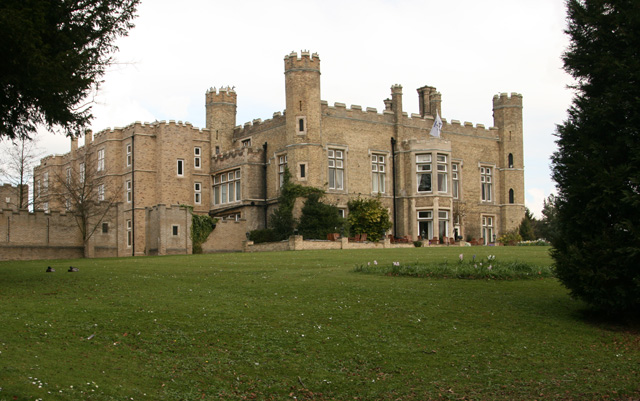
Cave Castle stands on Church Hill in South Cave, a village in the East Riding of Yorkshire about 14 miles west of Hull. Despite its battlements and polygonal turrets, it is not a medieval fortress but a Gothick country house, built in 1804 for the landowner Henry Boldero Barnard on the site of an older manor called East Hall. The Grade II listed building is today a privately owned hotel and country club, its parkland laid out as an 18-hole golf course.

Who built Cave Castle?
The estate behind Cave Castle is far older than the house that now carries the name. The manor of “South Cave alias East Hall” was bought by Sir Thomas Danby in 1582, then passed through several owners — sold to Francis Harrison in 1649, to John Idell in 1720 and to Leuyns Boldero in 1748. In 1769 Boldero assumed the surname Barnard under the will of his great-uncle, Dr Henry Barnard, and it was the Boldero-Barnard line that transformed the property.
Henry Boldero Barnard enlarged and partly rebuilt the manor house of East Hall around 1791, and by 1794 had renamed it Cave Castle — a signal that he meant to restyle the building into something far more romantic. That restyling was carried out between 1802 and 1809 to designs by the architect Henry Hakewill, and the house as it stands is dated 1804. The result was a castellated Gothick mansion built to look centuries older than it was.
The Boldero-Barnard family
The Barnards held Cave Castle well into the twentieth century. The house was extensively remodelled around 1872 for Charles Boldero Barnard, and some of its service ranges were demolished around 1938. In 1937 the house and its surrounding park were sold to the Carmichael family, ending more than 150 years of Barnard ownership and beginning the estate’s slow shift from private seat to public venue.
Is Cave Castle a real medieval castle?
No. For all its turrets and battlements, Cave Castle is a work of the Gothic Revival, not a defensive stronghold. It was raised in 1804 on the footprint of a manor house, and its castle-like silhouette was a matter of fashion rather than fortification. The Georgian and Regency elite prized architecture that evoked chivalry and the medieval past, and a sham castle in a landscaped park was a statement of taste and status. The building’s square plan with polygonal angle turrets, executed in local limestone, belongs firmly to that romantic movement.
That distinction is worth drawing clearly, because genuine fortresses look and function very differently. Compare Cave Castle’s decorative battlements with the blunt Norman keep of Peveril Castle in Derbyshire, the ruined coastal ramparts of Okinawa’s Katsuren Castle, or the cliff-edge Sasanian fortress of Qaleh Dokhtar in Iran — all of them built for war rather than for weekend house parties. Cave Castle belongs to a later, gentler tradition of English historical places that borrow the language of the Middle Ages without the sieges.

What does Cave Castle look like?
The house is a compact, roughly square block dressed with the vocabulary of a medieval castle: crenellated parapets, polygonal corner turrets, pointed and hood-moulded windows, and pale limestone walls. Its gatehouse and lodges continue the theme — the west lodge and screen walls are separately listed in their own right — so that the whole approach was staged to read as a fortified entrance. The 1872 remodelling for Charles Boldero Barnard reshaped the interiors and elevations without abandoning that castellated character.
The setting matters as much as the building. Cave Castle sits in a designed landscape of parkland, mature trees and a lake, the kind of picturesque grounds that Georgian and Victorian owners laid out to frame a country house. Henry Boldero Barnard (1783–1815) is recorded as commissioning the noted landscape designer William Emes to lay out the grounds around 1787, immediately after the enclosure of the parish. The Yorkshire Gardens Trust lists the estate as one of the East Riding’s historic designed landscapes, and much of that parkland survives today beneath the golf course.
From private seat to country hotel
After the Carmichael purchase in 1937, Cave Castle gradually left private hands. In the decades since, the house has been adapted into a hotel and country club: the principal rooms serve as function and dining spaces, a spa and gym occupy parts of the estate, and the wider parkland has been turned into an 18-hole golf course. The conversion has kept the building in active use — a common fate for large English country houses that became impossible to run as single-family homes after the Second World War.

The village and the church of All Saints
Cave Castle is bound up with the older story of South Cave itself, whose parish church stands a short distance from the castle grounds. The church is dedicated not to St Mary but to All Saints, and it is a genuinely medieval building — a useful contrast with the castle’s manufactured antiquity. All Saints preserves a mid-13th-century chancel arch and transept arch, a 15th-century west tower that was heightened in the 17th century, and a chancel rebuilt in 1847 by the architect J. L. Pearson. It is listed at the higher Grade II* level, reflecting that authentic medieval fabric.
South Cave lies about 14 miles west of Hull, on the old road toward the Wolds, and the parish historically took in the townships of South Cave, Broomfleet, Faxfleet and Osmandyke. The village’s long continuity — a medieval church, a Georgian sham castle, and a Victorian town hall — is exactly what makes it a rewarding place to read the layers of English building history in a single walk.
Sources and Further Reading
- South Cave — Wikipedia
- Cave Castle, South Cave — British Listed Buildings (Historic England list entry 1281684)
- Cave Castle — Yorkshire Gardens Trust
- South Cave / Cave Castle — Parks & Gardens UK heritage database
- John George Hall, A History of South Cave and of Other Parishes in the East Riding of Yorkshire (1892) — Internet Archive
- Barnard and Boldero of Cave Castle and Aspenden Hall — Landed Families of Britain and Ireland
- All Saints’ Church, South Cave — A Church Near You

Neural Pathways is a collective of seasoned experts and researchers with a profound passion for unraveling the enigmas of ancient history and artifacts. With a wealth of combined experience spanning decades, Neural Pathways has established itself as a leading voice in the realm of archaeological exploration and interpretation.