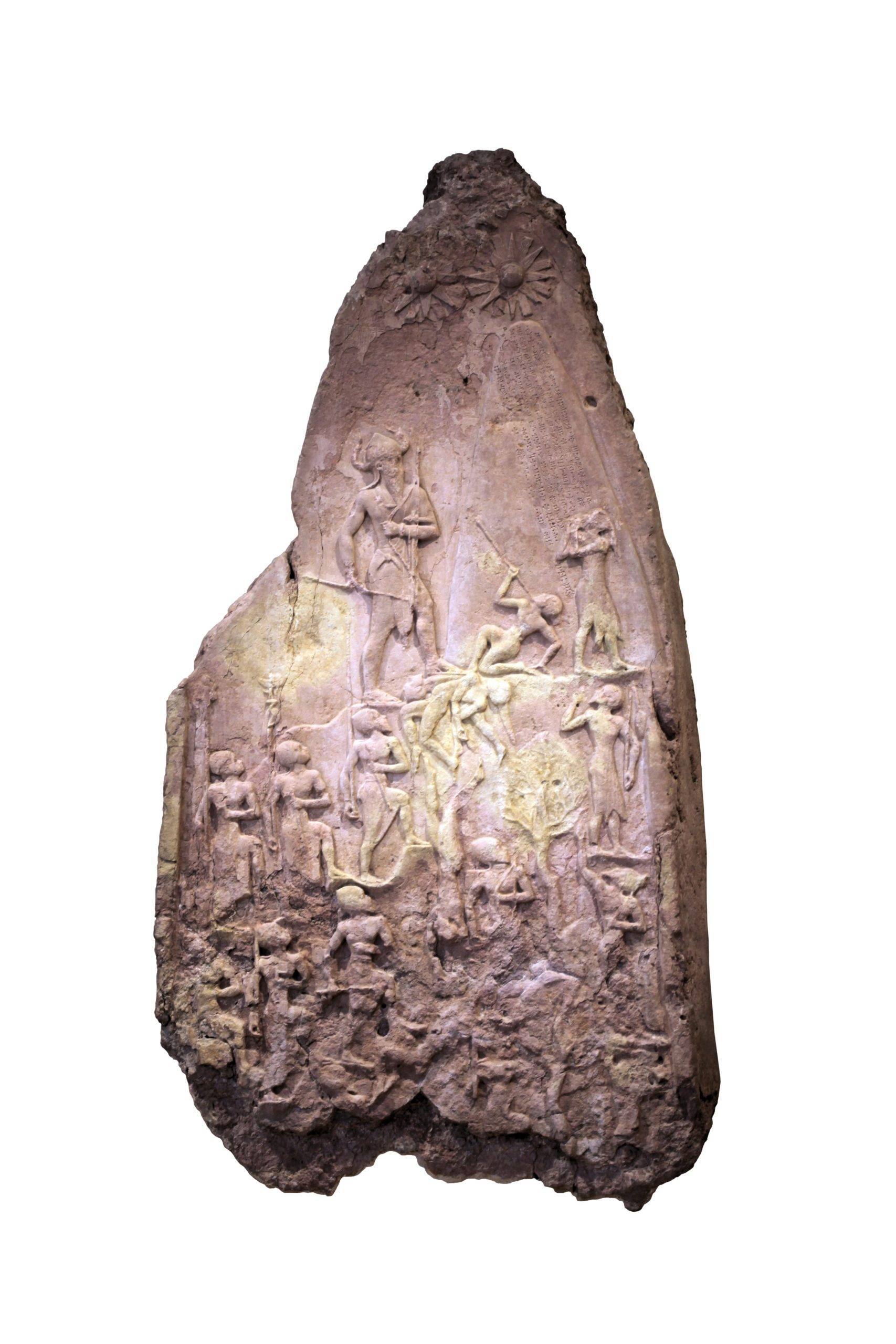
Located in the Louvre Museum in Paris, the Victory Stele of Naram-Sin is a fascinating artifact that dates back to the Akkadian period of Mesopotamia. This magnificent limestone monument, standing over 6 feet tall, is a testament to the grandeur of ancient civilizations and their artistic prowess. It is a captivating piece of history that offers a glimpse into the life and reign of Naram-Sin, a powerful Akkadian ruler.

Historical Background
The Victory Stele of Naram-Sin was created around 2250 BC during the reign of Naram-Sin, the grandson of Sargon of Akkad. Naram-Sin ruled the Akkadian Empire for 56 years, a period known for its military conquests and architectural achievements. The stele commemorates Naram-Sin’s victory over the Lullubi, a mountainous tribe from the Zagros Mountains. It is one of the earliest works of art to celebrate a specific military victory and the first to depict a king as a god.

About the Artifact
The Victory Stele of Naram-Sin is a large limestone slab measuring approximately 2 meters in height. It is carved in relief, a technique where the figures and elements are raised above the background surface. The stele is divided into three registers or levels, with Naram-Sin depicted at the top, towering over his enemies and his own soldiers. He is shown wearing a horned helmet, a symbol of divinity, and ascending a mountain under the gaze of solar deities. The lower registers depict the defeated Lullubi and the Akkadian soldiers.
Theories and Interpretations
The Victory Stele of Naram-Sin is a rich source of historical and cultural information. The depiction of Naram-Sin as a god-king is a significant departure from earlier conventions where kings were shown as mortal beings. This suggests a shift in the perception of kingship during Naram-Sin’s reign. The stele also provides insights into the military tactics and weaponry of the Akkadian Empire. The dating of the stele is based on the historical records of Naram-Sin’s reign and the stylistic elements of the artwork.
One intriguing feature of the stele is the presence of a star or celestial body above Naram-Sin. Some scholars interpret this as a symbol of divine approval or protection. Others suggest it might represent a specific astronomical event, possibly a supernova, that occurred during Naram-Sin’s reign. However, these interpretations remain speculative.

Good to Know/Additional Information
The Victory Stele of Naram-Sin was discovered in 1898 in the modern-day town of Sarpol-e Zahab in Iran. It was found in the ruins of a fortress built by the Elamite king Shutruk-Nahhunte in the 12th century BC. According to an inscription on the stele, Shutruk-Nahhunte claimed to have taken the stele as a war trophy during his conquest of Mesopotamia. This suggests that the stele was moved from its original location and re-used in different historical contexts, adding another layer to its fascinating history.

For further reading and to validate the information presented in this article, the following sources are recommended:

Neural Pathways is a collective of seasoned experts and researchers with a profound passion for unraveling the enigmas of ancient history and artifacts. With a wealth of combined experience spanning decades, Neural Pathways has established itself as a leading voice in the realm of archaeological exploration and interpretation.