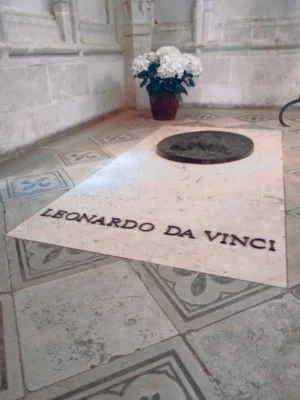
The tomb of Leonardo da Vinci stands inside the Chapel of Saint-Hubert, a small 15th-century Gothic chapel inside the grounds of the Royal Château of Amboise in the Loire Valley, France. Leonardo died on 2 May 1519 at the nearby manor of Clos Lucé (then called Le Cloux), the residence given to him by his last patron, King Francis I of France. His original burial was in the now-vanished collegiate church of Saint-Florentin, also inside the château precinct. After Saint-Florentin was demolished following the French Revolution, a controversial 1863 excavation by Arsène Houssaye recovered remains that were reinterred in the surviving Saint-Hubert chapel, where they have lain ever since. Whether they really are Leonardo’s bones is still debated.
Another contested Renaissance burial is the Tomb of Giuliano de’ Medici in Florence, carved by Michelangelo for the New Sacristy of San Lorenzo.

Where and What It Is
Amboise sits on the north bank of the River Loire, about 25 kilometres east of Tours. The Royal Château commanded the town from a low cliff above the river and was a favourite royal residence in the late 15th and 16th centuries. The Chapel of Saint-Hubert stands on the south-eastern edge of the château precinct, originally built between roughly 1491 and 1496 by King Charles VIII as a private oratory for his queen, Anne of Brittany. It is a small but architecturally rich late-Flamboyant Gothic building, with intricate stone tracery, a famous lintel showing the conversion of Saint Hubert, and a stone-vaulted interior. The tomb of Leonardo is set into the north wall of the chapel’s nave, marked by a sober slab bearing his name and dates.
Why Leonardo Was Buried in Amboise
The story begins in 1516, when the 64-year-old Leonardo accepted an invitation from Francis I of France (who had succeeded to the throne in 1515) and left Italy for the Loire. The king gave him the title “Premier Painter, Engineer and Architect of the King”, an annual stipend of 1,000 écus, and the use of the manor of Le Cloux — known today as Clos Lucé — a short walk from the royal château along an alleged underground passage. Leonardo spent his last three years here, working on the late Saint John the Baptist, the Adoration of the Magi reworking, the Mona Lisa (which he carried with him from Italy and never sold), engineering studies and the unrealised royal palace project at Romorantin. He died at Clos Lucé on 2 May 1519, and his pupil Francesco Melzi recorded the king’s grief in a letter to Leonardo’s brothers in Florence.
The First Burial at Saint-Florentin
Leonardo’s will, dated 23 April 1519, had requested burial in the collegiate church of Saint-Florentin inside the château precinct of Amboise — a foundation built by Louis XI in the 1470s and elevated to collegiate status during Charles VIII’s reign. The funeral took place on 12 August 1519, in the presence of senior clergy and members of the royal household. A funerary mass was sung, and Leonardo was interred under a stone in the cloister of Saint-Florentin together with his personal copy of an illuminated psalter. Saint-Florentin remained a working church for the next two and a half centuries.

The Revolution and the Destruction of Saint-Florentin
Saint-Florentin did not survive the upheaval that followed the French Revolution. The collegiate church was secularised in the 1790s, looted and then demolished in stages — the final stones came down between 1807 and 1808 under Napoleon’s government, when much of the older fabric of the château precinct was levelled. The cloister and its tombs were among the casualties. The bones inside the cloister were either thrown into a common pit, scattered, or — according to some accounts — partly buried in situ but with markers gone. For more than fifty years afterwards, the precise location of Leonardo’s grave was unknown.
The 1863 Houssaye Excavation
In 1863, the French author and amateur archaeologist Arsène Houssaye — director of the Comédie-Française, friend of Napoleon III and a fervent admirer of Leonardo — obtained royal permission to excavate the site of the demolished Saint-Florentin. His team uncovered a large male skeleton, a number of skull fragments, broken tomb-stone pieces carved with the surviving letters “-EO … AR … DUS … VINC-“, and several French medals from the reign of Francis I. On the basis of the inscription, the dates of the medals, and the unusual size of the cranium (consistent with Leonardo being widely described as tall and well-built), Houssaye concluded that he had found the great man. The remains were placed in a wooden coffin and, after extensive ceremony, reinterred in the chapel of Saint-Hubert at the southern edge of the château precinct — one of the few buildings of the old precinct still standing.

Are These Really Leonardo’s Bones?
The Houssaye identification has always been disputed. The case for it is the cluster of partial letters reconstructable to “Leonardus Vinci”, the chronological fit of the Francis I-era medals, the cranial size, and the lack of any rival candidate in the cloister assemblage. The case against it is that Houssaye was searching for Leonardo specifically — a known cognitive risk in 19th-century archaeology — and the cloister contained the burials of several other named individuals who could conceivably have generated the same evidence. The remains have never been subjected to DNA analysis, although a 2019 study by the Italian palaeogeneticist David Caramelli proposed extracting DNA from the bones in Saint-Hubert and comparing them against samples from Leonardo’s documented relatives in Vinci, Italy. To date the French heritage authorities have not granted permission for the comparison. The identification therefore remains strongly suggested but technically unproven.
Visiting the Tomb Today
The Chapel of Saint-Hubert is open to visitors as part of the standard ticket to the Château Royal d’Amboise, which has been operated as a public visitor site by the Saint-Louis Foundation since 1974. Photography of the tomb is permitted but flash is not. The chapel is small and the tomb itself is modest: a single carved stone slab set into the north wall, with a low-relief portrait medallion of Leonardo and the inscription giving his name, his dates (1452–1519) and his last titles in the French court. The wider archaeological landscape of the Loire Valley — a UNESCO World Heritage Site since 2000 — connects Amboise to Chambord, Chenonceau, Blois and Clos Lucé itself, which now functions as a Leonardo museum.
Sources and Further Reading
- Wikipedia — Leonardo da Vinci (death and burial)
- Wikipedia — Château d’Amboise (including Saint-Florentin and Saint-Hubert)
- Atlas Obscura — Leonardo da Vinci’s Tomb in Amboise
- Amboise Val de Loire Tourist Office — Leonardo da Vinci at the Royal Château of Amboise

Neural Pathways is a collective of seasoned experts and researchers with a profound passion for unraveling the enigmas of ancient history and artifacts. With a wealth of combined experience spanning decades, Neural Pathways has established itself as a leading voice in the realm of archaeological exploration and interpretation.