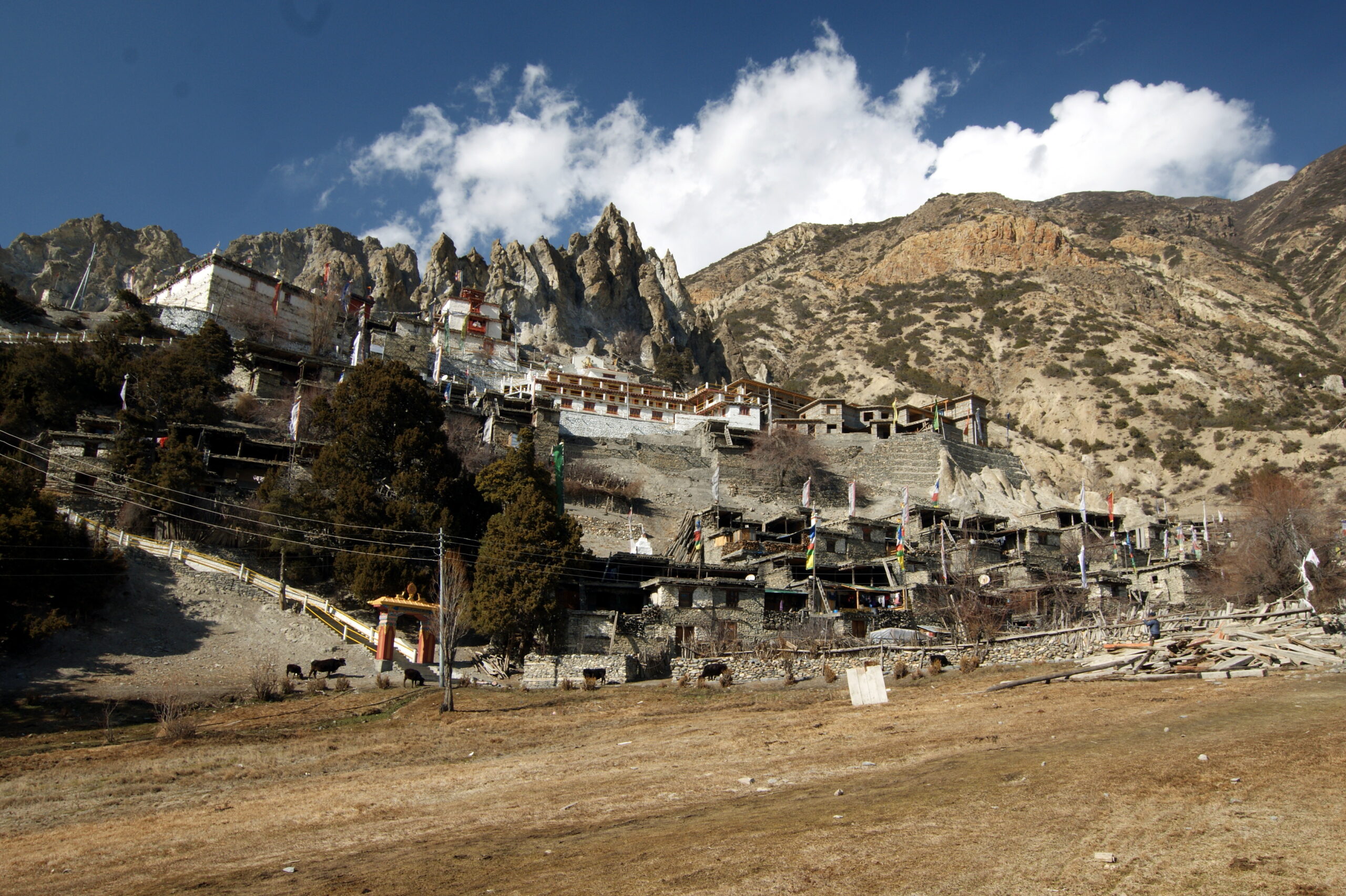
Milarepa Cave is a Tibetan Buddhist meditation site on the Annapurna Circuit, just outside Manang in Nepal’s Gandaki Province, at roughly 4,100 metres (13,450 feet). It is revered as a retreat of the 11th century yogi and poet Jetsun Milarepa (c. 1052–1135), who by local tradition meditated in these mountains and turned a hunter away from killing. Today the cave sits on a scree slope above the village of Braga, reached by a short but steep climb that trekkers fold into their acclimatisation days before crossing the Thorong La pass.
Where Is Milarepa Cave in Manang?
The cave lies in Manang District, in the upper Marsyangdi valley of Gandaki Province, northern Nepal. Its recorded coordinates place it at about 28.64°N, 84.04°E, roughly 4,100 metres above sea level and within direct sight of Annapurna III and Gangapurna. The site is more than a single hollow in the rock: it includes a small gompa (a Buddhist temple hall) and a holy spring, with the cave itself set beyond the gompa on a steep bank of glacial moraine. Pilgrims often pray from the edge of the moraine, in a direct line of sight to the cave, because the final approach up the scree is loose and exposed.

Reaching the cave from Braga
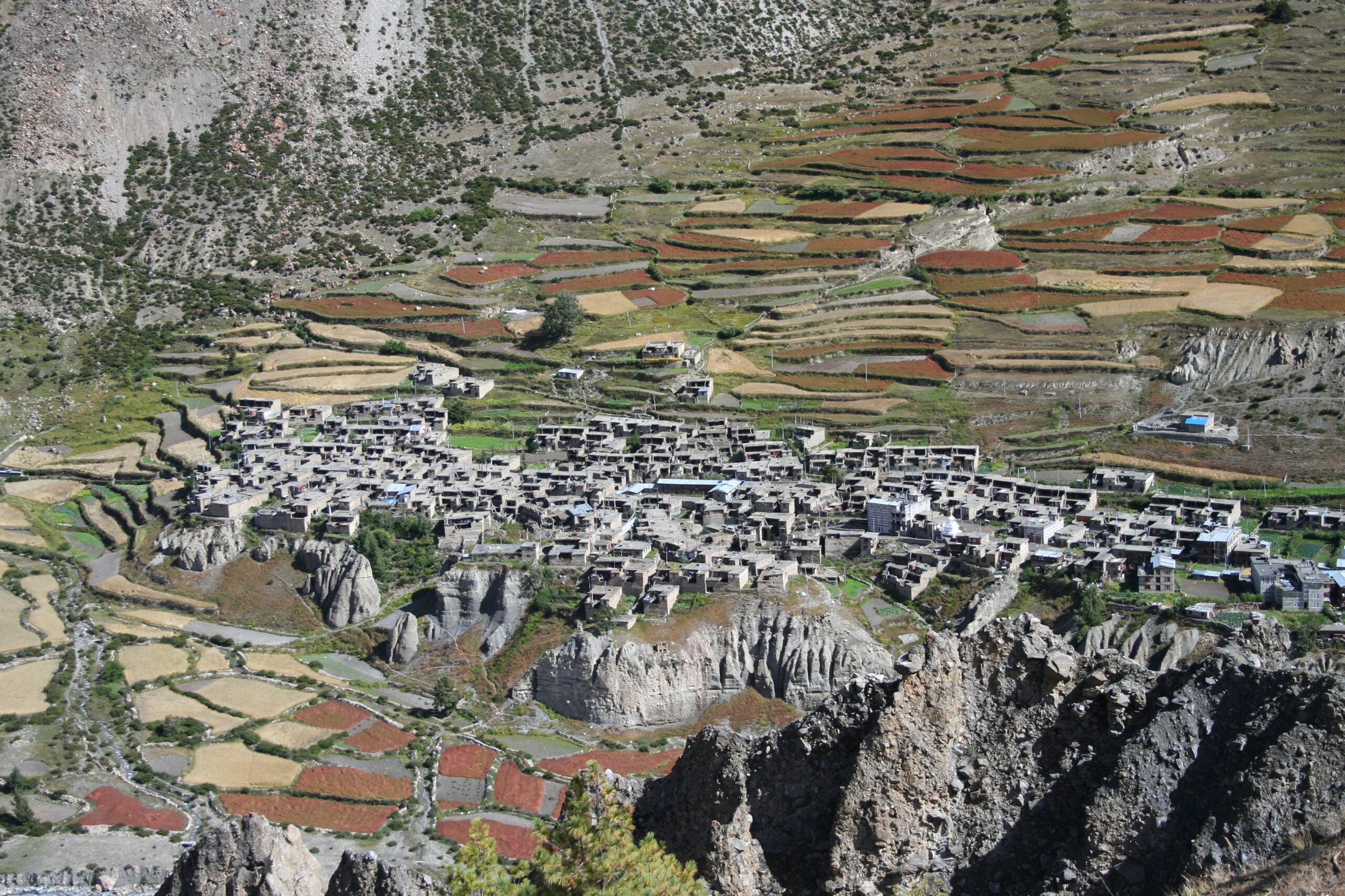
Most visitors climb to the cave from Braga (also spelled Braka), a compact stone village strung along the trail an hour or so before Manang town. A gentle path winds up past terraced barley fields, roadside shrines and lines of fluttering prayer flags before the ground steepens toward the moraine. The walk is not technically difficult, but at this altitude every rise is felt, which is why the cave has become a favourite half-day excursion on the acclimatisation days that trekkers spend around Manang. The reward is both spiritual and scenic: a working shrine in one of the highest inhabited valleys in the Himalaya.
Who Was the Yogi Milarepa?
Jetsun Milarepa (c. 1052–1135) is one of the most celebrated figures in Tibetan Buddhism, remembered as a yogi, ascetic and poet whose life became a template for spiritual transformation. Tradition holds that he began adulthood steeped in black magic and revenge, then repented, apprenticed himself to the translator Marpa, and endured years of hardship before attaining realisation through solitary meditation. He is a foundational figure of the Kagyu lineage, and his spontaneous teachings survive as verse — the collection known in English as the Hundred Thousand Songs of Milarepa. Nepali and Tibetan tradition places part of his wandering retreat in Nye Shang, the old name for the Manang valley, where he is said to have meditated in the mountains for years.

How Did Milarepa Humble a Hunter Here?
The story that anchors this cave is Milarepa’s Song to the Hunter. According to local folklore, a hunter named Kera Gompa Dorjee was chasing a deer with his dog when the terrified animal fled to where Milarepa sat in meditation. The yogi calmed the deer, then the pursuing dog, and finally the hunter, who in fury loosed arrows at him. The arrows, it is said, could do the yogi no harm. Rather than answer violence with anger, Milarepa taught all three — deer, dog and hunter — the workings of cause and effect and the value of compassion, in the form of three linked songs: the song of the deer, the song of the dog, and the song of the hunter. A bow still hangs from the cliff near the cave, said by locals to be the hunter’s, left behind when he abandoned killing. The episode is preserved among the verses translated by Garma C. C. Chang in Sixty Songs of Milarepa.
What Do Pilgrims Find at the Cave Today?
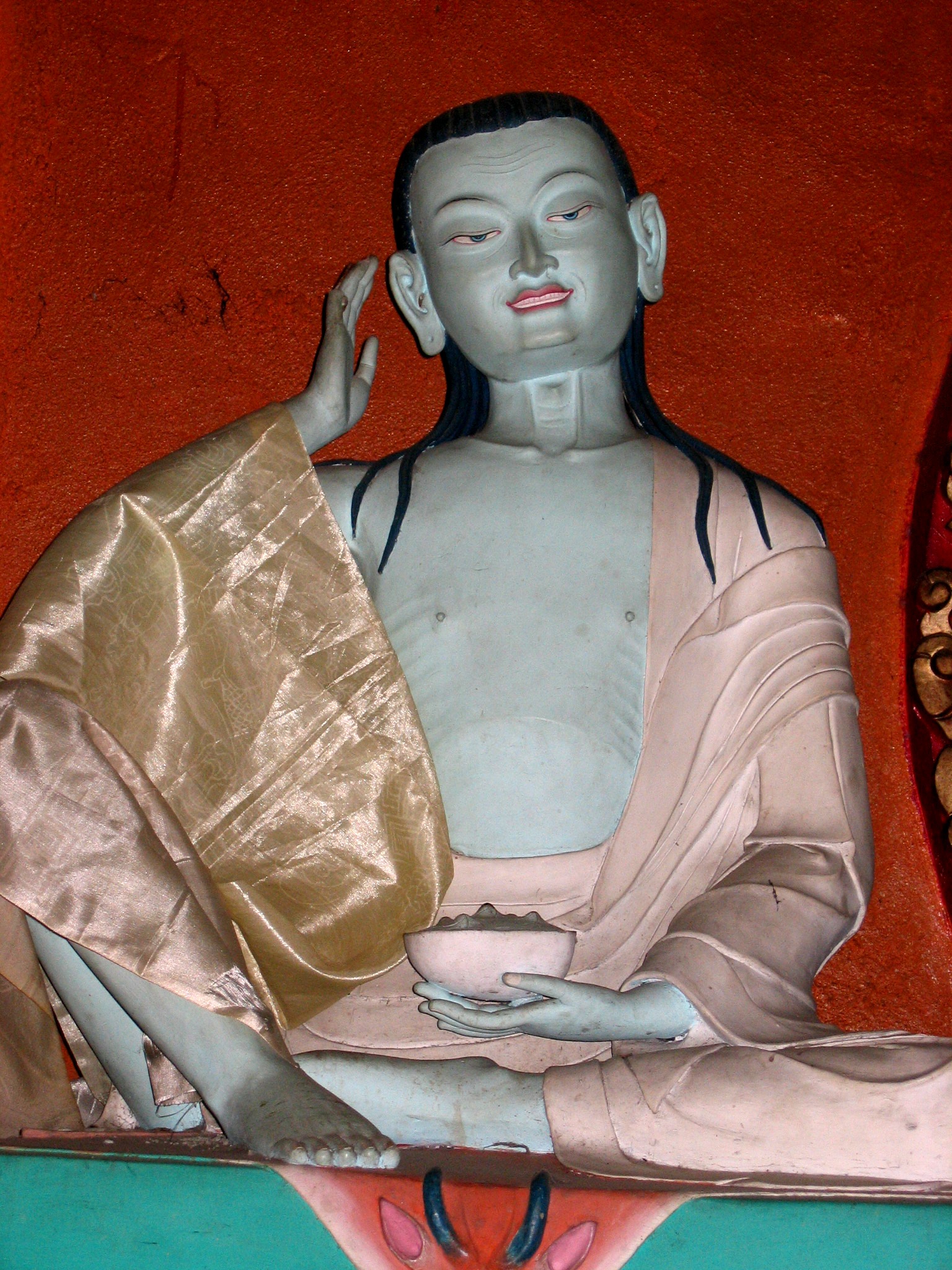
The interior is austere rather than ornate. Reliable accounts describe a simple statue of Milarepa seated in meditation, set among butter lamps, offerings, prayer beads and white khata scarves, with the stone walls darkened by generations of incense and lamp smoke. The atmosphere, not the architecture, is the draw: a small, smoke-blackened space that has absorbed centuries of devotion. Below sits the gompa where visitors light lamps and leave offerings, and the holy spring that forms part of the same sacred complex. The famous bow on the cliff turns the whole hillside into an illustration of the legend, so that the landscape itself reads as scripture for those who know the story.
Milarepa Cave, Nyalam and Namkading: Clearing Up the Confusion
Several Himalayan caves claim Milarepa, and they are easily muddled. The Manang cave described here is distinct from Milarepa’s Cave at Nyalam — the site usually called Namkading — which lies about 11 kilometres north of the town of Nyalam in Tibet, on the far side of the border. Confusing the two is a common error in travel write-ups, and the “Namkading” name belongs to the Tibetan cave, not the Nepali one. A separate cluster of Milarepa retreat caves also survives at Lapchi, further east along the Nepal–Tibet frontier. It is worth adding a note on geography, too: Nepal reorganised its administrative map in 2015 and abolished the old zonal system, so references to a “Dhaulagiri Zone” are out of date — Manang District now sits within Gandaki Province. Like the man-made sky caves of Mustang to the west, the Manang cave shows how thoroughly the high Nepali valleys were shaped by Tibetan Buddhist practice.
A Living Himalayan Pilgrimage
Milarepa Cave is not a ruin but a working shrine, and it draws two overlapping streams of visitors: Buddhist pilgrims who come to pay homage and meditate, and trekkers who detour to it during their days in Manang. That dual role has put it on the radar of local government — the Gandaki Provincial Government commissioned a master plan for tourism development at the cave in 2019, aimed at improving access while protecting the fragile high-altitude setting inside the Annapurna Conservation Area. The same devotional world sustains far larger monuments across the region, from the great Boudhanath Stupa in Kathmandu to the birthplace shrines at the Maya Devi Temple at Lumbini. For more high-altitude sites and sacred landscapes, browse our historical places archive.
Frequently Asked Questions
Where is Milarepa Cave in Gandaki?
Milarepa Cave is in Manang District, in the upper Marsyangdi valley of Gandaki Province, northern Nepal. It sits on the Annapurna Circuit at roughly 4,100 metres (13,450 feet), just outside Manang town and above the village of Braga, within sight of Annapurna III. The cave lies beyond a small gompa and a holy spring, on a steep bank of glacial moraine, and is usually visited as a short side trip on acclimatisation days before trekkers cross the high Thorong La pass.
Why is Milarepa Cave sacred to Tibetan Buddhists?
The cave is venerated as a retreat of Jetsun Milarepa (c. 1052–1135), one of Tibet’s most revered yogis and poets and a founding figure of the Kagyu lineage. Local tradition holds that he meditated in the Manang mountains and, at this spot, converted the hunter Kera Gompa Dorjee to non-violence through his Song to the Hunter. Pilgrims come to meditate, light butter lamps and make offerings before a simple statue of Milarepa, connecting physically with a place tied to his life and teachings.
Is the Manang cave the same as Milarepa’s Cave at Nyalam?
No. They are two different sites often confused in guidebooks. The Manang cave stands on the Annapurna Circuit in Nepal’s Gandaki Province. Milarepa’s Cave at Nyalam — also called Namkading — lies about 11 kilometres north of Nyalam in Tibet, across the border. A further group of Milarepa caves survives at Lapchi. All are linked to the same eleventh-century yogi, but the “Namkading” name properly belongs to the Tibetan cave, not the one above Manang.
Sources and Further Reading
- Wikipedia — Milarepa Cave, Gandaki
- Buddhistdoor Global — Echoes of Milarepa in the Mountains of Manang
- Wikipedia — Milarepa
- World History Encyclopedia — Tibet
- World History Encyclopedia — Buddhism
- Wikipedia — Annapurna Circuit