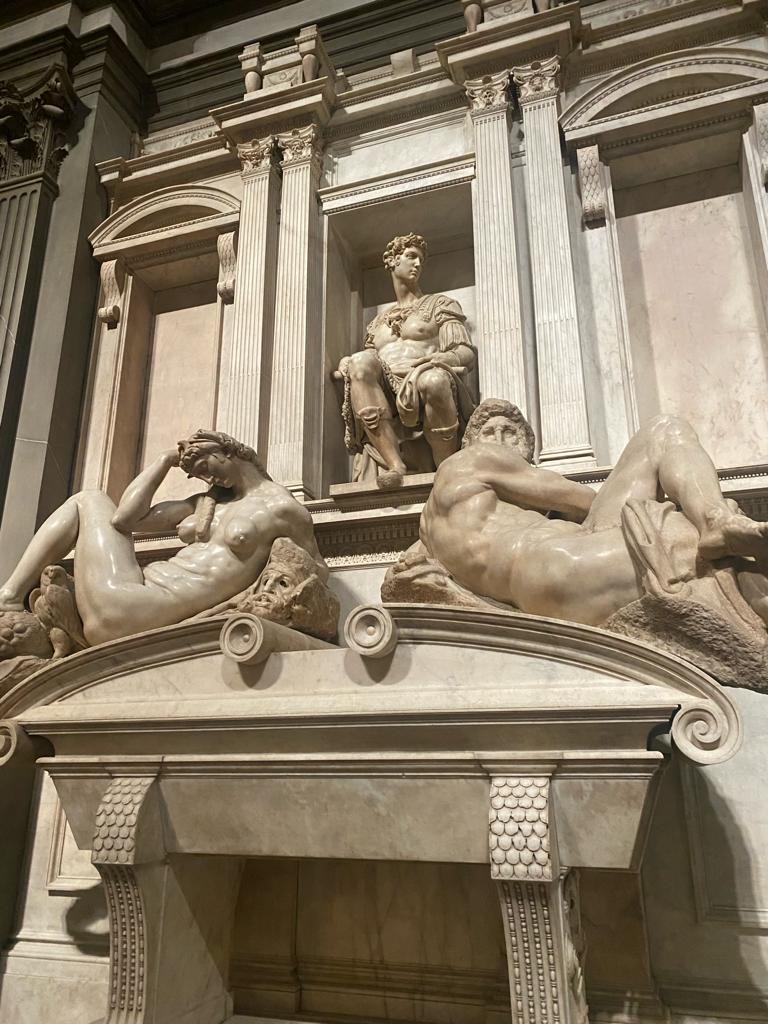
The tomb of Giuliano de’ Medici is a marble funerary monument carved by Michelangelo Buonarroti for the New Sacristy of the Basilica of San Lorenzo in Florence, Italy. Commissioned in 1520 and worked on until 1534, it is one of the most studied sculptural ensembles of the sixteenth century. Below the seated figure of Giuliano, Duke of Nemours, recline the two celebrated allegories of Night and Day — not Dusk and Dawn, which belong to the matching tomb on the opposite wall.
Who Was Giuliano de’ Medici, Duke of Nemours?
Giuliano di Lorenzo de’ Medici was born in Florence on 12 March 1479 and died on 17 March 1516. He was the third and youngest son of Lorenzo the Magnificent, and the younger brother of Giovanni de’ Medici, who in 1513 became Pope Leo X. After the Medici were expelled from Florence in 1494, Giuliano spent years in exile, much of it at the cultured court of Urbino, before the family was restored to power in 1512. He then governed Florence briefly from 1512 to 1513.
In 1515, through the influence of his brother the pope, Giuliano married Filiberta of Savoy and was invested by King Francis I of France with the title Duke of Nemours. He died the following year, still young and without a legitimate heir, and his death — together with that of his nephew Lorenzo, Duke of Urbino, in 1519 — left the senior Medici line dangerously thin. It was this dynastic crisis that set the building of the New Sacristy in motion.
Why Michelangelo Built the Tomb
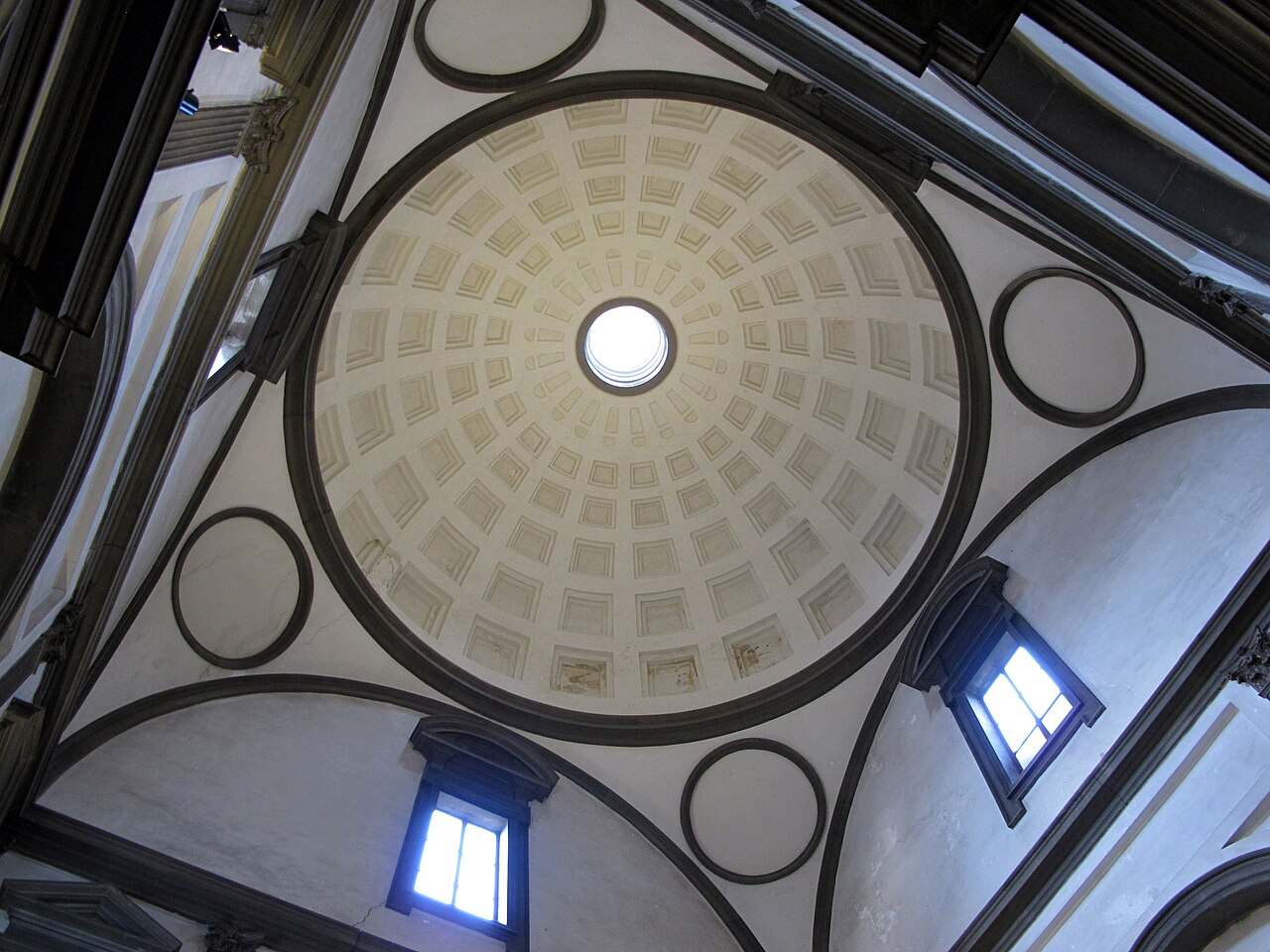
The monument was not an isolated work but part of an entire chapel. In 1520, Cardinal Giulio de’ Medici — the future Pope Clement VII — commissioned Michelangelo to design a new funerary chapel attached to San Lorenzo, the Medici parish church. It was conceived as a deliberate echo of the Old Sacristy that Filippo Brunelleschi had built a century earlier, and it became known as the Sagrestia Nuova, or New Sacristy.
A Commission Born of Dynasty and Crisis
The chapel was meant to honour four men: the two “Magnifici” — Lorenzo the Magnificent (died 1492) and his murdered brother Giuliano (killed in the Pazzi Conspiracy of 1478) — and the two recently deceased dukes, Giuliano of Nemours and Lorenzo of Urbino. Michelangelo began carving in earnest around 1524 and continued, with long interruptions caused by war and the Siege of Florence, until he left the city permanently in 1534. Like the great dome of St Peter’s Basilica that he would later design in Rome, the project shows Michelangelo working as architect and sculptor at once.
What Do Night and Day Actually Mean?
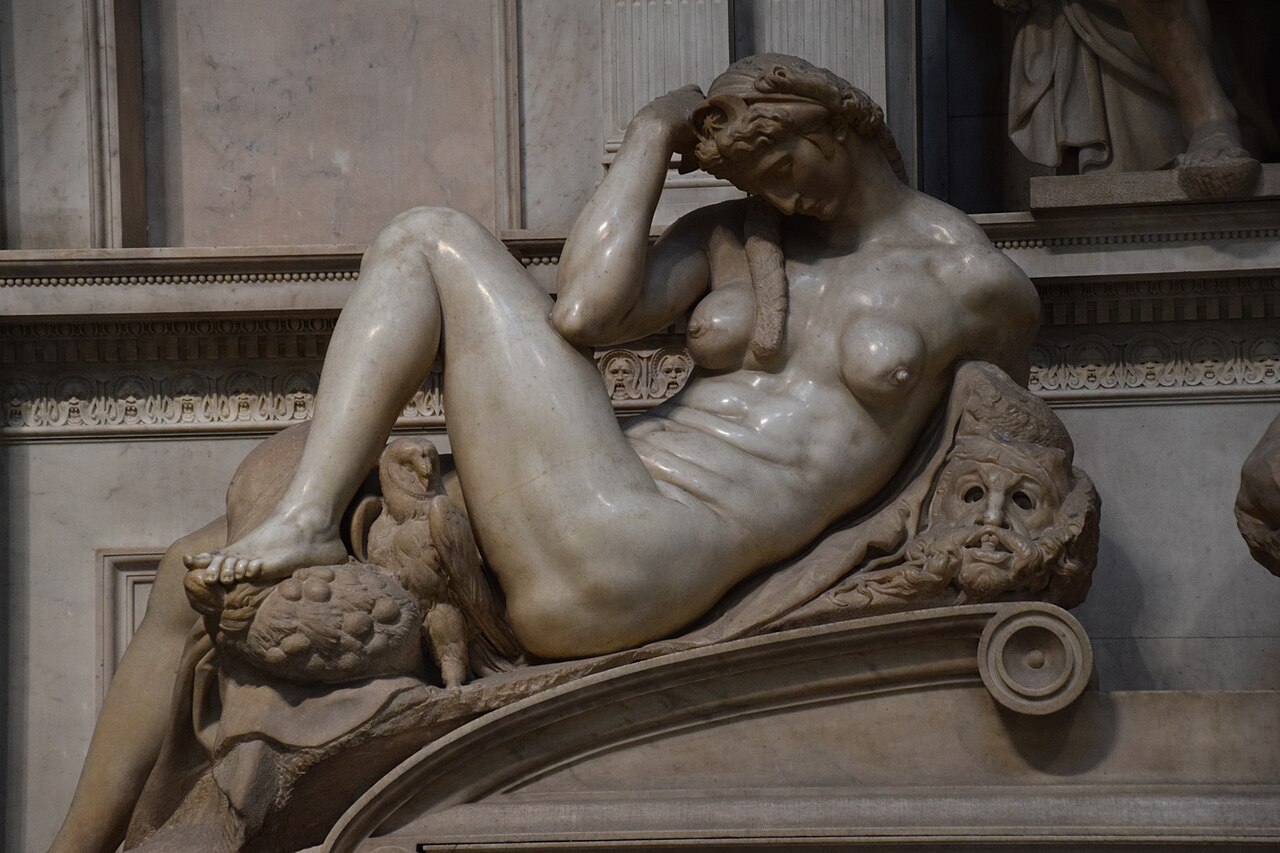
Giuliano’s wall tomb is built in three tiers. At the top, in a shallow niche, sits an idealised statue of the Duke in Roman armour, holding a commander’s baton and turning his head as if alert to action. He represents the vita activa, the active life. Beneath him, on the curved lid of the sarcophagus, recline two colossal nude figures: Night, a sleeping woman, and Day, a powerful man twisting to look back over his shoulder. The figures are not portraits; Michelangelo reportedly said that in a thousand years no one would care what Giuliano had really looked like.
The Symbols Hidden in Night
Night is the most loaded of the four allegories. She wears a diadem set with a crescent moon and a star; beneath her bent leg crouches an owl, the bird of darkness, and a bunch of poppies, the flower of sleep, lies at her feet. A grotesque mask, often read as a symbol of nightmares or of death, rests behind her. Day, by contrast, is left deliberately unfinished, his face barely emerging from the rough marble — an effect that only heightens his brooding power.
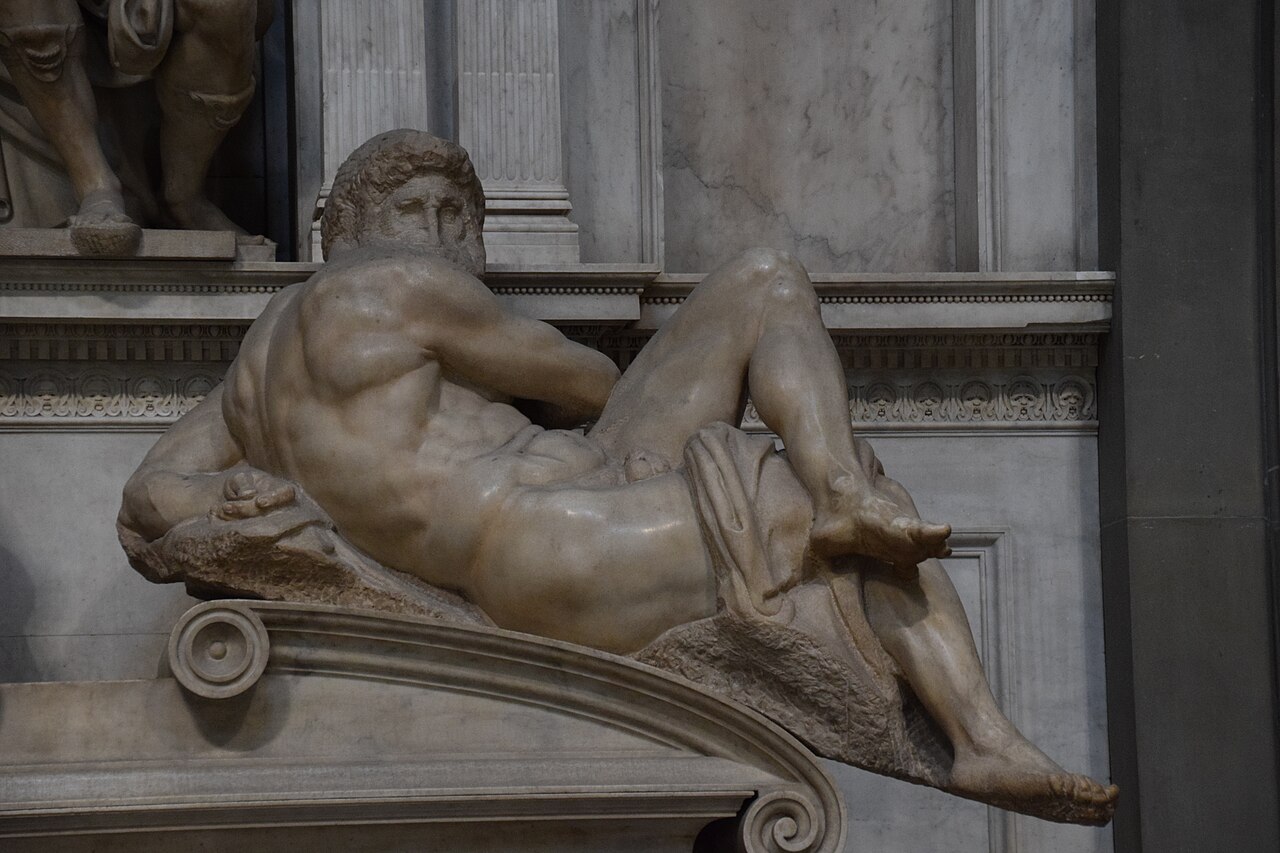
The four times of day on the two tombs — Night and Day here, Dusk and Dawn opposite — together evoke the relentless passage of time that carries every life, even a Medici life, toward death. The poet Giovanni Strozzi praised Night in a famous quatrain, claiming that because she was carved by an angel she lived and only slept, and could be woken. Michelangelo answered in the statue’s own voice: sleep, and being made of stone, was a mercy as long as injury and shame endured in the world — so, he wrote, “do not wake me; speak softly.”
The Unfinished Masterpiece
Despite its fame, the tomb was never completed to Michelangelo’s full design. Drawings and later accounts suggest he planned river gods for the base and additional figures that were never carved. When he left Florence for Rome in 1534 he abandoned the loose marble blocks where they lay; his pupils, including Giovanni Angelo Montorsoli and Niccolò Tribolo, finished and installed the statues, and the figures were finally arranged in the chapel in 1545 under the direction of Giorgio Vasari and Bartolomeo Ammannati. The result is a monument frozen partway between conception and completion — one reason scholars find it so revealing of Michelangelo’s working method.
Giuliano’s Tomb and Its Companion Across the Chapel
It is easy to confuse the two ducal tombs, and many older guidebooks do. Directly opposite Giuliano stands the Tomb of Lorenzo de’ Medici, Duke of Urbino, whose pensive, helmeted figure represents the contemplative life and whose allegories are Dusk and Dawn. The two were designed as a deliberate pair, facing each other across the small, austere chapel. On a third wall, the unfinished Medici Madonna watches over the simple sarcophagus of the two Magnifici.
The New Sacristy belongs to the same Florentine Renaissance world that produced the disputed Tomb of Leonardo da Vinci in France, where Giuliano’s brother-in-law network reached through the court of Château de Chambord and Francis I, the king who had granted Giuliano his dukedom. For more monuments from this era, browse our Ancient Civilizations archive.
Sources and Further Reading
- World History Encyclopedia — Michelangelo
- HISTORY — The Medici Family
- World History Encyclopedia — Lorenzo de’ Medici
- Wikipedia — Sagrestia Nuova (New Sacristy)
- Wikipedia — Night (Michelangelo)
- Web Gallery of Art — Michelangelo’s Medici tombs

Neural Pathways is a collective of seasoned experts and researchers with a profound passion for unraveling the enigmas of ancient history and artifacts. With a wealth of combined experience spanning decades, Neural Pathways has established itself as a leading voice in the realm of archaeological exploration and interpretation.