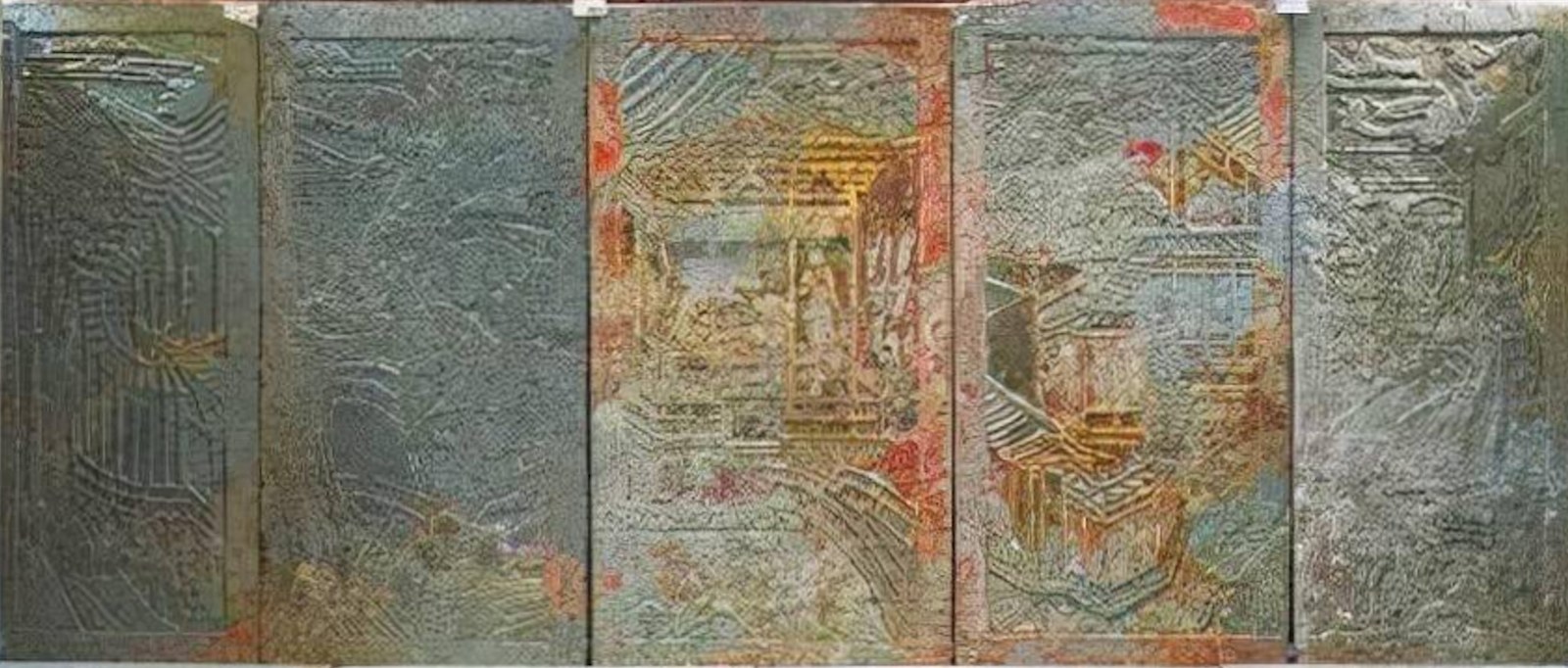
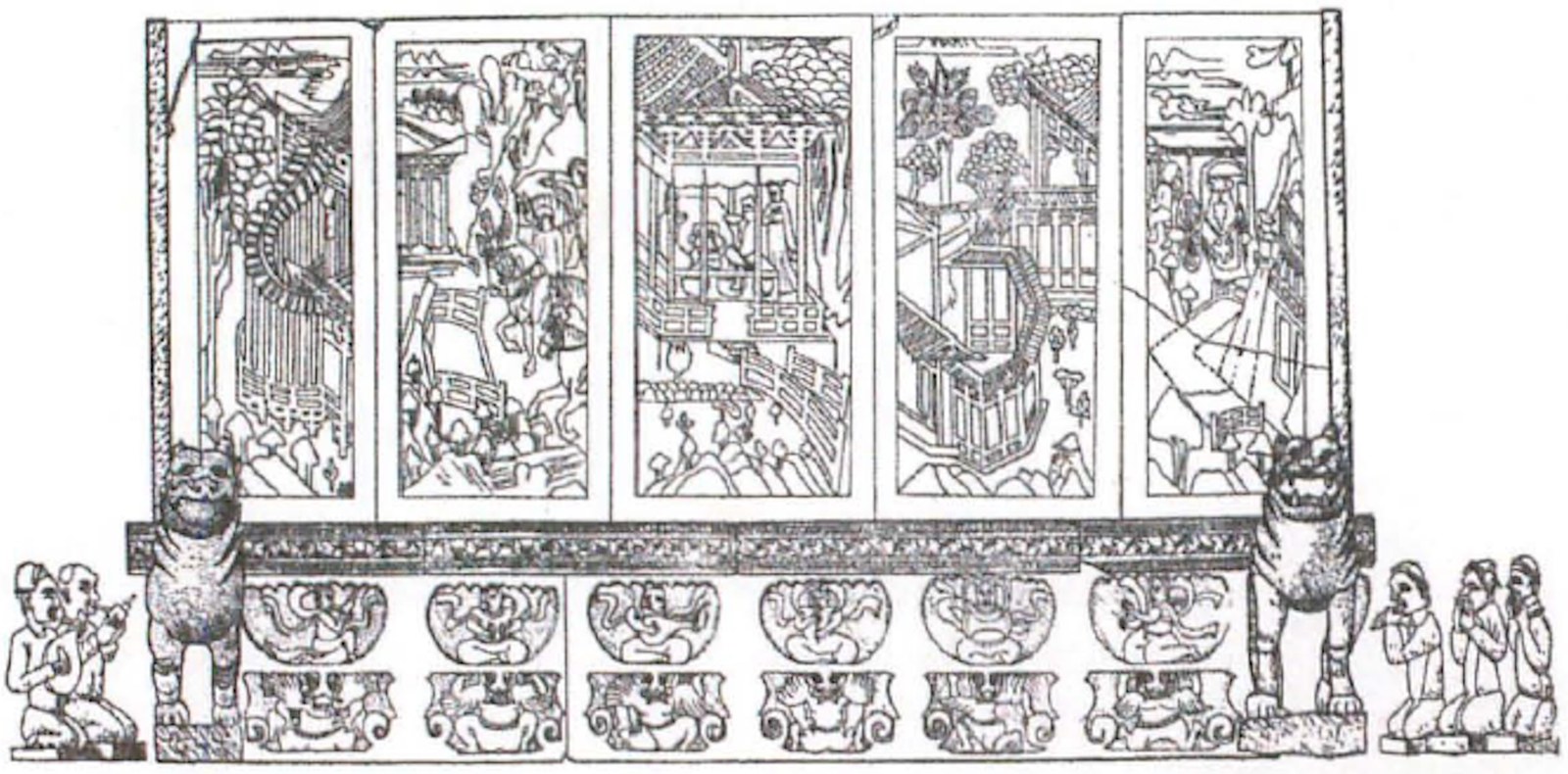
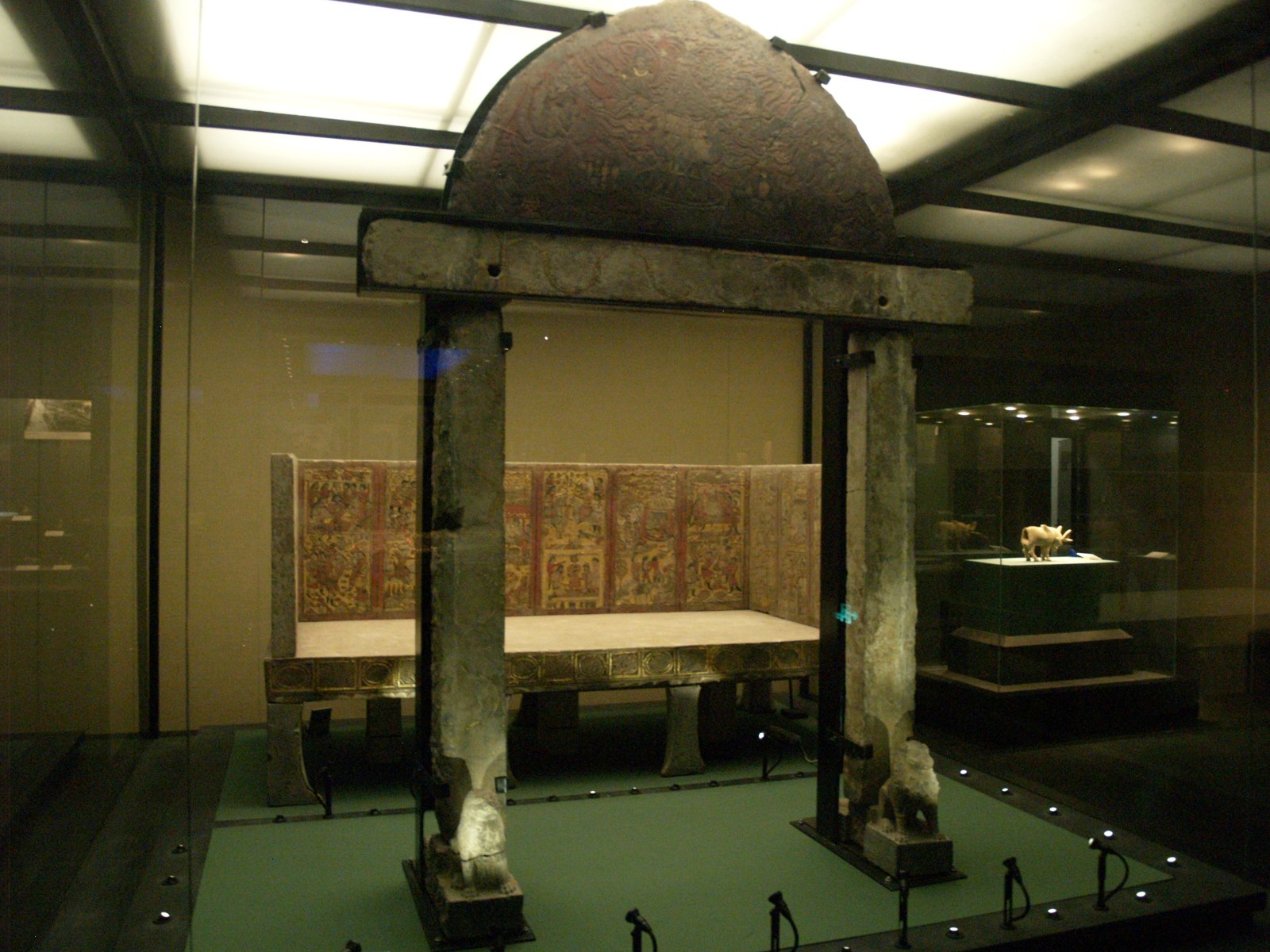
The Tianshui tomb is the burial of an anonymous Sogdian official who lived and died in Sui-dynasty China, and its centrepiece is a carved stone funerary couch unearthed at Shimaping, on the southern edge of the city of Tianshui in Gansu, in 1982. The couch is a raised stone bed enclosed by a screen of relief-carved slabs, and it belongs to the sixth and early seventh century AD, when families of Central Asian merchants had settled deep inside northern China. Because no epitaph survives to name its owner, the monument is known simply by its place of discovery, sometimes as the Tomb of Shimaping (石马坪粟特墓).
What makes the Tianshui couch remarkable is not gold or scale but the story carved into its stone. Its panels show hunting, feasting and drinking, and — most tellingly — scenes of fire worship drawn from the Zoroastrian faith the dead man’s ancestors had carried east from Central Asia. It is one of only a handful of such Sino-Sogdian funerary couches known, and among the very few dated to the Sui rather than the earlier Northern dynasties.
What is the Tianshui tomb?
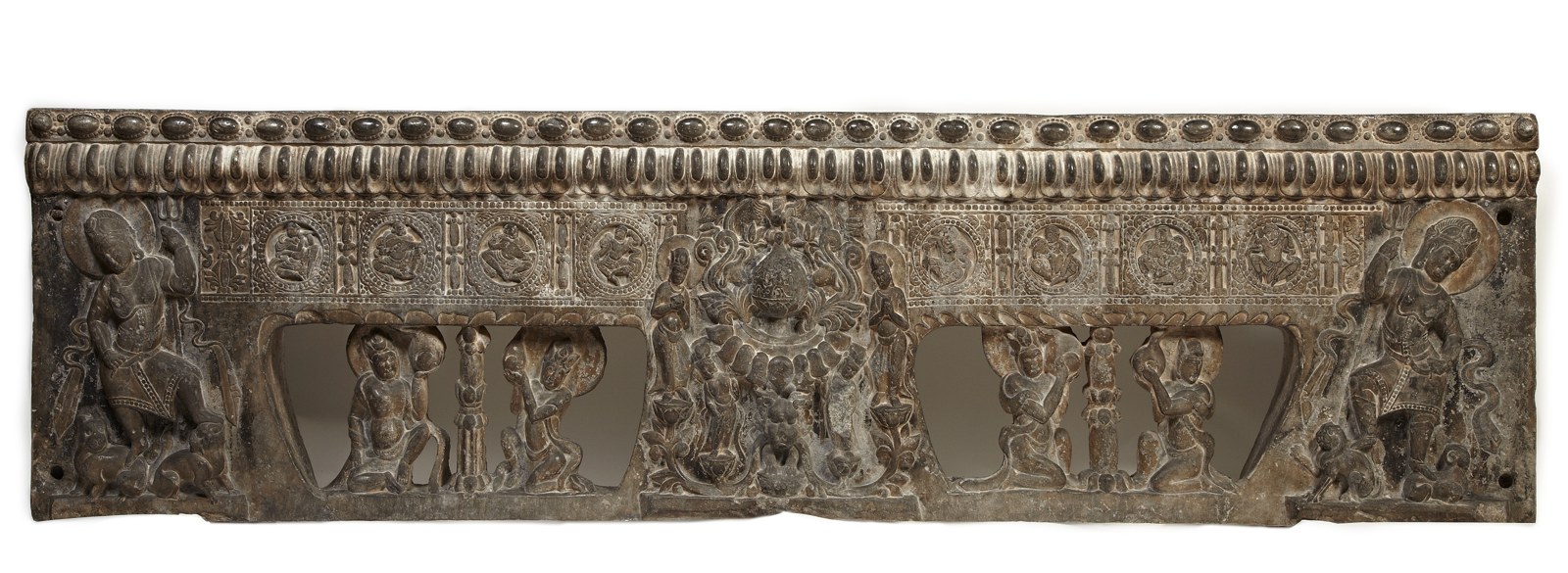
The Tianshui tomb (Chinese: 天水粟特墓) is a Sogdian funerary monument of the Sui dynasty (581–618 CE), discovered in 1982 in the Shimaping area of Tianshui, a city on the upper Wei River in eastern Gansu, northwest China. Its defining object is a stone funerary couch — in Chinese a weiping shita (围屏石榻), literally a “screened stone couch” — consisting of a low rectangular platform surrounded on three sides by upright stone slabs carved in low relief. The dead were laid on the platform; the slabs formed a pictorial screen around them.
Alongside the couch, excavators recovered a gold hairpin and a bronze mirror, modest but telling grave goods that suggest a man and his wife had been laid to rest together on the bed. The finds are now held by the Tianshui City Museum (some catalogues associate the material with Gansu’s provincial collections). The tomb is counted among the major examples of Sogdian burials in China, a small and closely studied group that has transformed how historians understand the Central Asian diaspora along the trade routes.
Who were the Sogdians on the Silk Road?
The people who commissioned tombs like this one were Sogdians, an Iranian-speaking people whose homeland, Sogdiana, lay between the Oxus and Jaxartes rivers in what is now Uzbekistan and Tajikistan, centred on cities such as Samarkand and Bukhara. From roughly the third to the eighth century AD the Sogdians were the great middlemen of the Silk Road, running the caravan trade that linked China to Central Asia, Persia and beyond. Sizeable Sogdian communities grew up in the cities of northern China, where their members served as merchants, interpreters, soldiers and officials.
The Nine Surnames of Zhaowu
Sogdians who settled in China were given Chinese surnames drawn from the names of their home cities, a set collectively known as the Nine Surnames of Zhaowu (昭武九姓). Kang stood for Samarkand, An for Bukhara, Shi for Chach (modern Tashkent), Cao for Kabudhan, Mi for Maymurgh, and so on. Many of the leaders of these communities held the office of sabao (薩保), a government post that made them the recognised head of the local Sogdian settlement. The owner of the Tianshui couch belonged to this world of assimilated Central Asians — Chinese in dress and administration, yet still keeping the funeral art and religious imagery of their ancestral homeland.
Reading the carved stone couch
The screen of the Tianshui couch reads almost like a graphic account of an elite Sogdian life. Its slabs carry the standard repertoire of these monuments: mounted hunts pursuing game, banquets under canopies, wine-drinking and music, and processions of figures in Central Asian dress. These are at once scenes from the life the dead man had led and images of the paradise he hoped to enter — the couch collapses biography and afterlife into a single carved programme.
Running through the imagery is the unmistakable stamp of Zoroastrianism, the fire-honouring religion of the Sogdian homeland. Scholars who have studied the Tianshui screen identify consecration scenes centred on fire altars, the kind of ritual imagery that marks the couch as the monument of a family that kept the rites of Central Asia even after generations in China. It is precisely this fusion — Chinese furniture form, Sogdian and Zoroastrian content — that makes the Sino-Sogdian couches such valuable documents.
How do we know the tomb is Sogdian, not Warring-States Chinese?
Older popular accounts of the “Tianshui tomb” badly misdescribed it — placing it in the Warring States period or early Han dynasty of the third to second century BC, crediting a chance discovery by farmers in 2004, and filling it with chariots, terracotta and hundreds of martial grave goods. None of that is accurate. The monument that archaeologists and art historians actually study is a Sui-dynasty burial of the sixth to seventh century AD, brought to light in 1982, whose defining feature is a carved stone funerary couch rather than any warrior’s arsenal.
The evidence that the tomb is Sogdian lies in the couch itself. Its form — the screened stone bed — and its iconography of hunts, banquets and fire-altar consecration match, point for point, the securely dated Sogdian couches excavated elsewhere in northern China, several of which came with epitaphs naming their Central Asian owners. Set beside those, the Tianshui couch falls unambiguously into the same family, an anonymous but genuine member of the Sino-Sogdian group. The gold hairpin and bronze mirror, meanwhile, fit a sixth-century couple’s burial, not a Warring-States war-grave.
The Tianshui couch among China’s Sogdian tombs
The Tianshui monument is one of roughly a dozen Sino-Sogdian funerary couches and sarcophagi known from China, and it gains most of its meaning when read against the better-preserved members of the group. The couch of An Jia (579 CE) and the sarcophagus of Wirkak, also called the Tomb of Wirkak (580 CE), both from Xi’an, are the touchstones — richly carved, precisely dated, and accompanied by epitaphs. The scattered panels of the Anyang funerary bed, now divided among museums in Boston, Paris and elsewhere, extend the pattern, as does the more humble couch of An Bei, an ordinary Sogdian clerk who died in 589 CE.
Against that company the Tianshui couch stands out for its date. Where most of the celebrated couches belong to the Northern Qi and Northern Zhou of the mid- to late sixth century, the Tianshui monument reaches into the Sui, the short-lived dynasty that reunified China in 581. It shows that the tradition of the Sogdian screen-couch did not end with the Northern dynasties but carried on into the reunified empire, even in a provincial city far up the Wei River rather than in a great capital.
Why the Tianshui tomb matters
For all that its owner is nameless, the Tianshui tomb is a valuable witness to the reach and persistence of the Sogdian diaspora. It records a Central Asian family established not in Chang’an or Luoyang but in a secondary city of the northwest, still commissioning a monument in the ancestral style at the very moment the Sui was welding China back together. Its Zoroastrian fire scenes show a community that had assimilated into Chinese administration without surrendering its religion, the same balancing act visible in every Sino-Sogdian couch. Traced back along the caravan roads to homeland cities like Panjakent, and set within the longer story of the ancient civilizations of Central Asia and China, the anonymous Tianshui couch speaks for thousands of Silk Road merchants whose names history never recorded.
Frequently asked questions
What is the Tianshui tomb?
The Tianshui tomb (天水粟特墓), also called the Tomb of Shimaping, is a Sui-dynasty (581–618 CE) burial of an anonymous Sogdian official, discovered in 1982 at Shimaping in the city of Tianshui, Gansu Province, China. Its defining feature is a carved stone funerary couch — a raised bed enclosed by a screen of relief-carved slabs — decorated with scenes of hunting, feasting and Zoroastrian fire worship. A gold hairpin and bronze mirror were also recovered. The finds are held by the Tianshui City Museum.
Who was buried in the Tianshui tomb?
The occupant was a Sogdian nobleman or official whose name is not recorded, because no epitaph survived to identify him. He belonged to the community of Central Asian Sogdians — Silk Road merchants and administrators from cities such as Samarkand and Bukhara — who had settled in northern China. The gold hairpin and bronze mirror found with the couch suggest that he and his wife were buried together on the stone bed in the sixth or early seventh century AD.
Why is the Tianshui funerary couch important?
It is one of only about a dozen Sino-Sogdian funerary couches known from China, and one of the very few dated to the Sui dynasty rather than the earlier Northern dynasties. Its carved screen combines a Chinese furniture form with Sogdian subject matter and Zoroastrian fire-altar scenes, making it a rare document of how a Central Asian community kept its ancestral religion and art while assimilating into Chinese society. It also shows the tradition surviving into a provincial city, far from the imperial capitals.
Sources and further reading
- Tianshui tomb — Wikipedia
- Sogdia — Wikipedia
- Sui dynasty — Wikipedia
- Sogdiana — World History Encyclopedia
- The Silk Road — World History Encyclopedia
- Judith A. Lerner, “Aspects of Assimilation: The Funerary Practices and Furnishings of Central Asians in China,” Sino-Platonic Papers 168 (2005)

Neural Pathways is a collective of seasoned experts and researchers with a profound passion for unraveling the enigmas of ancient history and artifacts. With a wealth of combined experience spanning decades, Neural Pathways has established itself as a leading voice in the realm of archaeological exploration and interpretation.