The Tomb of the Infernal Chariot (Italian: Tomba della Quadriga Infernale) is an Etruscan painted tomb in the Pianacce necropolis at Sarteano, in the province of Siena, Tuscany. It was discovered on 11 October 2003 by Alessandra Minetti, director of the town’s Civic Archaeological Museum, working with volunteers of the Etruria Archaeological Group. Cut roughly five metres down into the local travertine and dated to about 330–320 BC, the tomb preserves one of the great masterpieces of Etruscan wall painting: a red-skinned demon driving a chariot pulled by two lions and two griffins toward the underworld. Its extraordinary state of preservation and the uniqueness of its scenes make it one of the most important Italian archaeological finds of recent decades — a vivid counterpart to the great painted tombs of Tarquinia.

Discovery and Location
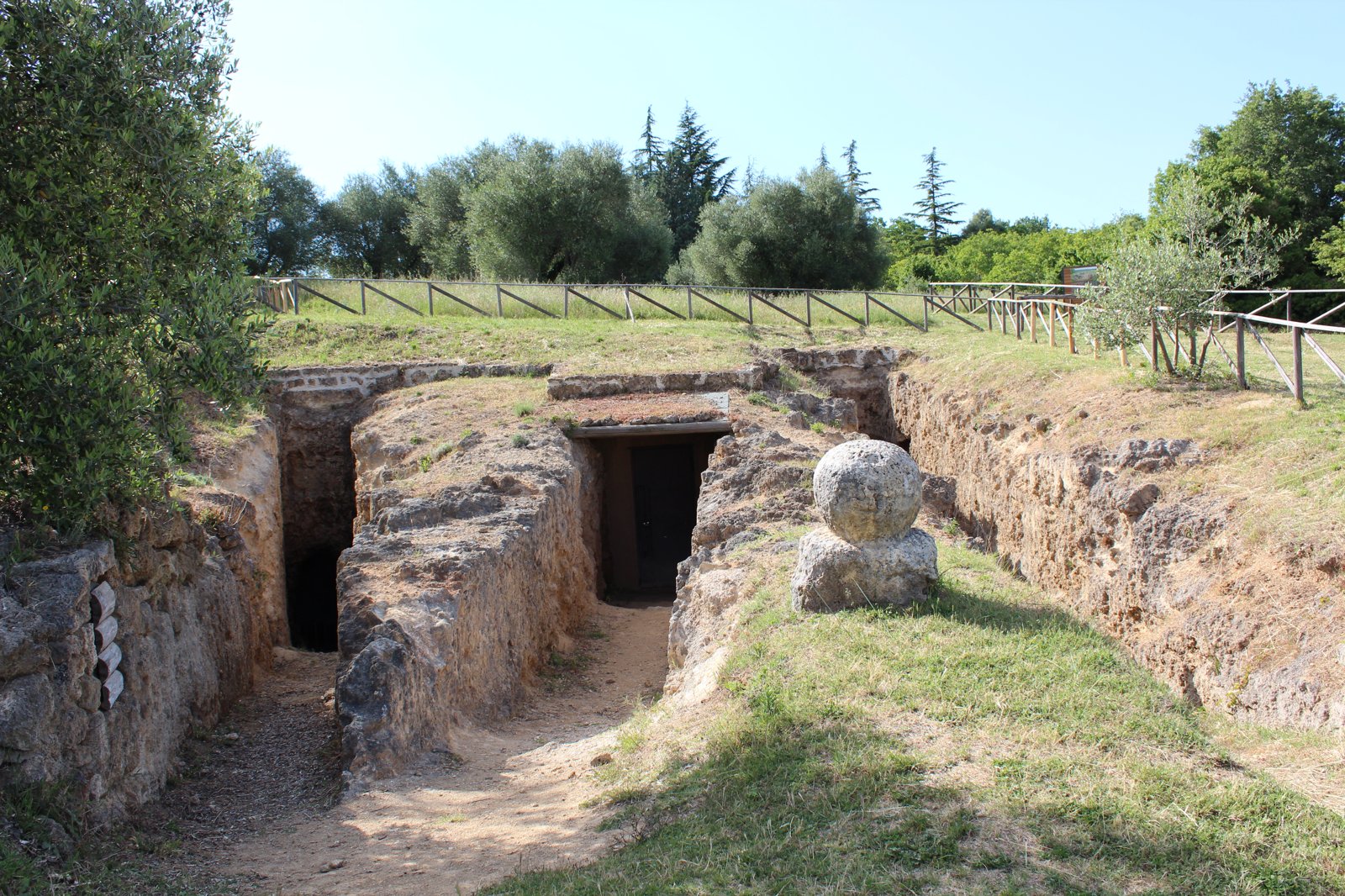
The tomb lies in the Pianacce necropolis, an Etruscan burial ground on a hillside just outside Sarteano, roughly 90 kilometres southeast of Siena. Sarteano sits in the territory that once looked to the powerful Etruscan city of Chiusi (ancient Clevsin), and its cemeteries had been known and dug into for generations. On 11 October 2003, a team led by museum director Alessandra Minetti opened a monumental rock-cut tomb whose paintings had survived almost untouched. Unlike the frescoed tombs of Tarquinia, which are painted on a plaster layer, the Sarteano artist worked directly onto the smoothed travertine wall, which helps explain the exceptional freshness of the colours.
What is the Tomb of the Infernal Chariot?
The tomb is entered through an unusually long dromos — an open corridor about 19 metres long, lined with four niches — that leads through a doorway into a rectangular burial chamber roughly 3.5 metres on each side. The whole structure was carved from the living travertine at a depth of about five metres. The chamber walls and the corridor frieze carry a continuous painted programme that maps the journey of the dead from the world of the living into the depths of Hades. Rather than the banquets and dancing that dominate earlier Etruscan tombs, the imagery here is overwhelmingly infernal, dominated by demons, monsters and the machinery of the afterlife.
The Red Demon and the Infernal Chariot
The tomb takes its name from its most startling image: a figure with red skin and wild eyes, hair seemingly aflame, gripping the reins of a quadriga — a four-animal chariot — drawn not by horses but by two lions and two griffins. A black cloud boils up around the beasts and reaches toward the driver’s face. Scholars identify this charioteer as Charun (the Etruscan Charu), the demon who conducts souls to the underworld and the local equivalent of the Greek ferryman Charon. The choice of animals is deliberate and learned: the lions echo the iconography of the goddess Cybele, while the griffins recall the “winged dragons” that pull Persephone’s chariot down to Hades on painted Orvieto amphorae. Charun also appears in the great painted tombs of Tarquinia, including the Velcha family tomb.

The Banquet, the Serpent and the Sea
Reading the painted programme
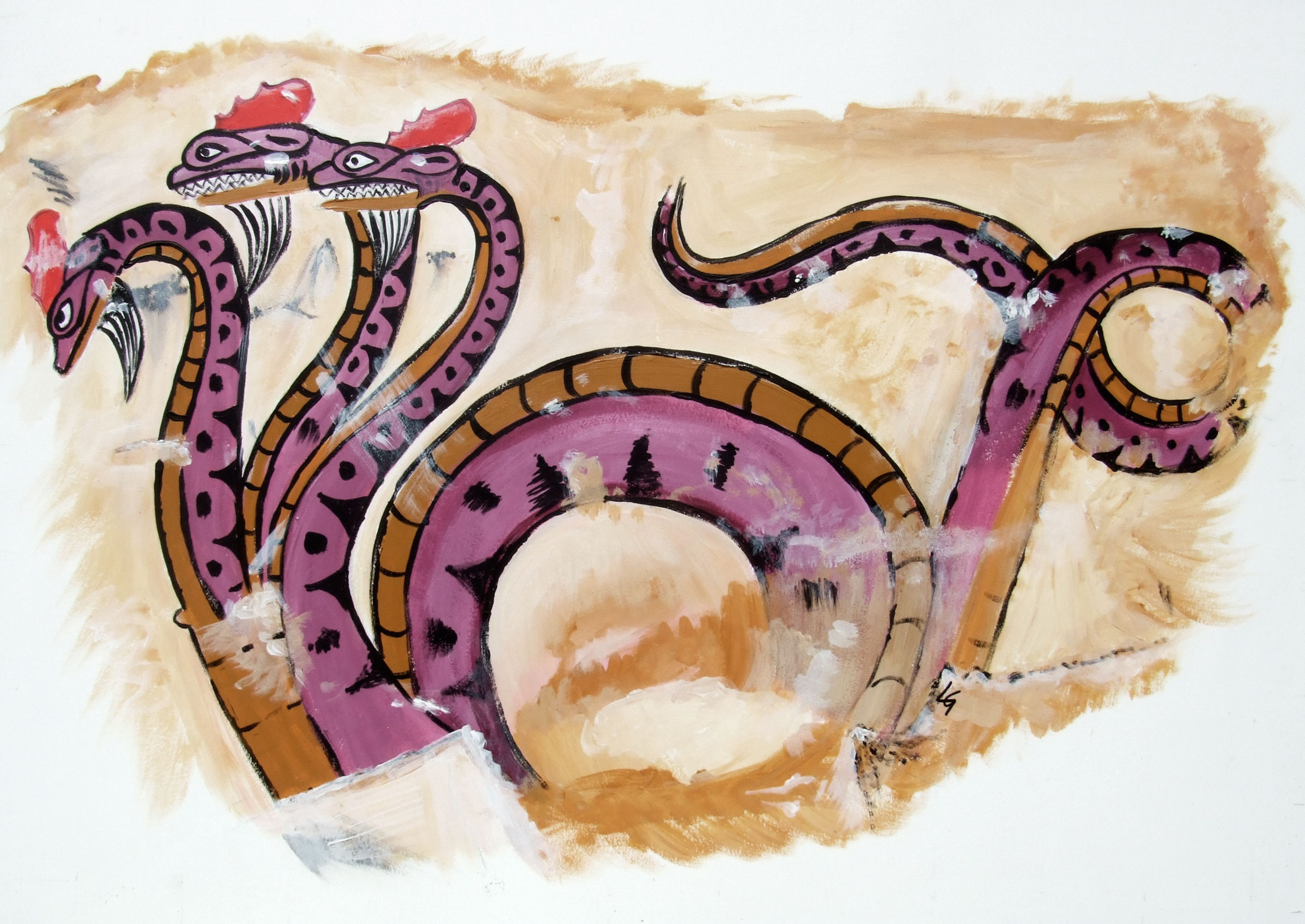
Beyond the demon and his chariot, the painted cycle unfolds as a sequence. A traditional banquet scene shows two male figures reclining together on a couch; both are the deceased, though whether they were a couple or father and son is unknown. Inside the chamber, symbolising the depths of the underworld, an enormous three-headed serpent rears on a white ground, its body coiled into a single great spiral. On the back wall’s half-gable swims a large hippocamp (seahorse), while dolphins ripple along the corridor frieze — the sea serving as a metaphor for passage, the plunge into the waves standing for the crossing between the earthly and the otherworldly. Together the scenes form one of the most complete visual accounts of the Etruscan idea of death to survive from the 4th century BC.
Who were the Etruscans of Sarteano?
The Etruscans were the dominant people of pre-Roman central Italy, whose city-states flourished across Tuscany, Umbria and northern Lazio from roughly the 8th century BC. By the second half of the 4th century BC, when this tomb was cut, Etruscan independence was already under pressure from an expanding Rome, and the darker, more anxious afterlife imagery of tombs like this one reflects the mood of a culture in decline. Sarteano belonged to the orbit of Chiusi, one of the twelve cities of the Etruscan League, and the wealth on display here — a private monument decorated by a master painter — marks out an aristocratic family able to command the finest funerary art of its day. The same funerary world can be traced at the Banditaccia necropolis at Cerveteri and at Vulci.
Visiting the Tomb Today
Because the paintings are so fragile, the original tomb opened to the public only two years after its discovery and can be entered on just one day a week, in small guided groups, to protect the microclimate. For visitors who cannot access the tomb itself, the Civic Archaeological Museum of Sarteano unveiled a full-scale reproduction in 2023 — timed to the twentieth anniversary of the discovery — recreated using theatrical scenography techniques so that the entire painted cycle can be seen in one room. The museum also holds the finds excavated from the Pianacce and other local necropolises, setting the tomb in the wider context of Etruscan Sarteano.
Sources and Further Reading
- Civic Archaeological Museum of Sarteano — Tomb of the Infernal Chariot (official)
- Visit Tuscany — In the footsteps of the Etruscans in Sarteano
- World History Encyclopedia — Etruscan Civilization
- History.com — The Etruscans
- Wikipedia — Charun, the Etruscan demon of death
- Wikipedia — Etruscan civilization

Neural Pathways is a collective of seasoned experts and researchers with a profound passion for unraveling the enigmas of ancient history and artifacts. With a wealth of combined experience spanning decades, Neural Pathways has established itself as a leading voice in the realm of archaeological exploration and interpretation.