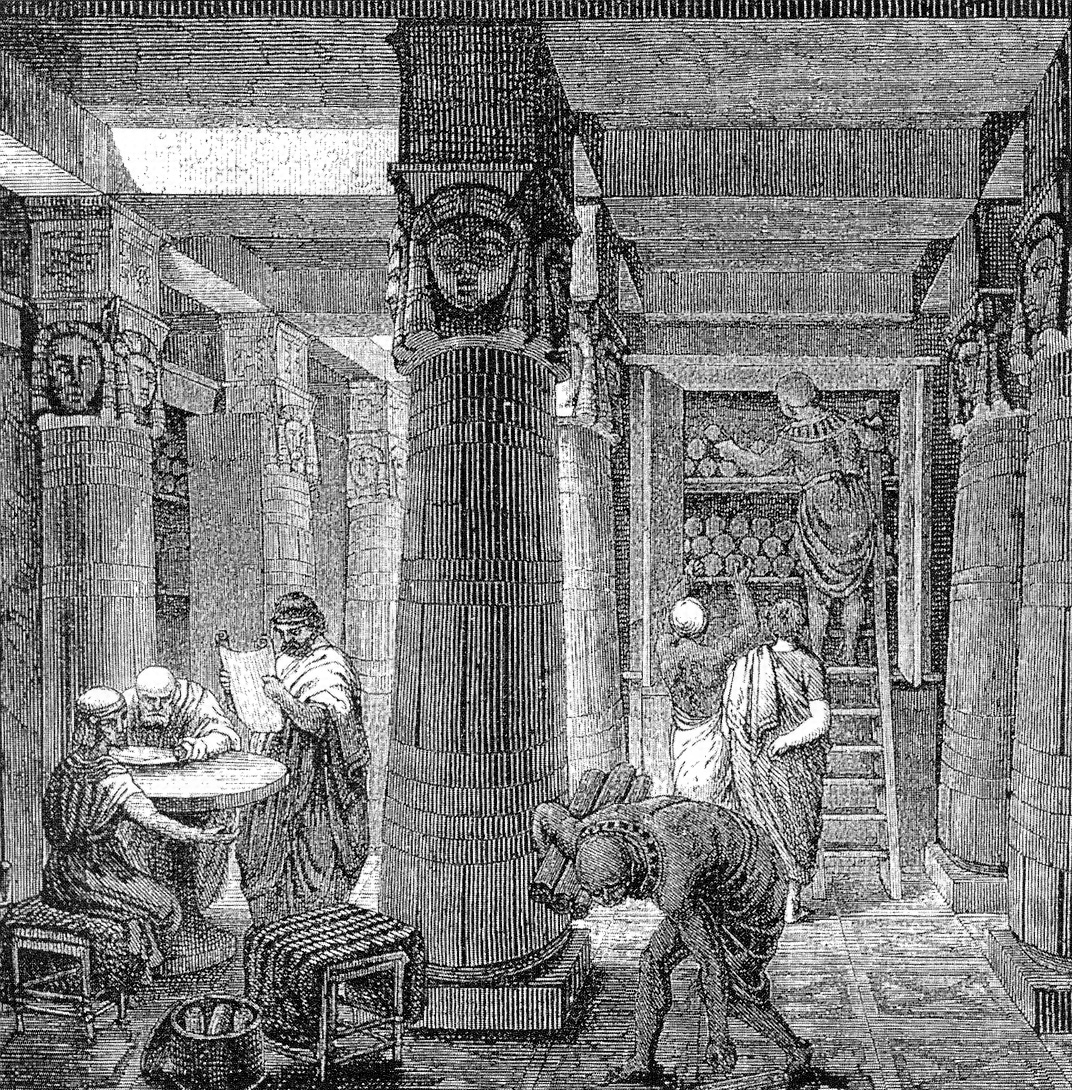
The Library of Alexandria was the most ambitious intellectual project of the ancient world. Built on the Mediterranean shore of Hellenistic Egypt during the third century BCE, it set out to collect, in a single place, every book worth reading — and for several centuries, it nearly succeeded. By the height of its activity it housed somewhere between forty thousand and several hundred thousand papyrus scrolls,[1] employed dozens of paid scholars, and produced work in mathematics, astronomy, medicine, geography and literary criticism that would shape Western thought for the next two thousand years.
A Centre of Hellenistic Learning
The library was founded under the first two Ptolemaic kings of Egypt — Ptolemy I Soter and his son Ptolemy II Philadelphus — at some point between roughly 295 and 280 BCE. It was attached to a larger research institution called the Mouseion, or “shrine of the Muses,”[1] from which the modern word museum derives. The Mouseion was less a public museum than a state-funded research college: scholars lived on site, dined together, and pursued their work under royal patronage.
Alexandria itself was a deliberate creation. Alexander the Great had founded the city in 331 BCE as a Greek capital in a thoroughly Egyptian setting, and after his death the Ptolemies — one of his successor dynasties — set out to make it the cultural rival of Athens. The library was central to that project. By assembling Greek philosophy, Egyptian temple knowledge, Babylonian astronomy and Jewish scripture in one place, the Ptolemies turned Alexandria into the working capital of Hellenistic intellectual life.

What the Library Contained
The scale of the collection is famously hard to pin down. Ancient writers gave wildly different numbers — some as low as 40,000 scrolls, others as high as 700,000. The variation partly reflects what was being counted: complete works, individual volumes, duplicates, or every scroll housed in either the main library or its smaller daughter institution at the Serapeum temple. What is not in doubt is that the holdings were enormous by ancient standards and represented a serious attempt at comprehensive coverage.
The Ptolemies pursued books with the energy of modern collectors.[2] Royal agents were said to comb the markets of Athens and Rhodes for scrolls. Ships arriving in Alexandria’s harbour were searched for books; any text not yet in the library was confiscated, copied, and the copy — not the original — returned to its owner. The library also commissioned translations, the most famous being the Septuagint, the early Greek translation of the Hebrew Bible.

The Scholars Who Worked There
The list of scholars associated with Alexandria is a roll-call of antiquity’s most consequential thinkers. Euclid compiled the Elements, the textbook of geometry that would remain in use for two millennia. Eratosthenes, who served as chief librarian in the third century BCE, calculated the circumference of the Earth using nothing more than the shadow of a stick and the distance between two Egyptian cities — and got the answer to within a few percent of the modern figure. Hipparchus compiled the first known star catalogue and discovered the precession of the equinoxes. Aristarchus of Samos proposed, eighteen centuries before Copernicus, that the Earth orbits the Sun.[1]
Beyond mathematics and astronomy, Alexandria produced foundational work in medicine, particularly through the anatomist Herophilus, who was probably the first scholar in the Greek tradition to perform systematic human dissections.[2] Literary criticism — the practice of editing, annotating and grading texts — was effectively invented at the library by scholars working on the Homeric epics.

The Head Librarians and Their Catalogues
The Library’s authority rested on a succession of named head librarians, each appointed by the king and each remembered for a different intellectual contribution. Zenodotus of Ephesus served as the first head librarian from around 280 BCE and produced the earliest critical editions of the Homeric poems; he is also the first scholar known to have organised a collection alphabetically by the first letter of an author’s name. Apollonius of Rhodes, the second head librarian and a student of Callimachus, wrote the Argonautica — the only complete Greek epic to survive from the Hellenistic period after Homer. Aristophanes of Byzantium, librarian around 200 BCE, invented the system of Greek diacritical marks — the accents, breathings and punctuation that made it possible to read ancient Greek aloud with consistent pronunciation. Hero of Alexandria, who worked at the Mouseion in the first century CE, built the world’s first recorded steam engine, a small spinning device called the aeolipile. Callimachus, though never head librarian himself, compiled the Pinakes, a 120-book catalogue[4] that listed every author held in the collection, with brief biographies and complete bibliographies — the world’s first known library catalogue.
The Building and the Inscription
The Library was built in the Brucheion, the royal quarter of Alexandria, as part of the Mouseion complex.[4] Ancient descriptions speak of Greek-columned halls, a covered walking corridor known as a peripatos, a shared dining hall where scholars ate communally, lecture rooms, gardens and reading rooms — the model on which every modern university campus is ultimately based. The scrolls themselves were housed in collections called bibliothekai, after which the modern word “bibliography” is named. According to one tradition preserved by the later Latin writer Diodorus Siculus, the inscription above the shelves read “the place of the cure of the soul”. The Library of Alexandria was not the first great collection of texts in the ancient world — it followed the much older Library of Ashurbanipal at Nineveh[4] in the seventh century BCE — but it was the first to attempt comprehensive coverage of every written work of the Greek-speaking world, and the first to make book-collection the explicit policy of a state.
Eratosthenes and the Circumference of the Earth
The single most famous result produced at Alexandria came from Eratosthenes of Cyrene, who served as the library’s third chief librarian from around 245 BCE. He had heard that on the summer solstice, at noon, the sun shone directly down a deep well in the southern Egyptian city of Syene (modern Aswan), casting no shadow. At the same moment in Alexandria, several hundred miles to the north, a vertical stick did cast a shadow — at an angle of roughly 7.2 degrees from the vertical. Eratosthenes reasoned that if the Earth were a sphere, that angular difference, combined with the linear distance between the two cities, would give him the planet’s full circumference. He estimated the distance at 5,000 stadia. Multiplying by 50 (since 7.2 degrees is one-fiftieth of a full circle), he arrived at a circumference of about 250,000 stadia — somewhere between 39,000 and 46,000 kilometres in modern terms, against the actual figure of 40,075 km. That a librarian in Hellenistic Egypt could measure the size of the planet using nothing more than a well, a shadow and a working knowledge of geometry remains one of the most striking achievements in the history of science.
The Rivalry with the Library of Pergamon
By the second century BCE, Alexandria’s monopoly on scholarship faced a serious challenger. The Attalid kings of Pergamon, in western Anatolia, founded their own great library and began aggressively recruiting scholars and acquiring scrolls. The Ptolemies responded by banning the export of papyrus from Egypt — a deliberate attempt to starve their rivals of writing material. According to Pliny the Elder, this is what prompted Pergamon to perfect the use of treated animal skins as a writing surface, which became known as pergamenum in Latin and, ultimately, as parchment in English. The rivalry shaped Mediterranean scholarship for over a century, and produced one of the few situations in antiquity where a single technological innovation — the codex of parchment leaves that would eventually replace the papyrus scroll — can be traced to a specific diplomatic dispute. Mark Antony is later reported to have given Cleopatra 200,000 scrolls from the Pergamon library[2] as a gift, though the story is uncertain.
The Septuagint and the Translation Project
The most consequential single project carried out at Alexandria was the translation of the Hebrew Bible into Greek, known as the Septuagint from the Latin for seventy — the traditional number of scholars said to have worked on it. The translation was commissioned by Ptolemy II Philadelphus in the third century BCE, on the advice of his librarian Demetrius of Phalerum, to make the Jewish scriptures accessible to the Greek-speaking Jewish community of Alexandria, which by then numbered in the hundreds of thousands. The Septuagint became the version of the Hebrew Bible used by the early Christian church, and through it most of the technical vocabulary of Western religious thought — Genesis, Exodus, Leviticus, Deuteronomy — entered Greek and from Greek into Latin and the European languages. Other librarians of the period, notably Callimachus and Aristarchus of Samothrace, set the model for systematic literary scholarship: cataloguing the holdings of the library, editing and annotating canonical texts, and inventing the practice of textual criticism that classical scholars still use today.
How was the Library of Alexandria destroyed?
The popular image of a single catastrophic fire destroying the Library of Alexandria is almost certainly wrong. The reality is closer to a long, uneven decline punctuated by several episodes of damage, each one reducing the collection further until — by the late Roman period — there was very little left to destroy.
The recorded incidents
The earliest documented incident is the fire that broke out in Alexandria’s harbour in 48 BCE during Julius Caesar’s intervention in the Egyptian civil war between Cleopatra and her brother Ptolemy XIII. Caesar’s own account is vague, and ancient historians disagreed even at the time about how much of the library proper was affected — some warehouses near the docks containing books were certainly burned, but the main library may have escaped. A second episode came in the late third century CE, when much of Alexandria’s royal quarter was destroyed in the wars of the Emperor Aurelian.[4] The Serapeum’s daughter library was destroyed in 391 CE[1] when the Emperor Theodosius ordered the closure of pagan temples and the local bishop Theophilus carried out his order in Alexandria.
The story that the library was destroyed in the Arab conquest of 642 CE is later medieval invention; scholars now consider it almost entirely fictional. By the time of the conquest, the great library of antiquity had been gone for centuries.
A Modern Successor
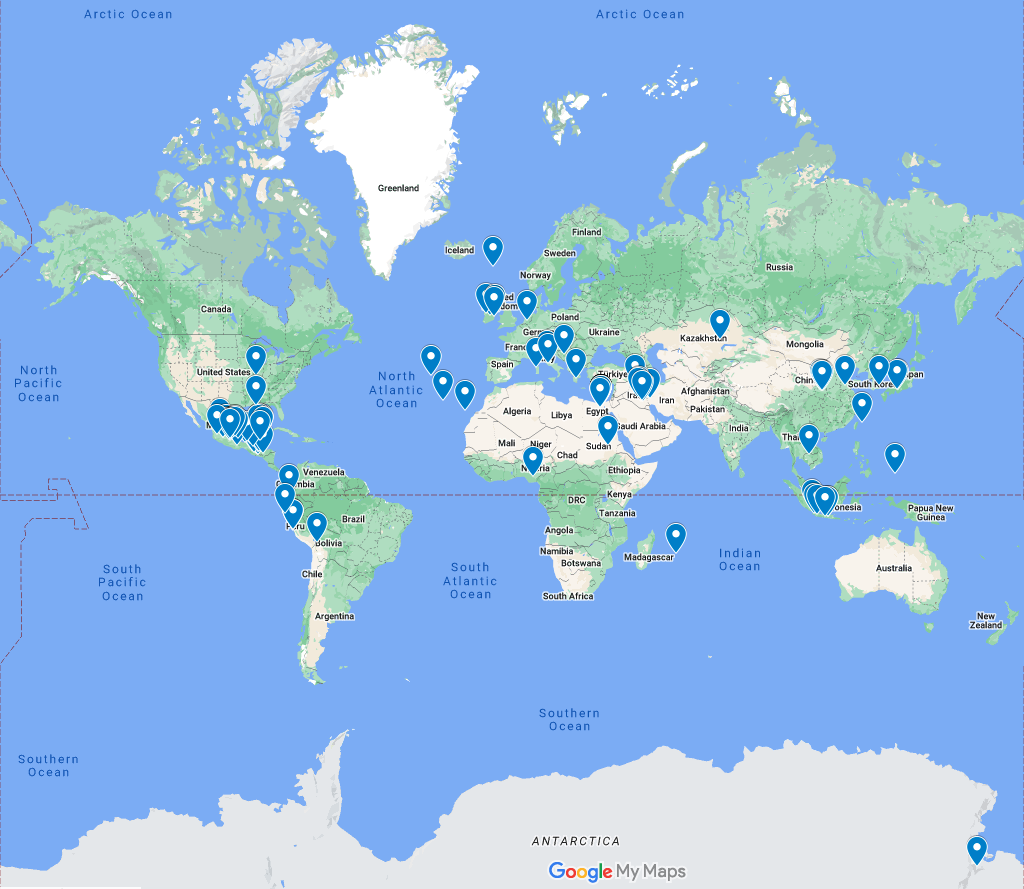
In 2002, after nearly twenty years of planning, the Bibliotheca Alexandrina opened[3] on the Mediterranean shore at Alexandria, a few hundred metres from where its ancient predecessor is thought to have stood. Designed by the Norwegian firm Snøhetta, the new library is a deliberate echo of the old: a research institution, a museum, a planetarium and a collection of millions of books in many languages. It does not pretend to recover what was lost. It is, instead, a monument to what scholarship was once capable of in this particular city, and an attempt to make that ambition possible again. The Library of Alexandria sits within a wider collection of historical places of the ancient world.

Sources and Further Reading
- Britannica — Library of Alexandria (entry by Mostafa El-Abbadi)
- World History Encyclopedia — Library of Alexandria
- Bibliotheca Alexandrina (modern library)
- Wikipedia — Library of Alexandria

Neural Pathways is a collective of seasoned experts and researchers with a profound passion for unraveling the enigmas of ancient history and artifacts. With a wealth of combined experience spanning decades, Neural Pathways has established itself as a leading voice in the realm of archaeological exploration and interpretation.