Lepakshi Temple — properly the Veerabhadra Temple — stands in the small village of Lepakshi in the Anantapur district of Andhra Pradesh, India, about 120 km north of Bengaluru. It is the surviving masterpiece of late Vijayanagara temple architecture, commissioned in 1538 CE by Virupanna Wadiyar, the treasurer of Emperor Achyuta Deva Raya, and his brother Viranna. The temple is famous for three things in particular: a colossal monolithic Nandi 20 feet high carved from a single block of granite, a complete cycle of 16th-century fresco-secco murals on the ceiling, and the celebrated “Hanging Pillar” — one of 70 stone pillars that, uniquely, barely touches the floor of the mahamandapa.

Where and What It Is
The temple stands on a low granite outcrop called the Kurma Saila (“tortoise hill”) and sits about 15 km east of Hindupur on the road to Bengaluru. Its presiding deity is Veerabhadra, the fierce four-armed warrior aspect of Shiva. The whole precinct is in three concentric enclosures, with two gopurams (gateway towers), a colonnaded outer mandapa, the great pillared mahamandapa, an antarala antechamber, and the sanctum. The complex carries about 20 stone inscriptions on its prakara walls — the majority dating to the reign of Achyuta Deva Raya between 1539 and 1542 CE, which give the building a tight historical anchor very rare for South Indian temples of this period.
How old is Lepakshi Temple?
The temple was completed in 1538 CE by Virupanna Wadiyar, who served as treasurer to the Vijayanagara emperor Achyuta Deva Raya (reigned 1529-1542). The construction is precisely dated by Virupanna’s own dedicatory inscriptions, by the inscriptions of Achyuta Raya on the prakara walls, and by the technical and stylistic transition from earlier Tuluva-period architecture (the dominant Vijayanagara style under Krishnadevaraya, who had built the great Ranga Mandapam at Virupaksha Hampi) into the more ornate late-Vijayanagara idiom. Lepakshi is therefore one of the few 16th-century South Indian temples whose construction date, patron, and reigning emperor are all securely documented.
The Hanging Pillar
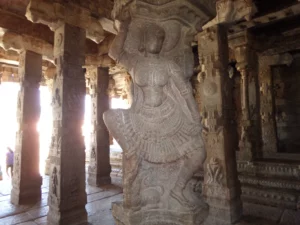
The mahamandapa is supported by 70 stone pillars, arranged in concentric rows around the central ritual space. One of them, in the eastern row, is the famous “Hanging Pillar” (aakaasha sthamba). The pillar appears to rise from floor to ceiling like all the others — but at its base it does not quite touch the stone floor. There is a gap of a few millimetres, and visitors traditionally pass a thin cloth or sheet of paper underneath it as proof. The engineering of how a 12-metre stone pillar carries any portion of the mahamandapa ceiling without making structural contact with the floor remains debated; the most widely cited explanation is that load redistribution from neighbouring pillars and the corbelled ceiling allowed the architects to leave the base dressed slightly proud of the floor by design.
The British-Era Damage
In the 19th century a British engineer — accounts disagree whether he was attached to the Madras Engineers or to Colin Mackenzie’s Survey of India team — attempted to lift the Hanging Pillar to understand how it stood without touching the floor. The intervention dislodged the pillar’s setting and damaged its alignment. The pillar today carries a visible tilt as a result, which is widely cited in popular accounts as the moment the original engineering was partially destroyed. The story has the texture of folk-history, but the small visible tilt is real, and matches what one would expect from a 19th-century failed mechanical lift attempt.

The Lepakshi Murals
The ceiling of the mukha mandapa, the antarala and the subsidiary shrines carries one of the most important cycles of Vijayanagara mural painting to survive anywhere in India. The technique is fresco-secco — pigment in lime medium applied to dry plaster, rather than the wet-plaster buon fresco of Renaissance Italy. The narratives shown include scenes from the Ramayana, the Mahabharata (including the Kiratarjuniyam episode and Draupadi’s swayamvara), the marriage of Parvati to Shiva, and the dedicatory scene of Virupanna and Viranna worshipping Veerabhadra — a near-contemporary portrait that gives the painting cycle exceptional documentary value. The palette is dominated by reds, ochres, blacks and a small range of greens — pigments derived locally from earth and mineral sources.

The Monolithic Nandi
About 200 metres west of the temple, in its own small enclosure, sits the colossal monolithic Nandi — the seated bull mount of Shiva. The figure is carved from a single block of grey granite, stands roughly 6 metres tall (20 feet) and 9 metres long (30 feet), and is widely cited as the largest monolithic Nandi in India. The body is shown garlanded and bedecked with the ceremonial bells of a temple-attendant Nandi, and the head turns to face the main shrine — so that Shiva, in his Veerabhadra aspect, looks out at his own bull every time the sanctum door is opened. Together the Nandi and the temple form a single visual composition designed for viewing from the road approach.
The Legend of Virupanna’s Blinding
Two stories give the temple its emotional weight. The first concerns its patron. According to a tradition probably no older than the 17th century but treated as serious local history, Virupanna was accused — wrongly, in most versions — of having diverted Vijayanagara treasury funds to pay for the Lepakshi project. Faced with the prospect of being officially blinded by the emperor, Virupanna is said to have blinded himself in front of the temple sanctum, and a small spot inside the precinct is shown as the place where the act took place. The second story concerns the village name. Lepakshi means “rise, bird” in Telugu — the words traditionally spoken by Rama to the wounded Jatayu, the mythical eagle who tried to defend Sita against Ravana, after Jatayu fell at this spot.
Recognition and Preservation Today
The Veerabhadra Temple was identified for the modern Western record by the Scottish surveyor Colin Mackenzie in 1800, during his project to map the Mysore territories after the fall of Tipu Sultan. It is now a centrally protected monument of national importance under the Archaeological Survey of India, and the entire precinct — together with the great monolithic Nandi — is part of India’s UNESCO World Heritage tentative list as “Sri Veerabhadra Temple and Monolithic Bull (Nandi), Lepakshi”. The site forms part of the broader archaeological landscape of Vijayanagara south India and is easily combined with a visit to Hampi to the north.
Sources and Further Reading
- Wikipedia — Veerabhadra Temple, Lepakshi
- UNESCO World Heritage tentative list — Sri Veerabhadra Temple and Monolithic Bull (Nandi), Lepakshi
- Incredible India (Government of India tourism) — Lepakshi Temple
- Amusing Planet — The Hanging Pillar of Lepakshi Temple

Neural Pathways is a collective of seasoned experts and researchers with a profound passion for unraveling the enigmas of ancient history and artifacts. With a wealth of combined experience spanning decades, Neural Pathways has established itself as a leading voice in the realm of archaeological exploration and interpretation.