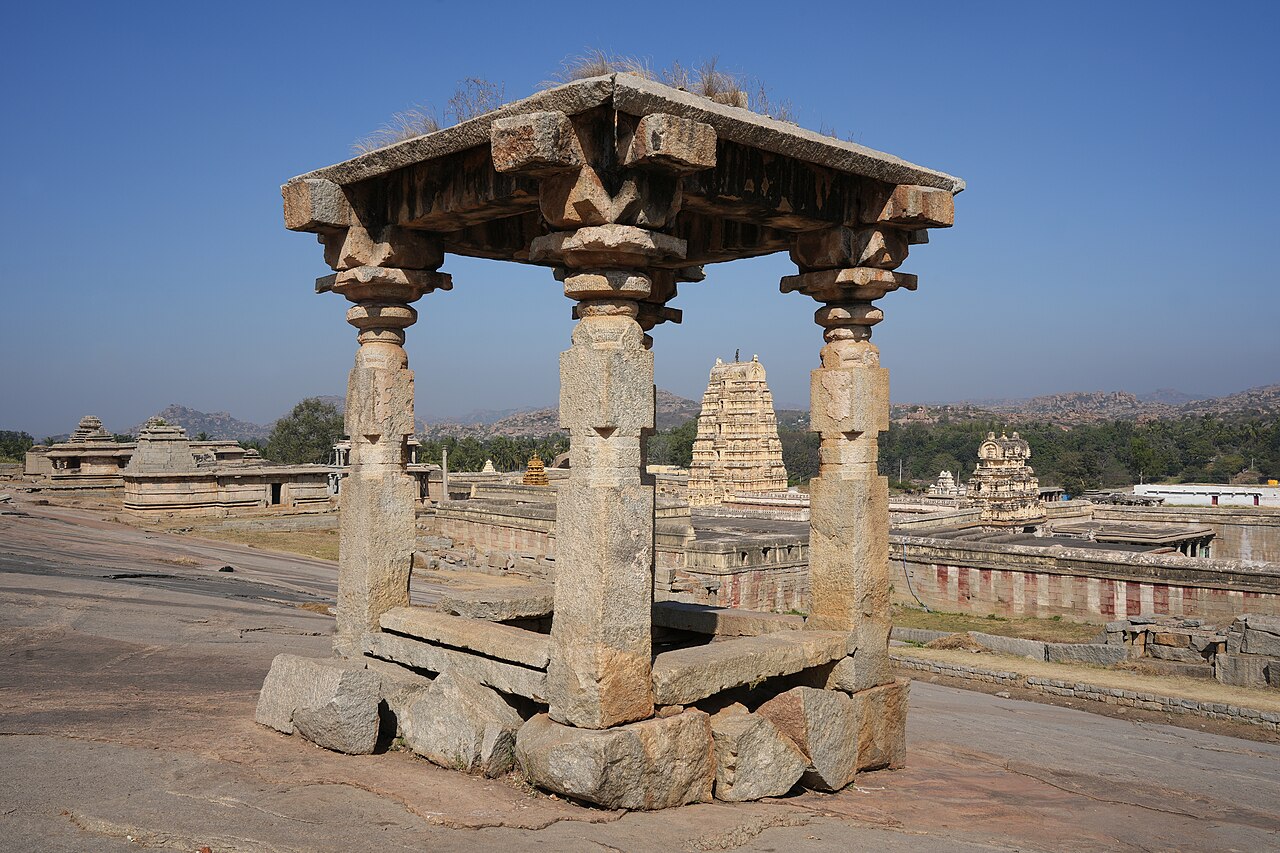
The Virupaksha Temple stands at the western edge of Hampi, in Karnataka, India — the medieval capital of the Vijayanagara Empire. What you see today is the only major temple in Hampi that survived the empire’s destruction at the Battle of Talikota in 1565, and it has been in continuous worship for over a thousand years, making it one of the oldest functioning temples in India. The eastern entrance is dominated by a ~50-metre, nine-storey gopuram (Dravidian-style gateway tower) — one of the tallest in South India. The temple is dedicated to Lord Virupaksha, a form of Shiva worshipped here together with his consort, the river-goddess Pampa.

Where and What It Is
Hampi sits on the banks of the Tungabhadra river in the Bellary district of Karnataka, about 350 km north of Bengaluru. The Virupaksha Temple is the focal point of the broader Group of Monuments at Hampi, a UNESCO World Heritage Site inscribed in 1986. The temple complex occupies a long east-west axis stretching from the great eastern gopuram, through a series of pillared halls and courtyards, to the central shrine and the smaller western Kanakagiri gopuram beyond it. To the north, the temple opens directly onto the river, where the Pushkarani ritual tank still serves bathing rituals for pilgrims.
How old is the Virupaksha Temple?
The continuous record of worship at this site reaches back to about the 7th century CE — but not as the great temple visible today. A small Pampa–Shiva sanctuary existed on this spot long before the Vijayanagara capital was founded; inscriptions referring to Shiva worship here date to the 9th and 10th centuries, and additions are documented from the late Chalukya and Hoysala periods (roughly 10th–13th centuries). The whole site was then transformed into the great temple complex you see today by the rulers of the Vijayanagara Empire, founded in 1336 CE, who selected the existing Pampa-Virupaksha shrine as their dynastic deity and built outward from it.
The Vijayanagara Expansion
Two named builders deserve credit for most of what survives. The first is Lakkan Dandesha, a nayaka (chieftain) under Deva Raya II in the 15th century, who funded a major round of additions including parts of the early enclosure. The second is the most famous patron at Hampi, Krishnadevaraya, whose reign from 1509 to 1529 marked the empire’s cultural peak. To mark his accession, Krishnadevaraya commissioned the temple’s central pillared hall — the Ranga Mandapam — in 1510 CE, and built the towering eastern gopuram in roughly the same campaign. Inside the Ranga Mandapam, 38 pillars in five aisles carry the carved yali (lion-like) figures and mounted riders that are characteristic of late-Vijayanagara workmanship.

The 50-Metre Gopuram
The eastern gopuram is the temple’s signature feature and Hampi’s most recognisable silhouette. It rises approximately 50 metres in nine tapering storeys, narrowing as it goes up so the top tier is only a fraction of the base width. The construction follows the Dravidian convention used across South India: a granite base carrying the load and a brick superstructure finished in lime plaster, then painted in white and ochre.
Stucco figures and pilgrim sightlines
Each storey carries stucco figures of deities, attendants, and mythological scenes; the tower’s profile was designed to be visible from kilometres away as pilgrims approached Hampi along the Tungabhadra valley.
Why It Survived 1565
The Vijayanagara Empire was destroyed at the Battle of Talikota in January 1565, when a coalition of five Deccan sultanates defeated the Vijayanagara army. The victors then occupied Hampi and systematically dismantled the city’s temples, palaces, and royal halls over the months that followed. Virupaksha is the only major Hampi temple that escaped — credibly because it remained an active living shrine with established Hindu worship, where destruction would have provoked direct religious confrontation rather than just the looting of an abandoned monument. Whatever the exact reason, the contrast around the temple is striking: the surrounding ruined temples and bazaars still lie in fragments, while the Virupaksha complex has had unbroken daily worship for fourteen centuries.
Rediscovery and Today
European awareness of Hampi as an archaeological site grew through the 19th century. The Scottish surveyor Alexander Greenlaw photographed Hampi in 1856, producing one of the earliest detailed photographic records of any ruined Indian capital. The Archaeological Survey of India later formalised the protection of the entire site, and the broader archaeological landscape of Hampi was placed on the UNESCO World Heritage list in 1986. Virupaksha itself, by contrast, has never been ruined — it remains a working temple managed by its own priesthood, performing the daily Shaiva rituals continuously since at least the 9th century. Major festivals at the temple include the marriage festival of Virupaksha and Pampa in December, and Maha Shivaratri in February.

Visiting the Virupaksha Temple
The temple is open daily, typically from dawn to noon and again from late afternoon until evening worship. Hampi is reached by road or rail from Hospet (the nearest railway station, 13 km away), with regular bus and auto-rickshaw connections; Bengaluru, Hyderabad and Goa are the practical air-arrival points. Photography is permitted in the temple courtyards but not inside the main shrine, and a small inner sanctum has restricted access during worship. Visitors should note that the resident temple elephant, Lakshmi, traditionally blesses pilgrims at the gateway in the morning — a long-running practice that has had to balance ritual continuity with growing welfare scrutiny, with the Karnataka authorities periodically reviewing the arrangement.
Sources and Further Reading
- Wikipedia — Virupaksha Temple, Hampi
- Encyclopaedia Britannica — Virupaksha Temple
- Impart — Virupaksha Temple, Hampi (architecture & built environment)
- Karnataka Tourism — Virupaksha Temple, Hampi

Neural Pathways is a collective of seasoned experts and researchers with a profound passion for unraveling the enigmas of ancient history and artifacts. With a wealth of combined experience spanning decades, Neural Pathways has established itself as a leading voice in the realm of archaeological exploration and interpretation.