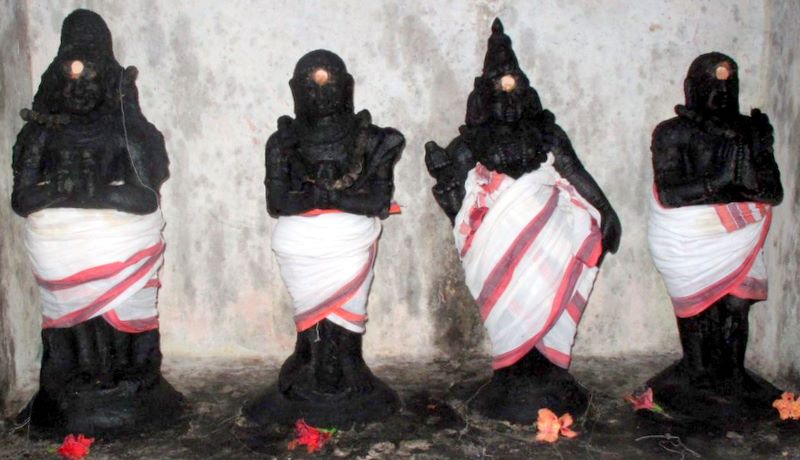
The Gneeliwaneswarar Temple — also written Neelivaneswarar or Sri Gneelivaneswarar — stands at Thiruppaingneeli (Thirupanjali), a small town about 20 kilometres north of Tiruchirappalli (Trichy) in Tamil Nadu, southern India. It is one of the 276 Paadal Petra Sthalams — the Shiva temples celebrated in the 7th-to-9th-century Tamil Thevaram hymns — and one of the smaller group of 44 sthalams whose praises were sung by all three of the saint-poets: Thirugnanasambandhar, Thirunavukkarasar (Appar), and Sundaramurthy. Its earliest dated shrine was built around 640 AD by the Pallava king Mahendravarman I, and the main complex carries inscriptions of the great Chola emperors Raja Raja Chola I and Rajendra Chola I. Locally, the temple is known as Thekku Kailasam, the “South Kailash”.

Where and What It Is
The temple is set on the northern bank of the Cauvery river, on the road from Tiruchirappalli to Karur in the Chola Nadu region. In the traditional sthalam classification it is the 61st Shiva Sthalam on the northern bank (Vadakarai) of the Cauvery. The presiding god is Lord Shiva worshipped here as Gneeliwaneswarar (the lord of the gneeli forest — a kind of indigo-blue tree), and the goddess is Neelnedunkanni, also known as Visalashi (“the wide-eyed”). The Shivalingam in the inner sanctum is a Swayambumurthy — “self-manifested” — a status given to lingams believed to have emerged from the earth on their own rather than to have been carved by human hands.
How old is the Gneeliwaneswarar Temple?
The temple’s structural history runs in three layers. The oldest dated part is the Soundareeswara sub-shrine, traditionally credited to the Pallava king Mahendravarman I in 640 AD. The wider Pallava complex was then expanded under the Cholas in the 10th and 11th centuries — the temple walls preserve inscriptions of Raja Raja Chola I (ruled 985-1014 CE), the patron of the great Brihadishwara Temple at Thanjavur, and of his son Rajendra Chola I (ruled 1014-1044 CE), who extended the Chola empire to the Ganges and across the Bay of Bengal to Southeast Asia. Later additions and renovations through the Vijayanagara and Nayaka periods completed the temple’s current footprint of gopurams, mandapams and a tank.
The Thevaram and the Three Saint-Poets
What makes the temple culturally distinctive is its place in the Tamil bhakti tradition. Between the 7th and 9th centuries CE, three Tamil Saiva saints — Thirugnanasambandhar, Thirunavukkarasar (Appar) and Sundaramurthy (Sundarar) — composed thousands of devotional hymns to Shiva known collectively as the Thevaram. The 276 temples whose deities are praised in those hymns became the canonical Paadal Petra Sthalams — literally “the places that received songs”. Of those 276, the smaller group of 44 received hymns from all three saint-poets together; Gneeliwaneswarar at Thiruppaingneeli is one of them. That triple endorsement signalled, in medieval Tamil religious culture, the very highest tier of Shaiva sanctity.

The Shrine to Yama
One feature makes Gneeliwaneswarar genuinely unusual within the Paadal Petra family: a separate shrine to Lord Yama, the god of death. Yama shrines are rare in Tamil Shiva temples — most Shaiva sanctuaries focus on Shiva himself, his consort, his sons Ganesha and Murugan, and a handful of related deities. At Thiruppaingneeli the Yama shrine has its own pilgrimage tradition: devotees come specifically to pray for the removal of obstacles to marriage and for boons of children, on the basis of a temple legend in which Yama himself was relieved of a curse here. Devotees performing these pujas perform the prayers at the Yama shrine first, then at the main Shiva sanctum.
Why “South Kailash”?
The popular name Thekku Kailasam — “South Kailash” — places Thiruppaingneeli in a small group of southern Indian Shiva temples whose sanctity is held to equal Mount Kailash in the Himalayas, the cosmological dwelling-place of Shiva himself. The claim is supported in temple tradition by the combination of a Swayambumurthy linga (the natural-manifestation status), the three-saint Thevaram endorsement, the Pallava-Chola pedigree and the unusual Yama shrine. The “South Kailash” epithet is shared in Tamil Nadu by a small handful of sites; Gneeliwaneswarar belongs to that select group, alongside temples such as Thirukoshtiyur and Pazhamalai.
Visiting the Temple
Thiruppaingneeli is easiest reached by road from Tiruchirappalli (Trichy), which has the nearest airport (Tiruchirappalli International Airport) and is well-connected by Indian Railways. The drive is approximately 30 minutes north on the Trichy-Karur road. The temple is open to visitors year-round; non-Hindus are usually permitted in the outer mandapams and prakara but not in the inner sanctum during worship. The temple is part of the broader archaeological landscape of medieval Tamil Nadu, which extends across the Chola heartland from Thanjavur and Kumbakonam in the east to Tiruchirappalli and Karur in the west. The most-visited puja times are early morning and evening (around the sandhi kalam transitions); marriage and child-boon pujas are performed throughout the day on prior arrangement.

Sources and Further Reading
- Wikipedia — Neelivaneswarar Temple
- Wikipedia — Paadal Petra Sthalam
- Shiva Temples of Tamil Nadu — Thevaara Paadal Petra Sivasthalangal index
- CasualWalker — Neelivaneswarar / Gneeliwaneswarar Temple visit guide
Another small Chola Shiva temple of the Kaveri delta is the Kailasanathar temple at Udayalur, claimed as the burial site of Rajaraja Chola I.

Neural Pathways is a collective of seasoned experts and researchers with a profound passion for unraveling the enigmas of ancient history and artifacts. With a wealth of combined experience spanning decades, Neural Pathways has established itself as a leading voice in the realm of archaeological exploration and interpretation.