The Bazda Caves are not caves. They are the hollowed-out remains of an underground limestone quarry in the Harran district of Şanlıurfa province, in southeastern Türkiye, worked from roughly the 2nd century AD until the 13th. Every straight wall, square pillar and vaulted gallery inside the hill was cut by hand, block by block, to build the city of Harran a short distance to the west. The stone that went into Harran’s Ulu Cami — the Grand Mosque — came out of this hill.
Who cut the Bazda Caves, and when?
The honest answer is that nobody has excavated the site properly, and the dating rests on indirect evidence. The quarry is generally held to have been in use from the 2nd century AD through to the 13th — a working life of something like eleven hundred years. That start date is inferred rather than proven: it aligns with the Roman period at Harran, known to the Romans as Carrhae, when the city was being built and rebuilt in cut stone on a scale that demanded an organised supply.
The firm end of the range is better evidenced. Arabic inscriptions cut into the quarry walls record activity in the 13th century, and they are specific enough to name individuals. That is unusually good evidence for a site with almost no formal archaeology behind it.
What the site is not is Assyrian. The attribution occasionally attached to Bazda — that the Assyrians cut it, on the strength of their reputation for monumental stonework — has nothing behind it. The Assyrian Empire fell at the end of the 7th century BC, some eight hundred years before the earliest activity anyone can actually document in this quarry. The same applies to claims that Bazda spans “several millennia”: the evidence supports roughly eleven centuries, all of them AD.
The archaeologist Oliver Dietrich, who visited in July 2007 on a day off from the excavation at Göbekli Tepe, put the problem plainly: there is not much research to find about this site. That was true then and it remains largely true now. The most substantial technical treatment is a geoengineering assessment of the quarries presented at the EUROCK 2013 rock-mechanics symposium — a stability study, not an archaeological one.
The claim that it is the world’s oldest
Local tourism material routinely describes Bazda as the oldest underground quarry in Türkiye, and sometimes as the oldest in the world. The first claim is plausible and hard to test. The second does not survive contact with the evidence: Egypt was working underground galleries for limestone and alabaster well over a thousand years before anything documented at Bazda. It is a good site. It does not need the superlative, and the superlative is what tends to get repeated.
How the quarrymen worked the rock
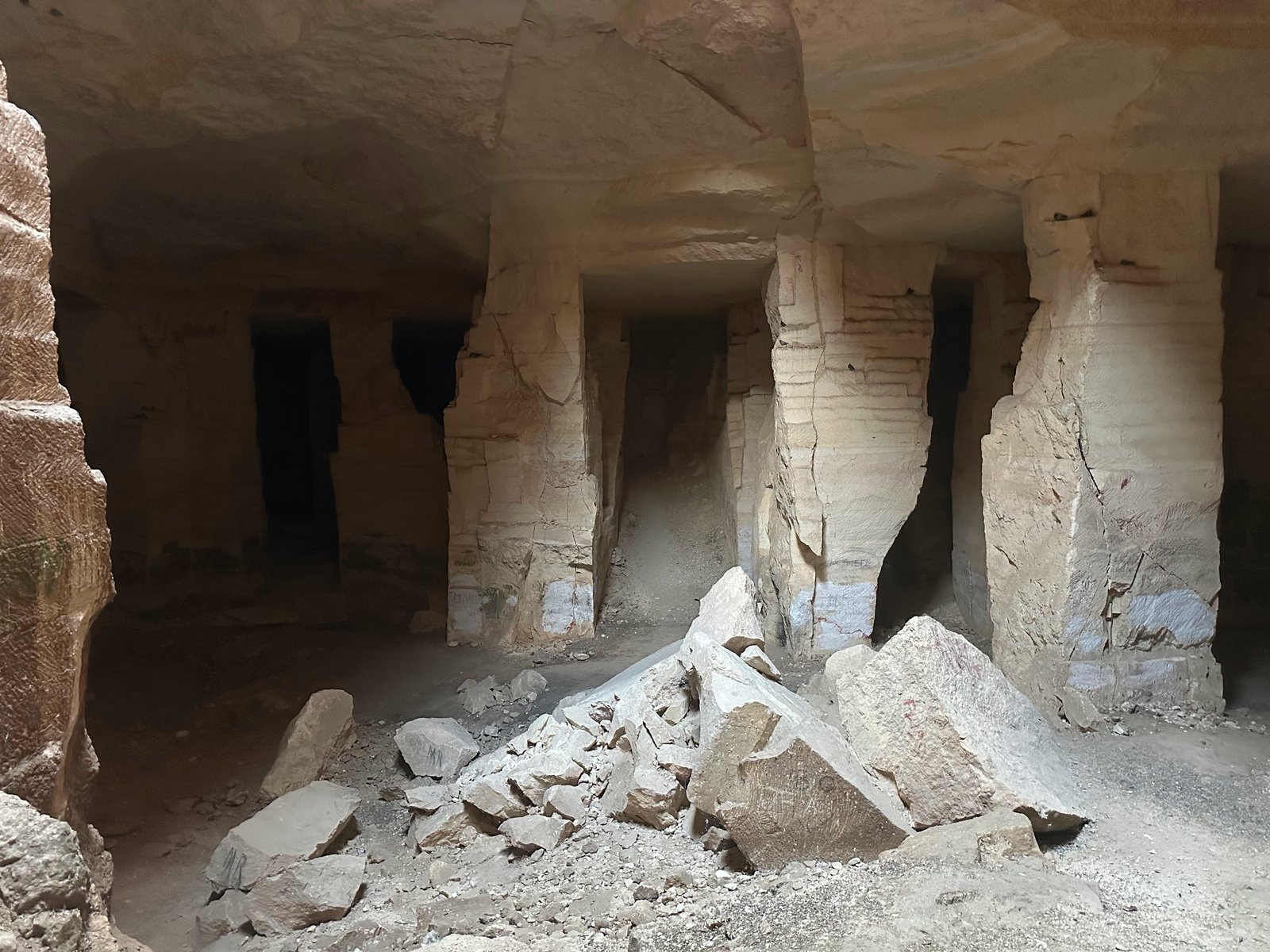
The method at Bazda is the inverse of a modern quarry. Today the approach is to strip the overburden and work downwards from an open pit. At Bazda the quarrymen drove tunnels horizontally into the hillside and took the stone out from within, leaving the hill itself standing over their heads.
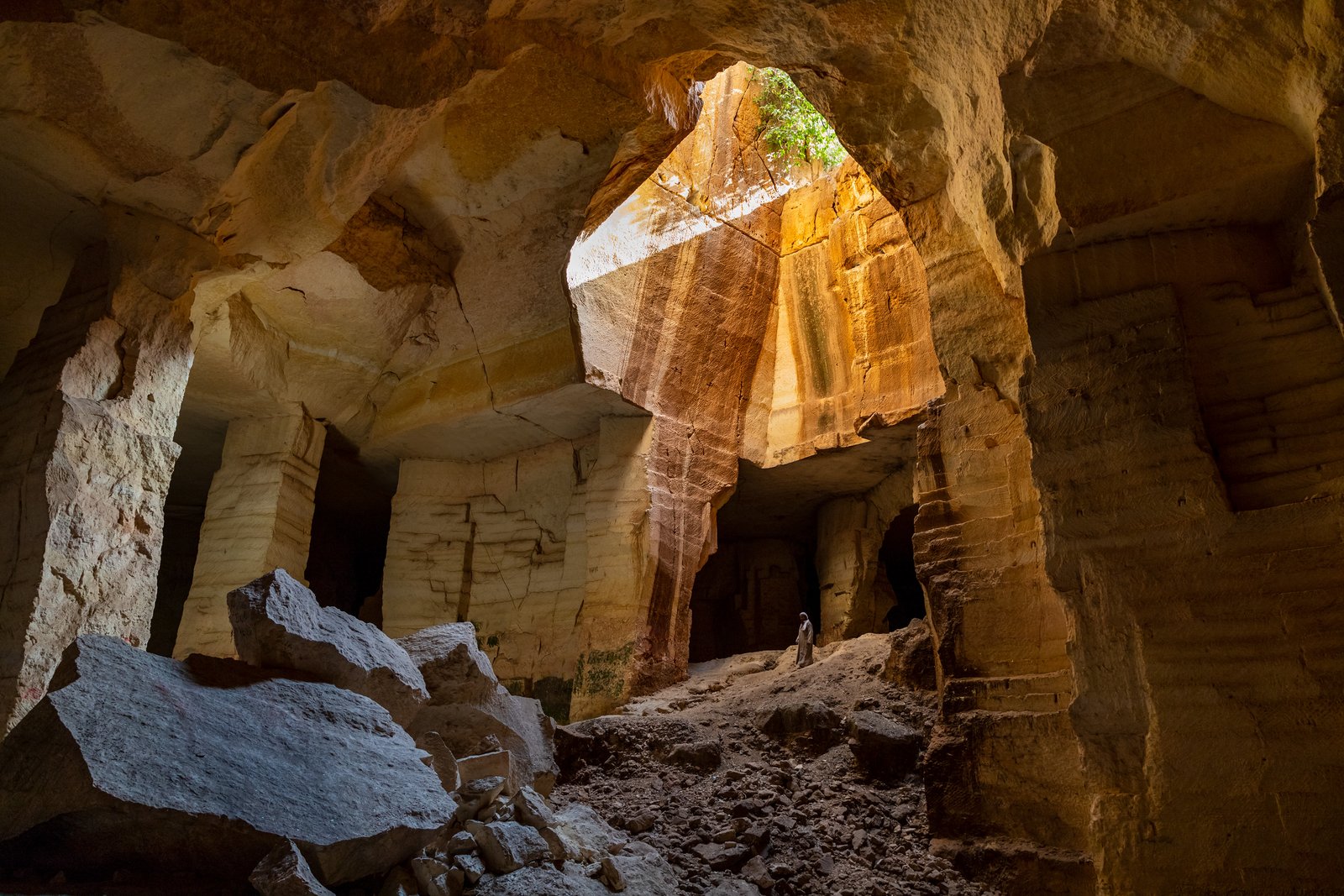
That choice has a structural consequence, and the solution is visible everywhere in the workings. Blocks were cut away in rooms, and pillars of uncut rock were deliberately left in place to carry the roof — the technique known as room-and-pillar. The pillars at Bazda are rectangular or close to square, and the feet left standing reach heights of ten to fifteen metres. Some of the underground rooms run more than fifty metres. In places the largest cave was cut on two storeys, with open squares created in the middle of the workings and long galleries and tunnels leading off toward different faces of the hill.
The stone itself is Eocene limestone — soft enough to cut with hand tools, durable enough to build with. The extraction faces still carry the marks: the rock was taken away in layers, and loose blocks lie where they were abandoned. The galleries were also cut wide and level enough to be practical haul routes, allowing carts drawn by donkeys or horses to reach the working face and carry finished blocks out.
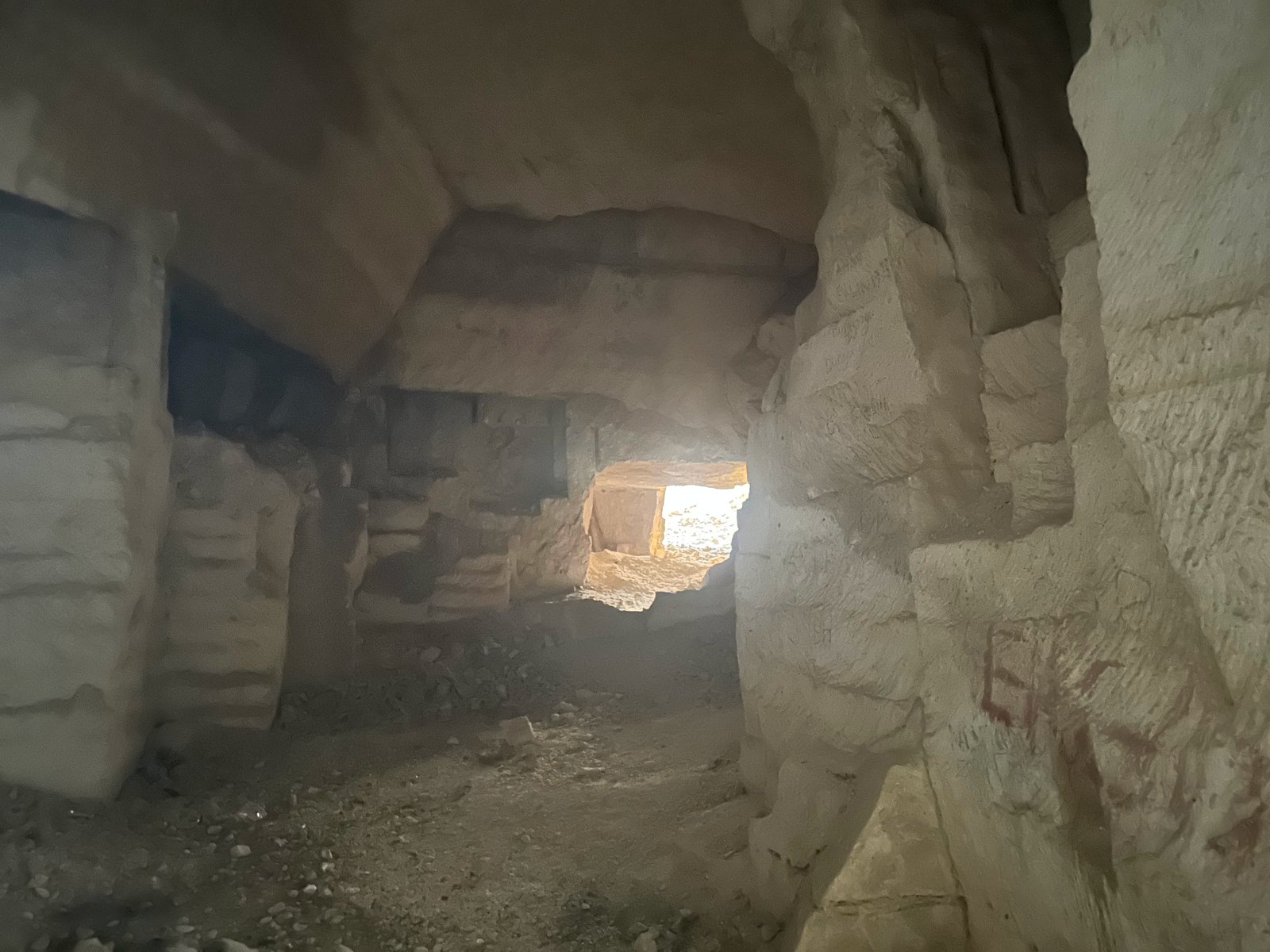
What Bazda does not appear to have is a deliberate ventilation and lighting system. Where daylight reaches the floor today, it does so through sections of ceiling that have collapsed — a failure of the roof, not a design feature.
The stone that built Harran
Bazda’s significance is not really about the quarry. It is about what the quarry explains. Harran is one of the most continuously important cities of upper Mesopotamia — a centre of the moon-god cult, the site of the Roman defeat at Carrhae in 53 BC — where Crassus lost 20,000 men and the First Triumvirate its balance — and later home to what is often described as the first university of the Islamic world. It sits in a dry, largely treeless plain. The obvious question about any stone city in that landscape is where the stone came from, and Bazda is the answer.
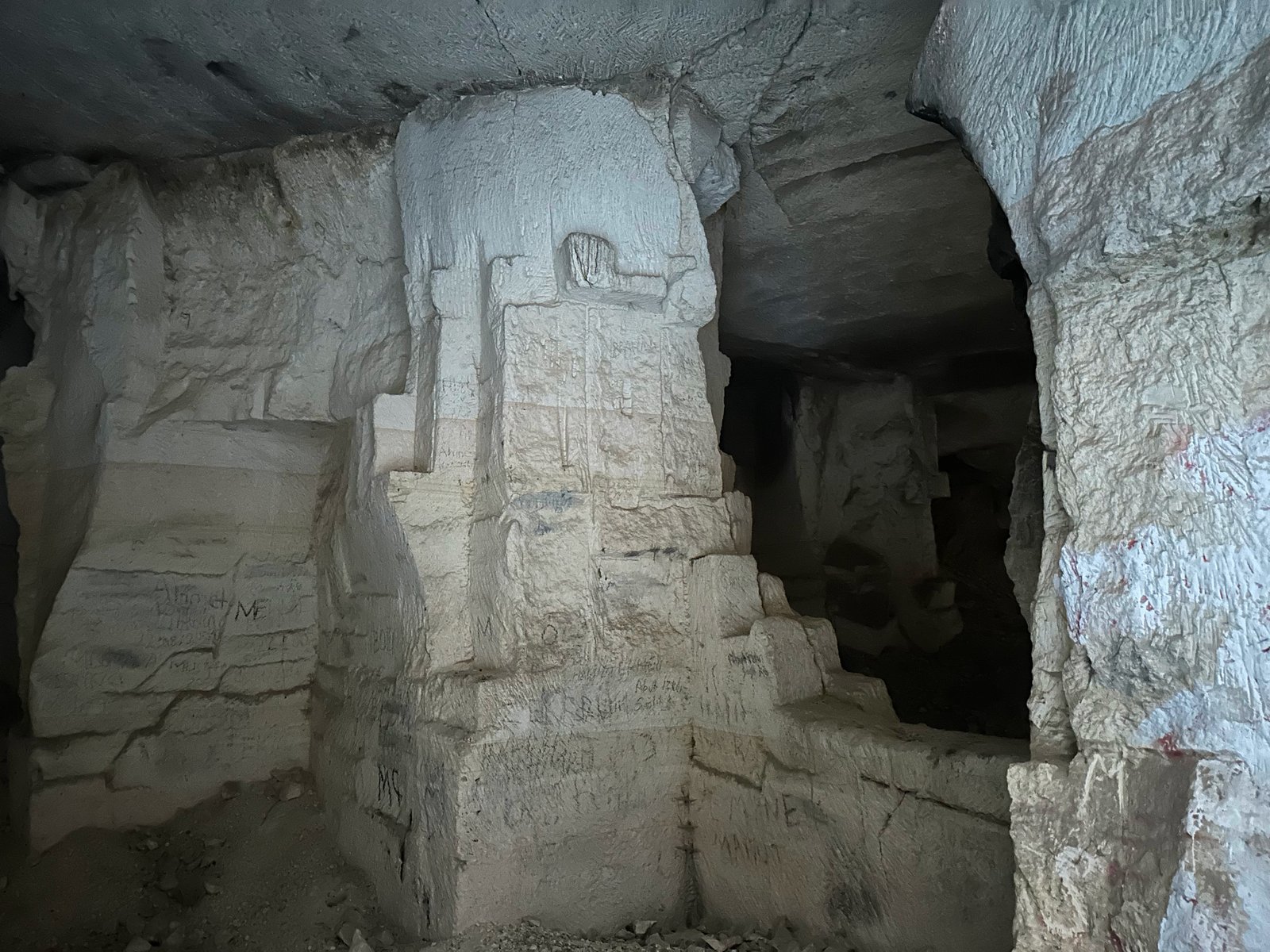
The quarry supplied Harran’s buildings, including its Ulu Cami — the Grand Mosque — whose stone is held to have come entirely from these caves. Its output also went to the surrounding sites of the Harran plain, including the settlement at Şuayb City and the Han El-Ba’rur caravanserai on the road east. Hundreds of years of cutting for those projects is what produced the squares, tunnels and galleries that survive.
Harran’s Ulu Cami and the Han El-Ba’rur
The relationship runs both ways, and it is the reason Bazda is worth taking seriously as a historical document. Harran’s monuments are mostly ruined and heavily rebuilt; the quarry preserves the negative space of those same buildings. Every block missing from the hill is a block that went into a wall somewhere on the plain. Read together with the standing remains — the city walls, the mosque, the mound — the quarry gives a sense of the sheer scale of quarrying that a medieval Mesopotamian city required, and of the labour force behind it.
The men who signed the walls
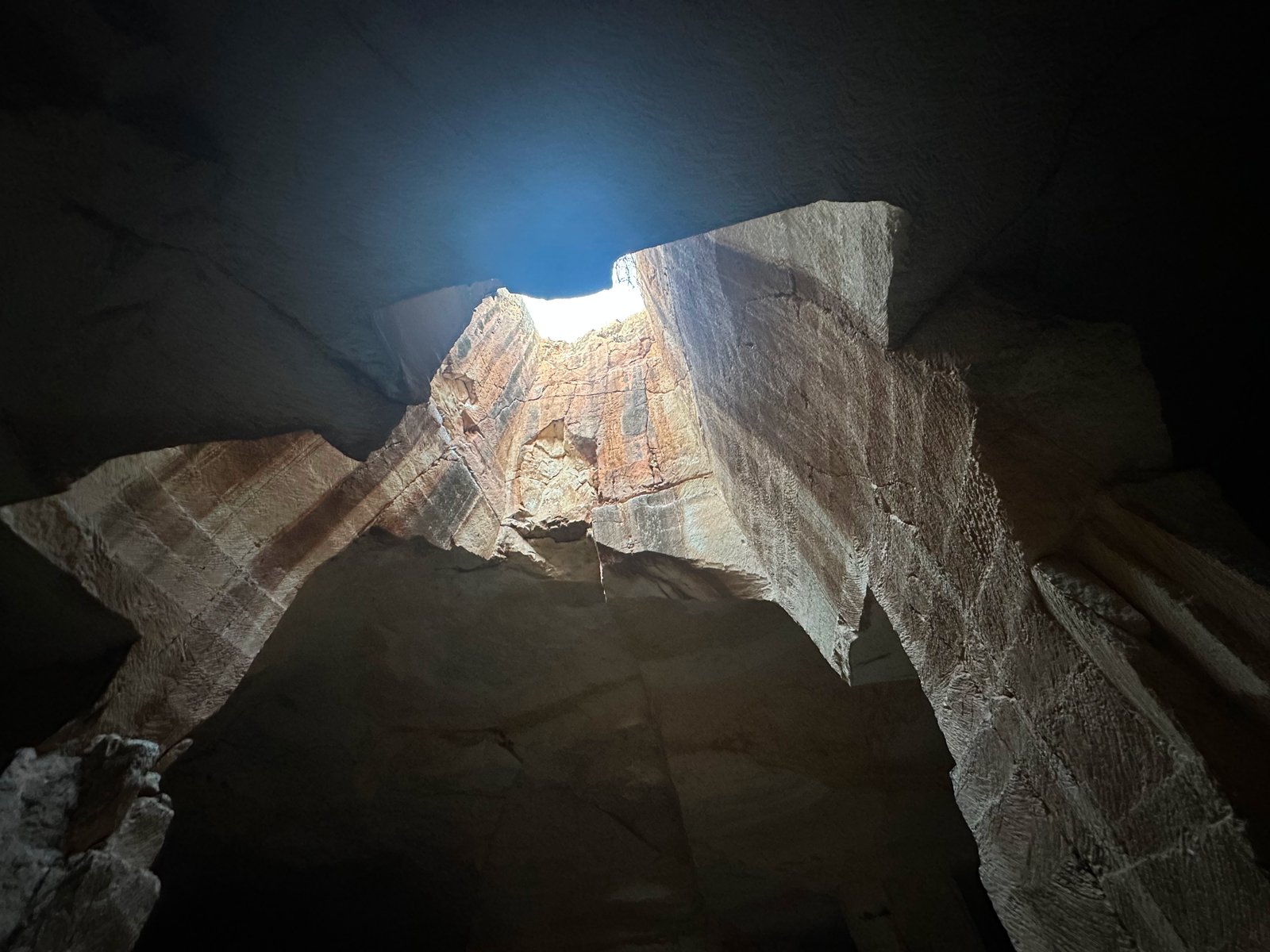
The most valuable thing in the Bazda Caves is writing. Arabic inscriptions cut into the rock record that the quarry was being operated in the 13th century, and they name the men running it: Abdurrahman el-Hakkâri, Muhammet İbn-i Bakır and Muhammed el-‘Uzzar. Transliterations vary across sources — the same three appear elsewhere as Abd al-Rahman al-Hakkari, Muhammad ibn Bakr and Muhammad al-Azhar — but the names, and the century, are consistent.
This matters more than it might sound. Quarries are among the most anonymous places in the ancient world. The people who cut the stone are almost never named anywhere, while the patrons who commissioned the buildings are named constantly. At Bazda the hierarchy is briefly inverted: we have no securely attributed architect for Harran’s Grand Mosque, but we do know the names of men who were working the quarry that supplied it. The inscriptions also carry the site’s firmest date, anchoring the late end of its working life to a period when Harran was still a functioning city — before the Mongol campaigns of the 13th century emptied it.
What the site looks like today
Bazda lies east of Harran, off the road running toward the Han El-Ba’rur caravanserai, reached by a rough track through a partly abandoned village. Nothing on the surface prepares you for it. Visitors consistently describe the same sequence: an unpromising landscape, a small sign, a modest hole in the hillside with concrete steps leading down — and then a vast, sharp-edged, obviously artificial space opening out underground. The Dutch broadcaster Wilco van Herpen, writing in Hürriyet Daily News after a visit, recorded exactly that reversal, and noted the detail that gives the place away: all the walls are straight.
The caves are protected as part of Türkiye’s cultural heritage, and much of the site remains undeveloped, unlit and unfenced, with collapsed ceilings and uneven floors. It is not a managed show cave. The lack of development is also why it survives in the state it does — the extraction faces have not been cleaned up or reconstructed, and the tool marks are still legible on the rock. For anyone interested in how pre-modern cities were actually supplied, Bazda is a more informative ruin than most of the monuments it built. Comparable evidence survives at Türkiye’s Yesemek quarry and sculpture workshop, where the stone was worked on site rather than hauled away raw.
At a glance
- Country: Türkiye (Harran district, Şanlıurfa province)
- Also known as: Bazda Mağaraları, Albazdu, Elbazde, Bozdağ Caves
- Type: Underground limestone quarry (man-made), room-and-pillar workings
- Stone: Eocene limestone
- Period of use: c. 2nd century AD – 13th century AD
- Cultures: Roman, Byzantine, medieval Islamic
- Supplied: Harran (including the Ulu Cami), Şuayb City, Han El-Ba’rur caravanserai
- Scale: Rooms over 50 m; rock pillars 10–15 m high; two-storey workings in places
- Hub: More sites like this in Historical Places
Frequently asked questions
Are the Bazda Caves natural caves?
No. The Bazda Caves are entirely man-made — an underground limestone quarry, not a karst cave system. The giveaway is the geometry: the walls are flat and vertical, the ceilings are level, and the pillars are rectangular or nearly square. Quarrymen tunnelled horizontally into the hillside and cut blocks out from within, leaving pillars of uncut rock to support the roof. Loose blocks and tool marks are still visible on the extraction faces. The only natural features are the sections of ceiling that have since collapsed, which now let daylight into parts of the workings.
How old are the Bazda Caves?
The quarry is generally dated to between the 2nd and the 13th centuries AD, giving it a working life of roughly eleven hundred years. The early date is inferred from the Roman-period building programme at Harran, then known as Carrhae, rather than established by excavation. The late date is much firmer: Arabic inscriptions on the quarry walls record operations there in the 13th century. Claims that the caves are Assyrian, or that they span several millennia, are not supported — the Assyrian Empire ended some eight centuries before the earliest documented activity at the site.
What was quarried at Bazda, and where did it go?
Bazda produced Eocene limestone, soft enough to cut with hand tools but durable enough to build with. Its output supplied the city of Harran a short distance west, including the stone for Harran’s Ulu Cami, or Grand Mosque, which is held to have come entirely from these caves. Stone from Bazda also went to nearby sites on the Harran plain, among them the settlement at Şuayb City and the Han El-Ba’rur caravanserai. Centuries of cutting for those projects hollowed out the squares, galleries and tunnels that survive today.
Sources and further reading
- Oliver Dietrich, A visit to the Bazda quarry caves near Harran, southeastern Turkey — first-hand account by an archaeologist working at Göbekli Tepe, with photographs (2021).
- Wilco van Herpen, Bazda caves near Harran, Hürriyet Daily News (2013) — site description and the 13th-century wall inscriptions.
- Bazda Mağaraları — Şanlıurfa Metropolitan Municipality, on the workings, the named 13th-century operators and the two-storey galleries.
- Harran — Wikipedia, for the city the quarry supplied, and its history as Carrhae.
- Harran — World History Encyclopedia, on the city’s role in upper Mesopotamia.
- Patrick Scott Smith, Battle of Carrhae, 53 BCE — World History Encyclopedia, for the Roman defeat at the city the quarry later supplied.
- Bazda Caves — Lonely Planet, on the site’s condition and access.