The North Grotto Temple, known in Chinese as Beishiku Si (北石窟寺), is a Buddhist cave complex carved into the cliffs of Fuzhong Mountain near Qingyang, in China’s Gansu Province. It was founded in AD 509, in the sixth century, by Xi Kangsheng, the Northern Wei military governor of Jingzhou, in the aftermath of a bloody provincial revolt. Over the following eight centuries carvers enlarged it into more than 300 caves holding over 2,000 stone statues, making it one of the four great grottoes of Gansu and a quiet waystation on the Silk Road’s Guanlong route.
For all that history, the temple remains little known outside China, and the version of its story that circulates online is often wrong — crediting the wrong emperor, inventing a modern “discovery”, and glossing over the general whose guilt, or ambition, first put chisels to the rock. This article sets out what the archaeological and textual record actually supports.
A General’s Temple: The Founding of AD 509
The North Grotto Temple did not begin as an act of imperial patronage. Its founder was Xi Kangsheng, a Northern Wei general appointed governor of Jingzhou, the prefecture that then administered this stretch of the Ru and Pu river valleys. In AD 509 a revolt broke out in the region — later accounts name the rebel leader Liu Huiwang — and the court dispatched Xi Kangsheng to crush it. He did so with heavy bloodshed.
In the same year, having pacified the prefecture, Xi Kangsheng ordered a great cave temple carved into the cliff at the foot of Fuzhong Mountain. A year later he founded a companion site further south, the South Grotto Temple (Nanshiku Si) near Jingchuan. The two are known as “sister grottoes”: twin foundations of a single patron, begun within twelve months of each other, and among the very few Chinese cave temples whose founding patron and date are securely recorded.
Piety, politics, or penance?
Why a victorious general should spend a fortune on Buddhist sculpture is a question the sources answer in more than one way. One tradition holds that Xi Kangsheng acted out of remorse for the monks and civilians killed in suppressing the revolt — a work of penance to settle an uneasy conscience. A more political reading is that the temple was built to steady the hearts of a traumatised population, binding the frontier to the dynasty through a shared devotional monument. The two motives are not exclusive. The Northern Wei had already sponsored the colossal imperial cave-temples at the Yungang Grottoes and were beginning work at Longmen, so a provincial governor commissioning his own grotto simply followed an imperial fashion.
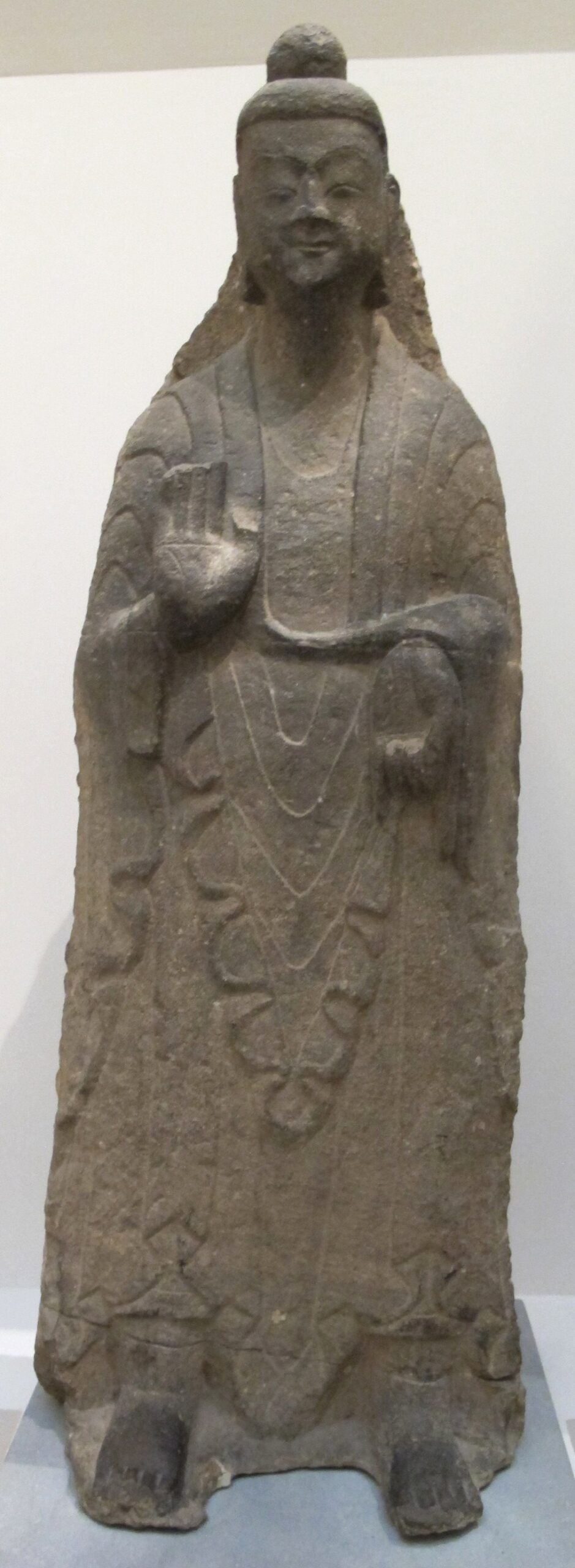
Cave 165: The Seven-Buddha Cave
The heart of the complex, and its earliest surviving cave, is Cave 165 — the Seven-Buddha Cave. Cut under Xi Kangsheng’s direction, it is a large chamber dominated by seven standing Buddhas, each about eight metres tall: three carved across the rear wall and two on each side wall. Between and around them stand attendant bodhisattvas — including a figure roughly four metres high — along with guardian and disciple statues. The scale was deliberate; these are among the largest Northern Wei figures in the region.
Why seven Buddhas?
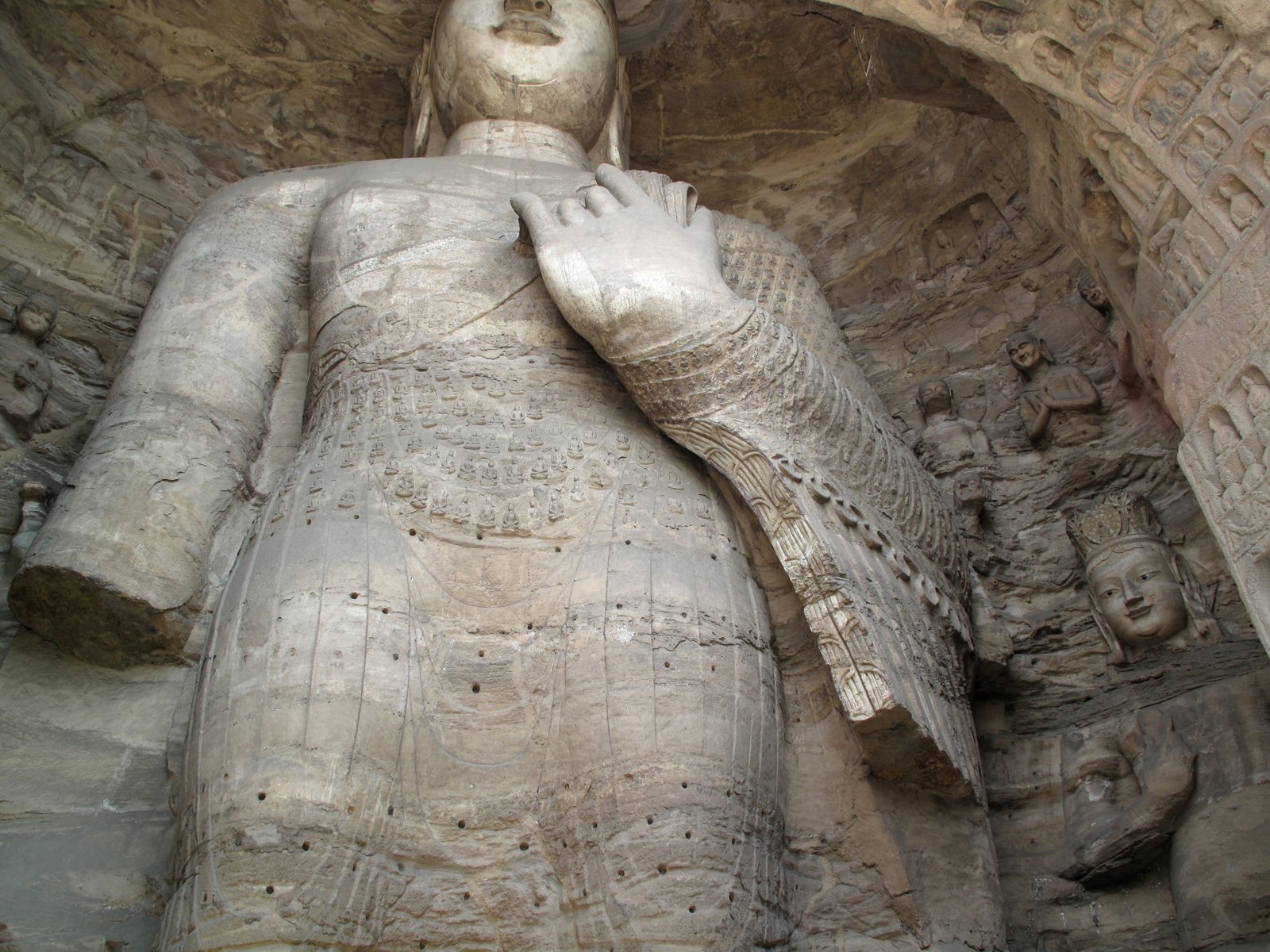
The seven figures represent the Sapta Tathagata, the “Seven Buddhas of the Past” — the six Buddhas said to have preceded the historical Buddha Shakyamuni, together with Shakyamuni himself. The theme had deep roots in early Chinese Buddhist art, but Cave 165 gave it monumental cave-temple form on an unprecedented scale, and it is often credited with setting a precedent that later Seven-Buddha caves across northern China would follow. The iconography echoed down the centuries; a comparable Seven-Buddha grouping survives from the Northern Zhou period, shown below.
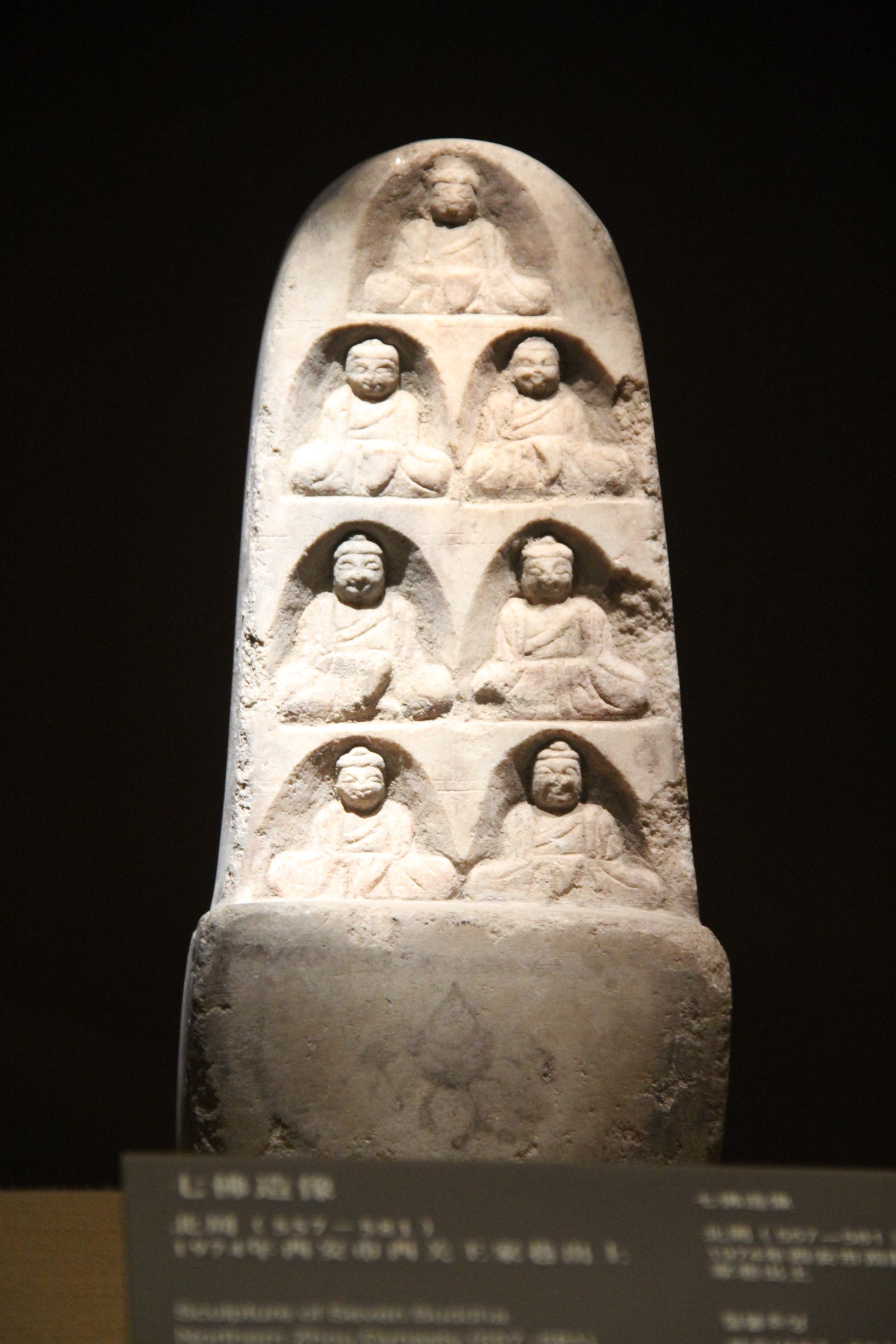
Eight Centuries of Carving: Northern Wei to Song
Cave 165 was only the beginning. Later dynasties returned to the cliff again and again, and the surviving caves record an almost continuous sequence of Buddhist patronage. Surveys count roughly 300 caves and niches in all — one widely cited figure is 307 — holding about 2,126 stone statues.
The distribution across the dynasties is uneven and revealing: seven caves survive from the Northern Wei (386–534), three from the Western Wei (535–556), thirteen from the Northern Zhou (557–581), sixty-three from the Sui (581–618), and 209 from the Tang (618–907), with a single cave added under the Song. In other words, roughly two-thirds of the temple is Tang work — the product of the era when Chinese Buddhism, and Chinese cave-temple carving, reached their height.
The Tang high-water mark
Cave 222, a large Tang chamber, is the best-known of the later additions. It shows the rounder, more naturalistic modelling of Tang sculpture set against the flatter, more archaic Northern Wei style of Cave 165 — two schools of Buddhist art preserved a few metres apart. After the fourteenth century no new caves were cut, but the site was never abandoned: it remained a place of worship and was repaired and repainted across the later centuries.
How was the North Grotto Temple built and preserved?
The caves were cut directly into the river-cliff face. Carvers hollowed each chamber out of the living rock, then shaped the statues in place rather than assembling them from blocks. The complex is not a single cliff but five separate cave groups strung along about three kilometres of the valley: the Sigou, Loudi Village, Shidaopo, Huabaoya and Shiyadongtai grottoes. The main concentration sits on a terrace where the Pu and Ru rivers meet, some 25 kilometres from modern Qingyang.
Its survival owes much to that remoteness. Tucked into a provincial valley far from the great capitals, the temple escaped the worst of the persecutions and wars that scarred more famous sites. Dating the caves has relied not on radiocarbon methods — which cannot date carved stone — but on dated inscriptions, dedicatory records and the stylistic evolution of the sculpture. Today Beishiku Si is protected as a Major Historical and Cultural Site at the National Level, with a dedicated institute monitoring the fragile carvings.
The North Grotto Temple on the Silk Road
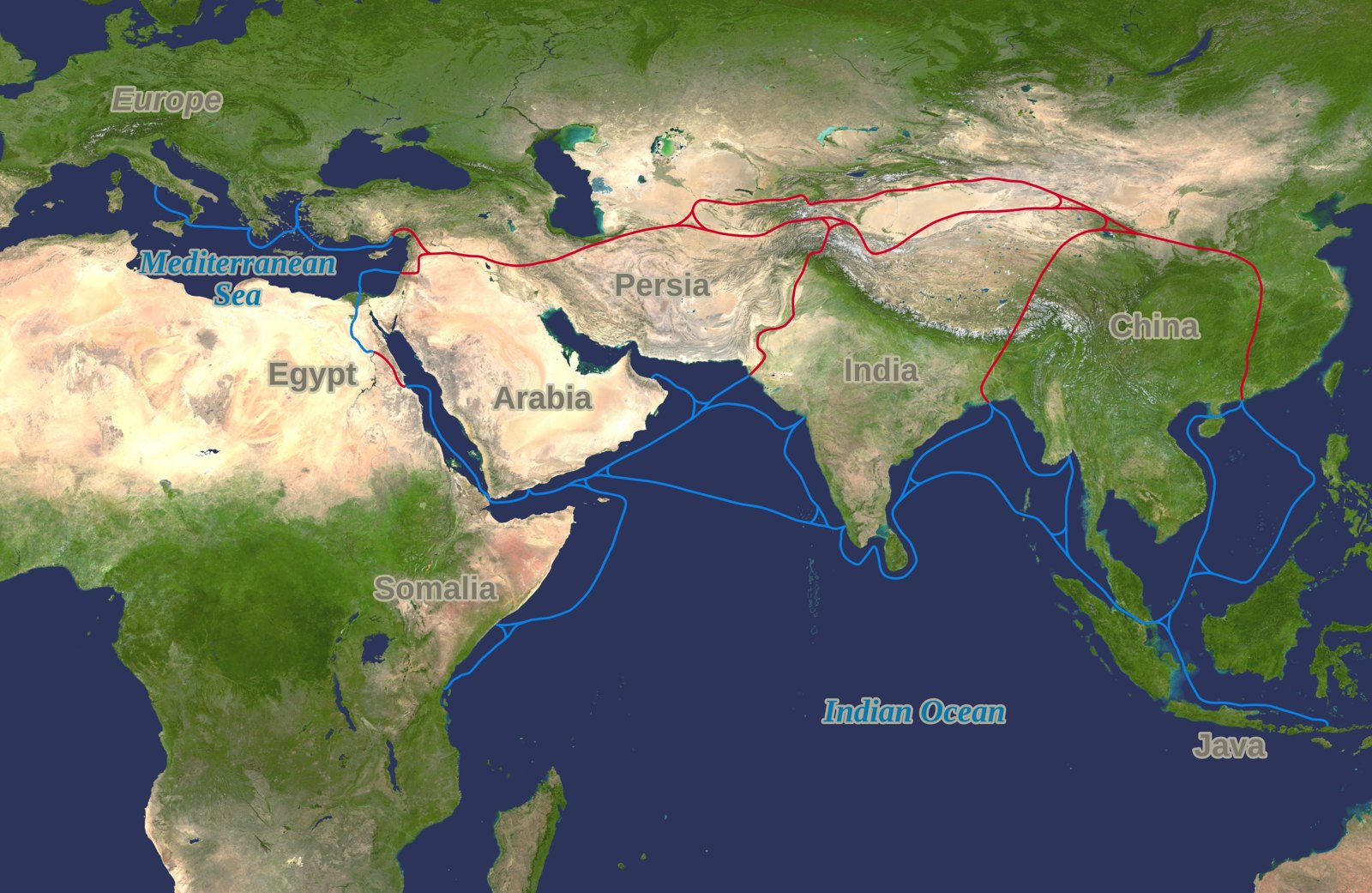
The temple’s location was not accidental. It stood at the eastern mouth of the Xiaoguan Road, a branch of the Guanlong route that carried traffic between the Wei River valley around Chang’an and the northwestern frontier. Merchants, monks and armies moving along this corridor passed through the Jing river basin, and the Buddhist faith travelled with them. Cave temples like Beishiku Si were both products of that traffic and stations along it — places where travellers could make offerings for a safe journey.
Seen this way, the North Grotto Temple belongs to a chain of grottoes strung across Gansu and the northwest along the Silk Road. To the west lie the Bingling Temple Grottoes above the Yellow River; to the north, the Xumishan Grottoes in Ningxia; and further along the same devotional highway, later colossal projects such as the Binxian Great Buddha near Chang’an. Its nearest neighbour, the Andingsi Grottoes, lies in the same Qingyang uplands. Together they map the spread of Buddhism into China along the trade roads of the first millennium. For more sites like it, browse our historical places archive.
Frequently Asked Questions
Who built the North Grotto Temple, and when?
The North Grotto Temple was founded in AD 509 by Xi Kangsheng, the Northern Wei governor of Jingzhou, immediately after he suppressed a regional revolt led by Liu Huiwang. Contrary to a common online claim, it was not begun by Emperor Xiaowen, who had died a decade earlier in 499. A year later, in 510, Xi Kangsheng founded the companion South Grotto Temple (Nanshiku Si) near Jingchuan; the two sites are known as sister grottoes.
What is Cave 165, the Seven-Buddha Cave?
Cave 165 is the temple’s earliest and grandest cave, carved under Xi Kangsheng around 509. It contains seven standing Buddhas about eight metres tall — the Seven Buddhas of the Past — arranged three across the rear wall and two on each side, with attendant bodhisattvas. It is regarded as one of the earliest monumental Seven-Buddha caves in China and is often said to have set the pattern for later examples across the north.
Is the North Grotto Temple a UNESCO World Heritage Site?
No. Despite its age and importance, Beishiku Si is not inscribed on the UNESCO World Heritage List. It is protected under Chinese law as a Major Historical and Cultural Site at the National Level, and it lies on the Guanlong branch of the Silk Road. It should not be confused with UNESCO-listed grottoes such as Longmen, Yungang or the Mogao Caves, nor with the similarly named Northern Xiangtangshan grottoes in Hebei.
Sources and Further Reading
- World History Encyclopedia — The Silk Road
- World History Encyclopedia — Buddhism
- Wikipedia — Northern Wei dynasty
- Showcaves — Beishiku Si (North Grotto Temple)

Neural Pathways is a collective of seasoned experts and researchers with a profound passion for unraveling the enigmas of ancient history and artifacts. With a wealth of combined experience spanning decades, Neural Pathways has established itself as a leading voice in the realm of archaeological exploration and interpretation.