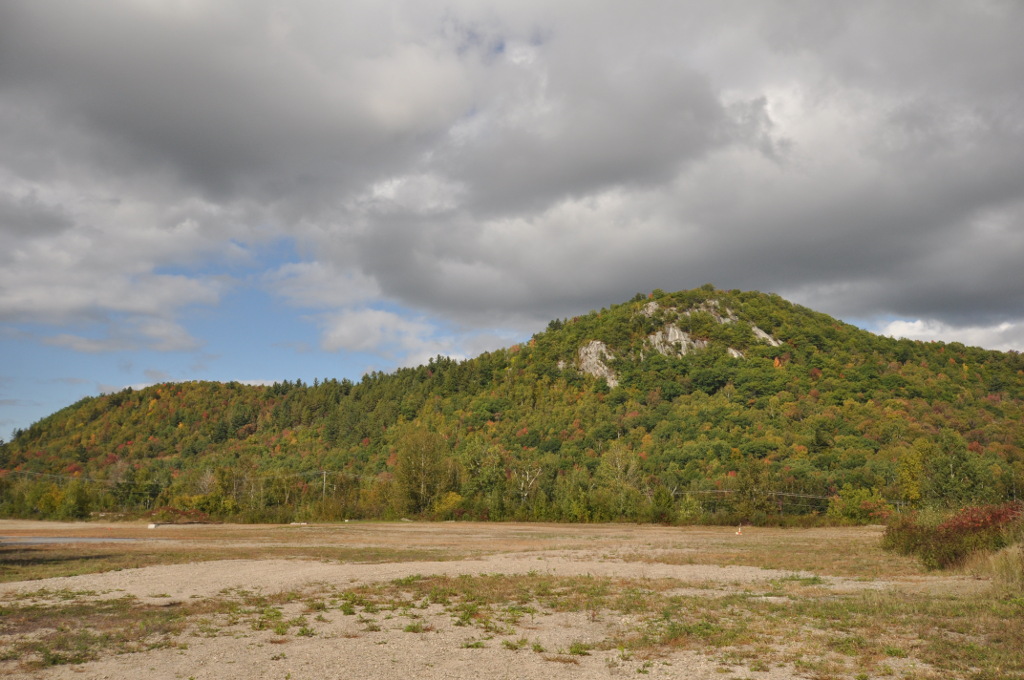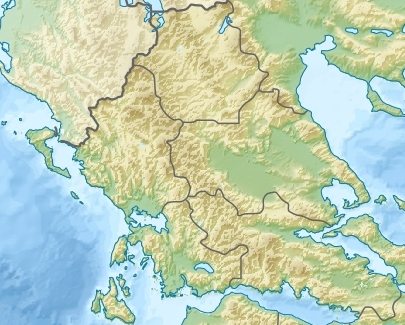
The Theopetra Cave is a prehistoric site on the northeastern slope of a limestone hill above the village of Theopetra, in the Thessaly region of central Greece — close to the famous monasteries of Meteora and overlooking the valley of the Lethaios river, a tributary of the Pineios. It has been continuously occupied by humans from at least 130,000 years ago, through the entire Middle Paleolithic, the Upper Paleolithic and the Neolithic. The site contains the oldest known human-made structure in Greece — a stone wall dated to roughly 23,000 years ago, built across the cave entrance during the last Ice Age — and three small human footprints, dated to around 135,000 years ago and believed to have been made by children.

Where and What It Is
The cave sits about 100 metres above the valley floor on the slopes of a 2.5-million-year-old limestone outcrop. Its single chamber is roughly 500 square metres in floor area — large by Greek prehistoric standards — with a wide southeast-facing opening. The valley below carries the Lethaios river towards its confluence with the Pineios, which gives the cave a strategic position on a natural movement corridor connecting Thessaly’s interior to the Aegean coast. The cave entrance was widened during occupation; the natural rock was modified to provide a better shelter, and a stone wall built across part of the entrance is now interpreted as a windbreak against last-glacial cold.
How old is the Theopetra Cave?
Radiocarbon and luminescence dating of the cave’s deepest layers places human occupation as far back as 130,000 years ago — in the Middle Paleolithic. The earliest occupants were Neanderthals; layers from approximately 50,000 to 35,000 years ago show the transition to anatomically modern humans (Homo sapiens), making Theopetra one of the few European sites where this replacement is preserved within a single continuous stratigraphy. Occupation continues uninterrupted through the Upper Paleolithic, Mesolithic and Neolithic, ending around 4,000 BCE. No other site in Greece preserves so long an unbroken record of human use.
The Children’s Footprints
One of Theopetra’s most striking finds is a set of three small human footprints preserved in a layer of clay sediment dated to approximately 135,000 years ago. The footprints are arranged in a brief stride pattern and — judging by their dimensions — were almost certainly made by children aged between two and seven. They are among the oldest hominin footprints discovered in Greece and one of the very few preserved sets dated to the Middle Paleolithic. The clay layer in which they sit was eventually covered by later occupation debris, sealing the prints under thousands of years of habitation.
The Oldest Man-Made Structure?
The most-publicised find from Theopetra is a stone wall built across part of the cave entrance, dated by optically-stimulated luminescence to approximately 23,000 years ago — the height of the Last Glacial Maximum. Researchers have argued that the wall was built to reduce wind chill and keep the cave’s interior habitable during the coldest period of the Late Pleistocene. If the dating holds, this is one of the oldest known examples of constructed architecture anywhere in the world. The claim is not universally accepted — some archaeologists prefer to call it a “modified natural feature” rather than a wall in the modern sense — but the consensus is that it represents deliberate human modification of the cave for shelter.
The Neanderthal-to-Sapiens Transition
What makes Theopetra most valuable to specialists is what its single stratigraphic column captures: two of the great transitions in European prehistory, both visible within one site. The lower layers contain Mousterian-tradition stone tools associated with Neanderthals; the layers from around 50,000–35,000 years ago show the gradual replacement by the blade-based Upper Paleolithic toolkits of Homo sapiens. Higher still, the cave records the much later shift from hunter-gathering to farming at the start of the Neolithic, around 9,000 years ago. Few sites in Europe contain both transitions in undisturbed sequence — most cave occupations record one phase or the other, not both.

Discovery and Excavation
Theopetra was systematically excavated from 1987 onwards by Dr Nina Kyparissi-Apostolika, a senior archaeologist at the Greek Ministry of Culture and the founder of the Ephorate of Palaeoanthropology and Speleology of Southern Greece. Excavations continued for over 25 years and uncovered thousands of stone tools, fragments of pottery, hearths, animal bones, and the small but extraordinary set of fossil footprints.
From closure in 2016 to the 2025 reopening
The cave was opened to the public as a managed archaeological site, but a series of partial collapses and conservation concerns led to its closure in 2016. In April 2025, after nearly nine years of structural reinforcement, the Greek Ministry of Culture reopened Theopetra Cave to visitors.

Visiting Theopetra Today
The cave is open to the public on a guided-tour basis, with strict visitor numbers to protect the deposits and the footprint layer. It is part of the broader archaeological landscape of Meteora and Thessaly, and is easily accessible by car from the town of Kalambaka. Tours are run by the Greek Ministry of Culture; the on-site interpretation centre displays a selection of the excavated tools and bones together with reconstructions of the cave’s stratigraphy. For visitors heading to the famous Meteora monasteries, Theopetra is roughly 4 kilometres south and a short detour from the main road.
Sources and Further Reading
- Wikipedia — Theopetra Cave
- Greek Reporter — Theopetra Cave reopens after 9 years (April 2025)
- Cambridge / Radiocarbon — The Cave of Theopetra, Kalambaka: Radiocarbon Evidence for 50,000 Years of Human Presence
- Archaeology & Arts — Theopetra Cave, Thessaly: 130,000-year-old prehistory
A comparable layered cave sequence survives in North America at Graham Cave State Park in Missouri, occupied from the Dalton period around 8000 BC.