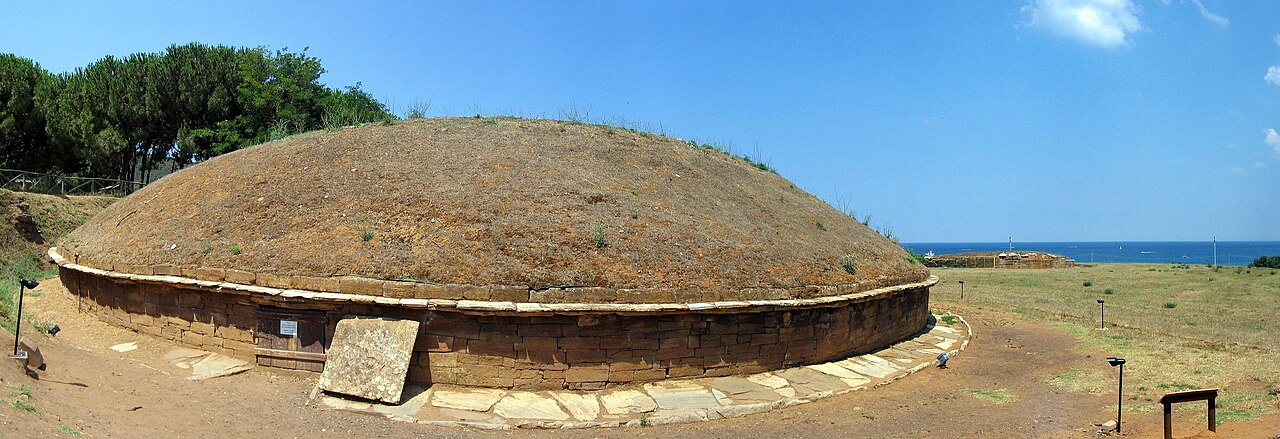
The “Necropolis of Tumuli” at Bolsena is not a conventional Etruscan cemetery. It is a series of four enormous submerged stone tumuli, known locally as the “Aiole”, lying just offshore in the volcanic Lake Bolsena in Lazio, Italy. The largest, off the Gran Carro site on the lake’s eastern shore, is roughly 5 metres high and 80 metres long, and is one of the most monumental prehistoric ritual structures known in central Italy. The mounds were built over the lake’s thermal springs by Final Bronze Age and Early Iron Age communities — most likely Villanovan, but possibly older Rinaldone-culture — and contained pottery, bronzes and a recently-recovered 3,000-year-old goddess figurine still bearing the fingerprints of the maker.

Where and What It Is
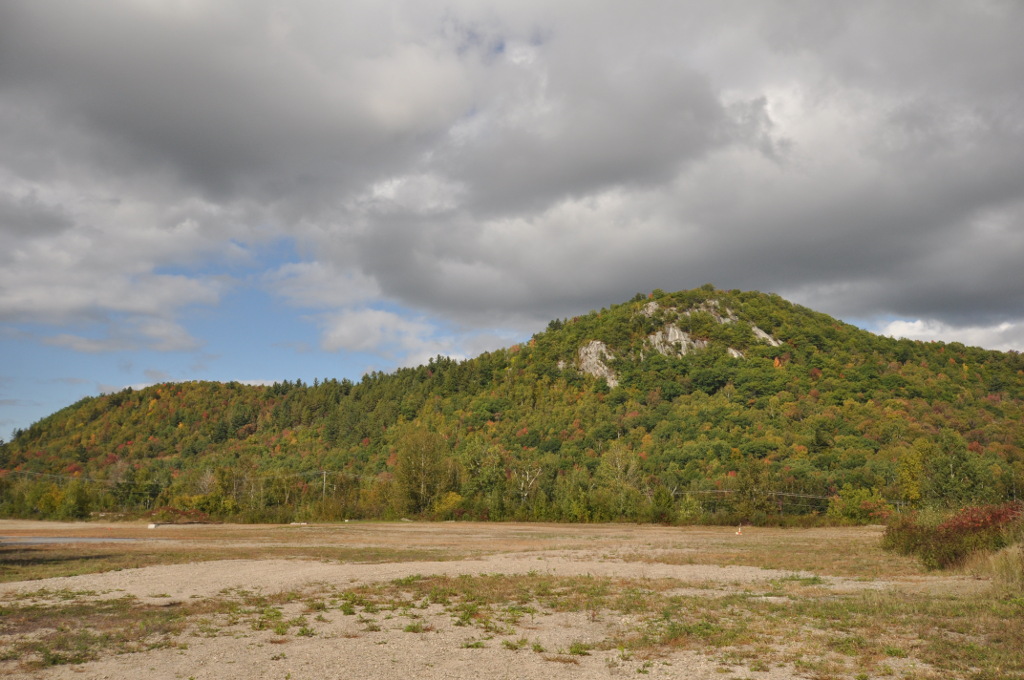
Lake Bolsena (Lago di Bolsena) is a volcanic caldera lake in the province of Viterbo in Lazio, central Italy — the largest of its kind in Europe, formed by collapse of the Vulsini volcanic complex around 370,000 years ago. The lakeshore was occupied in the prehistoric period and again in the Etruscan and Roman periods; today its eastern shore is dominated by the town of Bolsena, ancient Volsinii Novi, founded after the Romans destroyed Velzna (modern Orvieto) in 264 BCE. The submerged Aiole tumuli sit offshore from the lakeshore in roughly 3 to 5 metres of water, with the largest — the Aiola of Gran Carro — directly beside the underwater Iron Age stilt-house settlement of the same name.
How old are the Aiole tumuli?
The standard attribution places the Aiole in the Final Bronze Age and Early Iron Age, roughly the 12th to 9th centuries BCE, in the Villanovan or proto-Villanovan cultural phase. The Gran Carro Aiola sits directly above an Iron Age stilt-house village dated by dendrochronology and radiocarbon to the late 10th and 9th centuries BCE, and the two sites are clearly related. However, some excavators argue that the pottery deposits at the base of the mounds include earlier Copper Age material, and the gigantic monumental scale of the tumuli — well above anything else in the Villanovan repertoire — points to a possible Rinaldone-culture origin in the 4th-3rd millennia BCE, with later Villanovan reuse. The question is open.
The Gran Carro Aiola and Its Hot Spring
Of the four Aiole, the Gran Carro Aiola is the best studied. It rises about 5 metres above the lakebed, measures roughly 80 metres long by 60 metres wide, and was built from a great pile of large unworked stones laid up around a central depression. At the centre, a powerful thermal spring bubbles up from the lakebed at around 30°C — well above the lake’s normal cold temperature. The placement is the key clue to the mound’s function. Pre-Etruscan and early Etruscan religion treated thermal springs as openings into the chthonic world, and the systematic encasing of a thermal spring under a stone mound is best read as a foundation ritual or sacred enclosure, not a tomb.

The 2024 Goddess Figurine
In 2024, an Italian Carabinieri underwater archaeological team working on the Gran Carro site recovered a small, intact terracotta goddess figurine, roughly 3,000 years old, from sediments beside the Aiola. The figure’s surface preserved the fingerprints of its prehistoric maker — a rare survival, and a powerful piece of evidence that a single individual modelled the figure by hand at the time the Aiola was in use. The find drew international attention and prompted the Italian Soprintendenza to formally extend the protected zone around the Gran Carro site. The figurine is now in conservation at the Bolsena Territorial Museum, with public display planned once analysis is complete.
The Gran Carro Stilt-House Settlement
Beside the largest Aiola lies the contemporary Gran Carro settlement — a submerged Villanovan stilt-house village, known since 1959, where more than 500 wooden piles driven into the lakebed survive in remarkable condition. The piles supported a cluster of wooden houses that originally stood above the lake’s surface; subsequent inundation, possibly linked to volcanic-tectonic subsidence of the caldera, preserved them under sediment. Recent underwater excavations have recovered ceramics, bronze tools, animal bone and structural timbers that together establish Gran Carro as one of Europe’s most important Early Iron Age waterside settlements — and as the daily-life counterpart to whatever ritual activity was taking place around the neighbouring Aiola.
The Etruscan Reuse of the Sacred Lake
The Bronze Age sanctity of Lake Bolsena passed directly into Etruscan religion. The lake area later became one of the most sacred districts of Etruria; nearby was the Fanum Voltumnae, the federal sanctuary of the Twelve Cities of the Etruscan League. Etruscan tradition held that the prophet Tages — the boy-faced sage who taught the Etruscans the art of divination by reading the entrails of sacrificed animals — first emerged from the earth in a furrow at Tarquinia, but Lake Bolsena and its volcanic countryside remained the cosmographic heart of the Etruscan religious world. The Aiole, in this longer history, were the Bronze Age first chapter of a continuous sacred-water tradition that survived into Roman Italy.

How to Visit
Because the Aiole and the Gran Carro settlement are fully submerged, they cannot be visited directly without permission from the Italian heritage authorities. The Bolsena Territorial Museum (inside the Rocca Monaldeschi castle in the town of Bolsena) displays finds from the area and provides interpretive context for the underwater sites; permitted technical-dive operators occasionally run supervised visits to the upper reaches of the Aiole. The site is part of the broader archaeological landscape of Etruria, which also includes the great rock-cut necropolises of Cerveteri and Tarquinia further south. Photography of the underwater material is permitted; recovery of any object is strictly prohibited.
Sources and Further Reading
- Encyclopaedia Britannica — Bolsena
- Wikipedia — Bolsena
- World History Encyclopedia — Volsinii
- Ancient Origins — 3,000-Year-Old Goddess Figurine with Maker’s Fingerprints (Lake Bolsena, 2024)
- Tages.eu — “Le ‘Aiole’ del Lago” (Italian-language synthesis on the four Aiole)