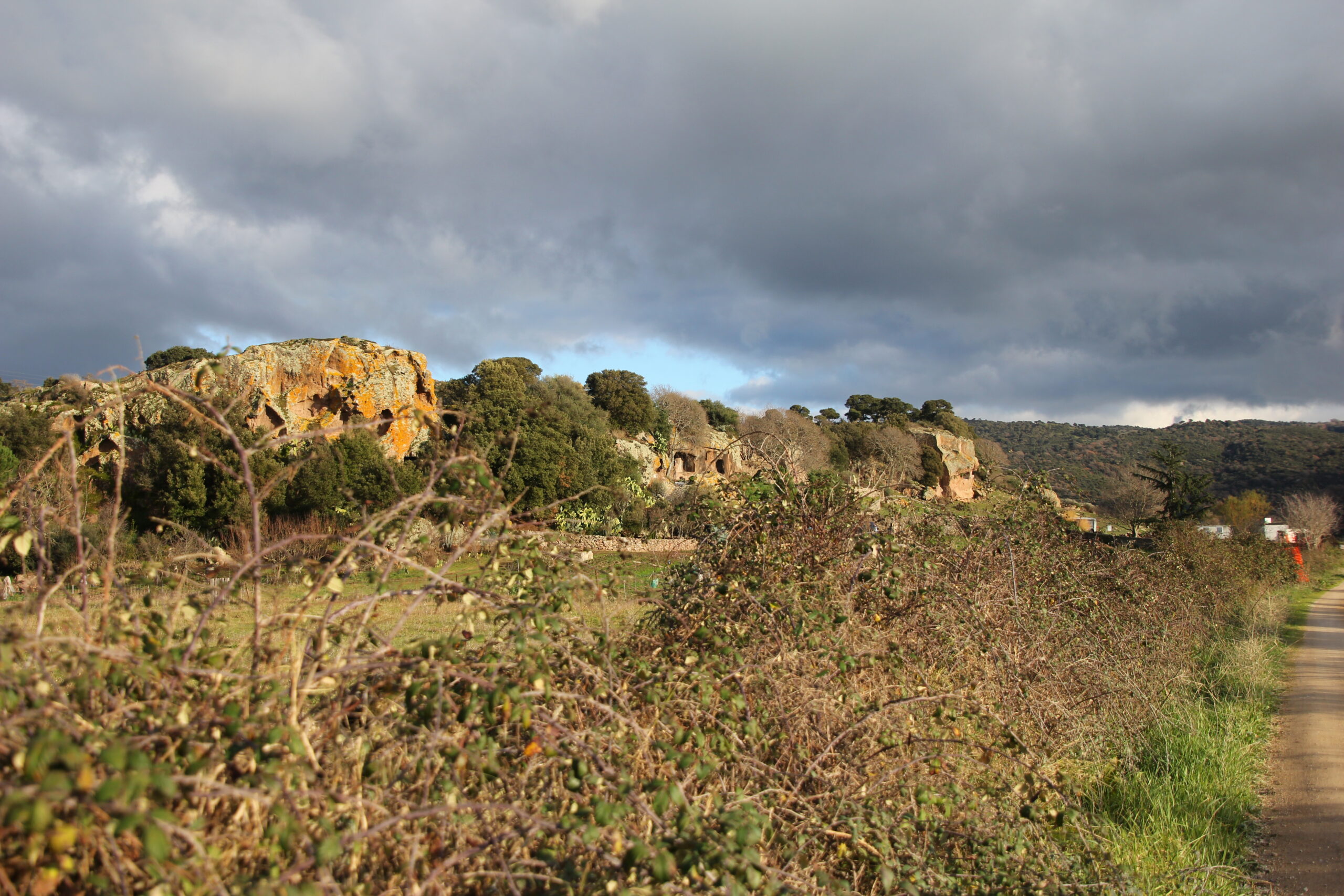
On a low trachyte ridge above the Santa Lucia plain near Bonorva, in central Sardinia, more than twenty tombs were cut into the living rock more than five thousand years ago, from around 3400 BC. This is the Necropolis of Sant’Andrea Priu, one of the largest and best-preserved complexes of domus de janas — the rock-hewn “fairy houses” of prehistoric Sardinia. Its greatest chamber, the Tomba del Capo, runs to more than 250 square metres across eighteen rooms, and was still serving as a Christian church thousands of years after the first burials were laid inside it. Sardinia’s other great rock-cut cemeteries include the Necropolis of Montessu, with more than forty domus de janas set in a natural amphitheatre near Villaperuccio.
What Are the Domus de Janas of Sant’Andrea Priu?
Domus de janas — Sardinian for “houses of the fairies” (or, in some villages, “houses of the witches”) — are pre-Nuragic rock-cut chamber tombs found across the island. Communities of the Late Neolithic quarried them by hand, hollowing out clusters of small rooms that imitate the homes of the living. At Sant’Andrea Priu the necropolis is cut into the face of a trachyte and ignimbrite outcrop about 10 metres high and some 180 metres long, on the south side of the fertile Santa Lucia plain in the comune of Bonorva, in the Province of Sassari, at the heart of the region the Sardinians call the Valle dei Nuraghi.
The complex numbers around twenty tombs, almost all of them multi-chambered. Inside, the carvers reproduced domestic architecture in astonishing detail: beams, joists, lintels, door-jambs, pillars and even a carved wainscot run along the walls, recreating an environment like the one the dead had lived in. The same tradition can be seen at sister necropolises elsewhere on the island, such as Anghelu Ruju near Alghero and Santu Pedru.
From the Ozieri Culture to the Bell Beaker Phase
The earliest tombs were quarried by communities of the San Ciriaco and Ozieri cultures in the Final Neolithic, roughly between 3400 and 2700 BC. This is a crucial point that older accounts often get wrong: the domus de janas are pre-Nuragic. They were carved more than a thousand years before the Nuragic civilization raised the stone towers — the nuraghi — that still stand on the surrounding plain. The hypogea stayed in use into the Copper Age and the Bell Beaker phase, and individual tombs were modified and reoccupied in the Nuragic, Roman, Late Antique and medieval periods.
The Tomba del Capo: Eighteen Rooms Cut from Rock
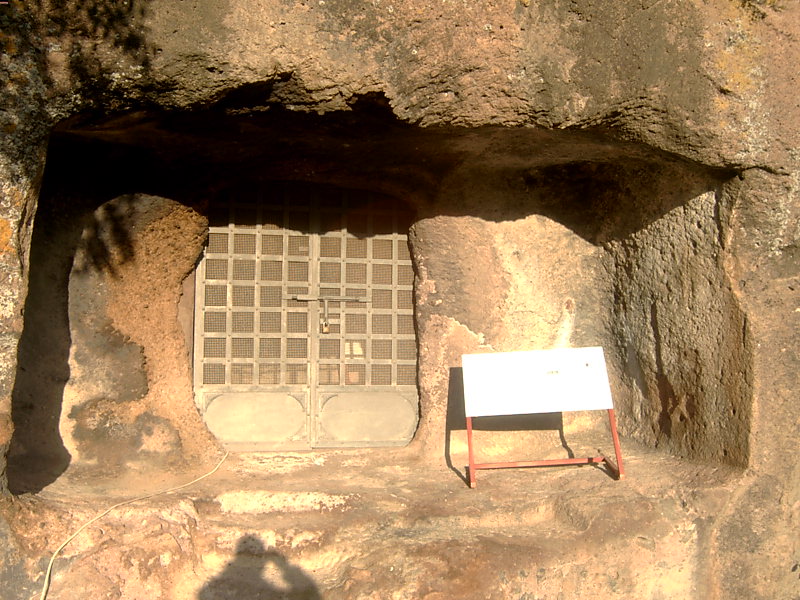
The showpiece of the necropolis is Tomb VI, the Tomba del Capo or “Tomb of the Chief.” With a floor area of more than 250 square metres it ranks among the largest rock-cut tombs in the whole Mediterranean basin. Its plan is organised around a central axis, with three large rooms set in line and a cluster of smaller chambers opening off the central hall — eighteen rooms in all, a scale that makes the interior feel less like a grave than an underground hall.
Houses Carved for the Afterlife
Like the other domus de janas, the rooms of the Tomba del Capo were shaped to mimic a dwelling, with false doors, wall niches and relief-carved ceiling beams. The intent seems clear: the dead were to continue a home-like existence underground, and the community returned again and again to the same chambers for collective burial. It is this architectural mimicry, repeated across the island, that makes the domus de janas such a vivid record of how Neolithic Sardinians imagined both their houses and their afterlife.
The Circular Hut Tomb and the Chamber Tomb
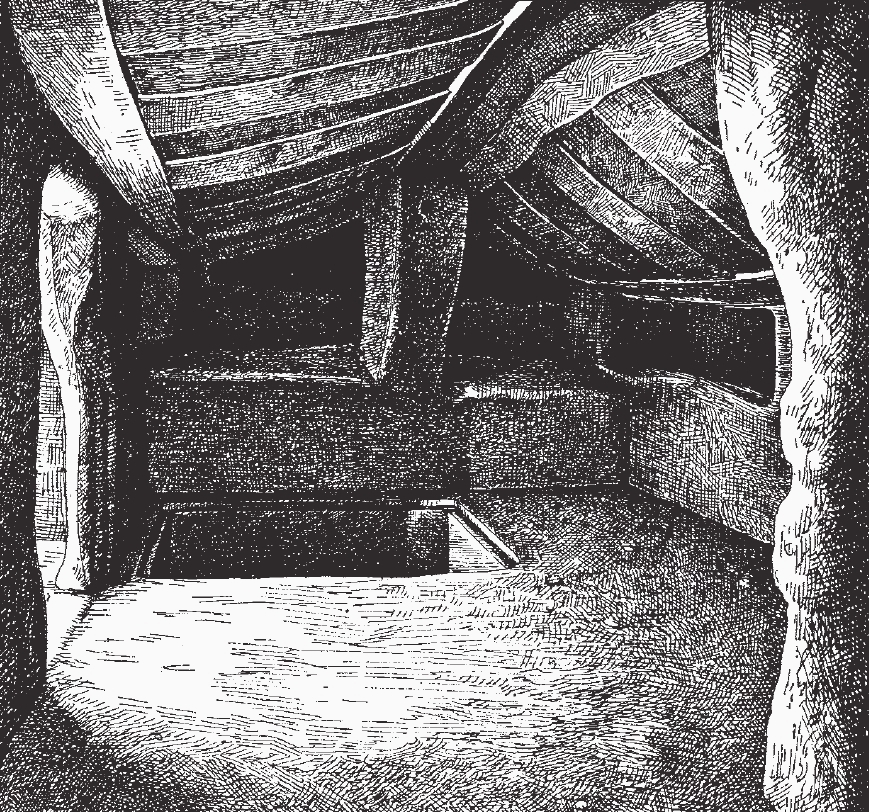
Two further tombs are singled out by archaeologists for their spectacular preservation. The Circular Hut tomb reproduces, in stone, the round huts of a prehistoric village: a circular chamber roofed by a carved conical ceiling, as though a thatched hut had been turned to rock. The Chamber tomb, meanwhile, preserves a clean rectangular plan that early excavators photographed in detail. Together with the Tomba del Capo, these three tombs are the reason Sant’Andrea Priu is so often called the most impressive domus de janas complex on the island.
How Did a Prehistoric Tomb Become a Christian Church?
The site’s name is itself a clue to its long afterlife. In Roman and Late Antique times the Tomba del Capo was adapted for Christian worship and dedicated to Saint Andrew — Sant’Andrea — and it is from this rock church that the necropolis takes its modern name. Three of the tomb’s main rooms were turned into a place of worship and frescoed with scenes from the lives of the Virgin Mary, Christ and the Apostles. Restored fragments of those paintings, dated between the 4th and 6th centuries AD, still survive on the rear wall of the central cell, and the rock church continued in use into the High Medieval Age. Few monuments anywhere capture the reuse of sacred space so neatly: a Neolithic tomb, a Bronze Age shelter and an early Christian chapel in the same hand-cut rooms.
The Bull of Sant’Andrea Priu
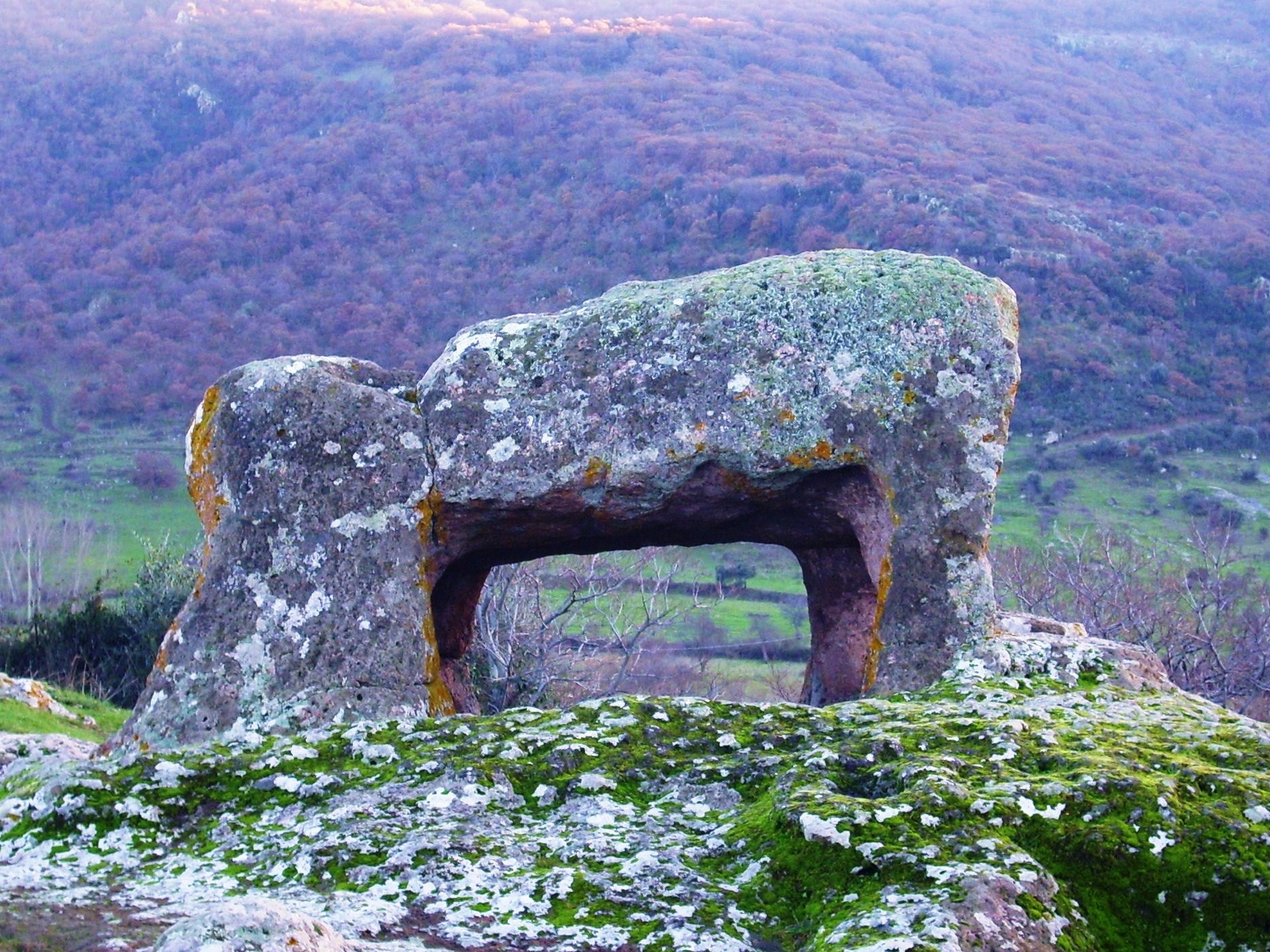
A short walk from the edge of the plateau stands one of the site’s enduring puzzles: a free-standing, perforated block of rock carved to resemble a four-legged animal, usually read as a headless bull. The bull was a powerful symbol in Sardinian prehistory, and the deliberate shaping of the stone suggests it was a genuine sculpture rather than a natural quirk of erosion. Antonio Taramelli noted and interpreted the feature during his early work at the site, and it remains one of the most photographed details of the complex.
Excavation, Discovery and UNESCO Status
The first systematic excavations were directed in 1916 by the Italian archaeologist Antonio Taramelli, who recorded the tombs, the frescoes and the curious bull-stone. The site has continued to yield surprises: fresh excavations in 2025 uncovered additional tombs, confirming that the necropolis is larger than the visible facade suggests.
That same year brought formal recognition. In July 2025 Sant’Andrea Priu was inscribed on the UNESCO World Heritage List as part of “Funerary Tradition in the Prehistory of Sardinia – The domus de janas,” a serial property gathering seventeen prehistoric necropolises across the island. It became Italy’s sixty-first World Heritage Site. Bonorva alone contains two of the seventeen — Sant’Andrea Priu and the painted tombs of nearby Sa Pala Larga — and of these Sant’Andrea Priu is generally judged the most impressive for its sheer size and the variety of its chambers. For more on the wider tradition, see our overview of ancient civilizations.
Frequently Asked Questions
What is the Necropolis of Sant’Andrea Priu?
The Necropolis of Sant’Andrea Priu is a prehistoric burial complex near Bonorva, in central Sardinia. It is made up of more than twenty domus de janas — rock-cut chamber tombs carved into a trachyte outcrop by Neolithic communities. Its largest tomb, the Tomba del Capo, has eighteen rooms and covers over 250 square metres, ranking among the biggest rock-cut tombs in the Mediterranean. The site was reused for thousands of years, and one of its tombs later became a Christian church dedicated to Saint Andrew.
How old are the domus de janas at Sant’Andrea Priu?
The earliest tombs were quarried in the Final Neolithic, roughly between 3400 and 2700 BC, by communities of the San Ciriaco and Ozieri cultures — more than five thousand years ago. They predate the Nuragic civilization that later built Sardinia’s stone towers. The hypogea stayed in use into the Copper Age and the Bell Beaker phase, and individual tombs were modified and reused in Roman, Late Antique and medieval times, giving the site an exceptionally long history of more than four millennia.
Is Sant’Andrea Priu a UNESCO World Heritage Site?
Yes. In July 2025 Sant’Andrea Priu was inscribed on the UNESCO World Heritage List as part of “Funerary Tradition in the Prehistory of Sardinia – The domus de janas.” The serial property brings together seventeen prehistoric necropolises across Sardinia and is Italy’s sixty-first World Heritage Site. Bonorva contains two of the seventeen: Sant’Andrea Priu and the nearby painted tombs of Sa Pala Larga. Sant’Andrea Priu is often considered the most impressive for its size and variety of chambers.
Sources and Further Reading
- Wikipedia — Necropolis of Sant’Andrea Priu
- Wikipedia — Domus de Janas
- Domus de Janas UNESCO (official serial nomination) — Necropolis of Sant’Andrea Priu
- SardegnaTurismo (Region of Sardinia) — Necropolis of Sant’Andrea Priu
- Encyclopædia Britannica — Sardinia