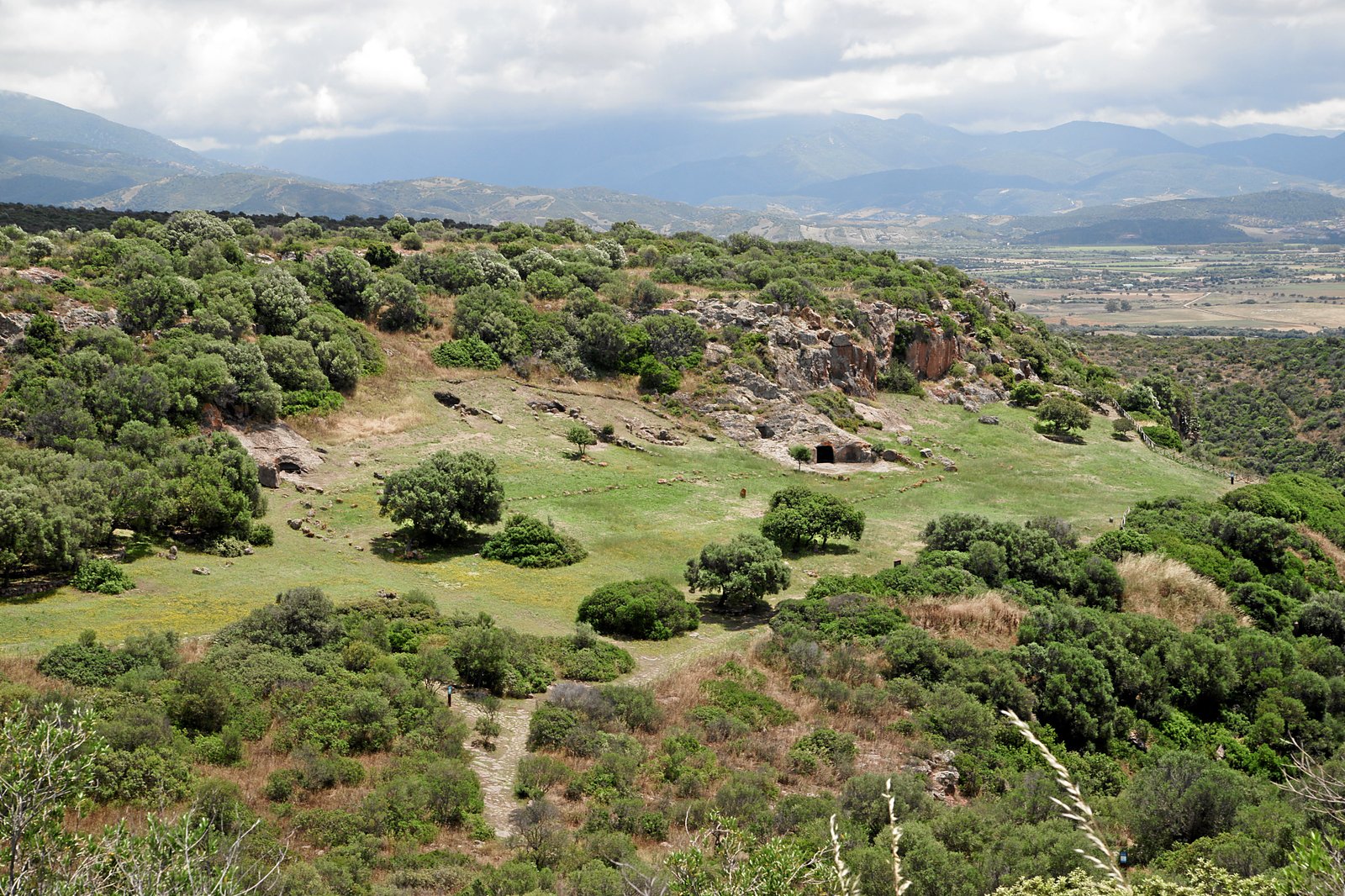
The Necropolis of Montessu is a pre-Nuragic burial ground carved into a natural rock amphitheatre near Villaperuccio, in the Sulcis region of southwest Sardinia. Begun in the Late Neolithic around 3200 BC by people of the Ozieri culture, its rock-cut chambers — the domus de janas, or “houses of the fairies” — number more than forty, making it one of the largest necropolises of its kind on the island. The site stayed in use for roughly fifteen centuries, into the Early Bronze Age, and in July 2025 it became part of a UNESCO World Heritage Site.
A Theatre of the Dead Carved into Sa Pranedda
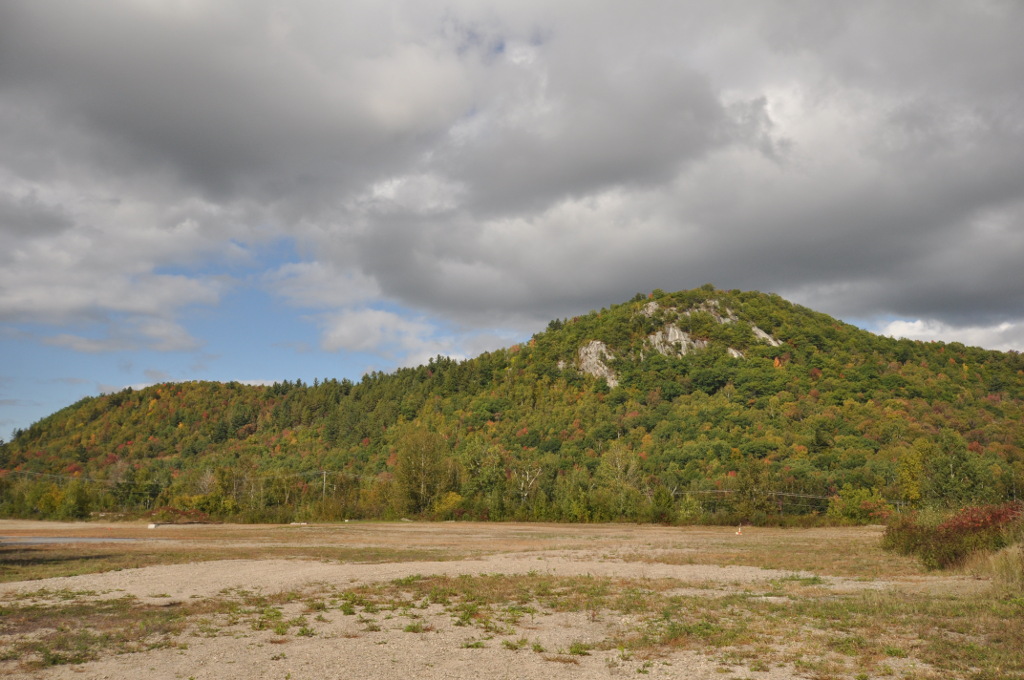
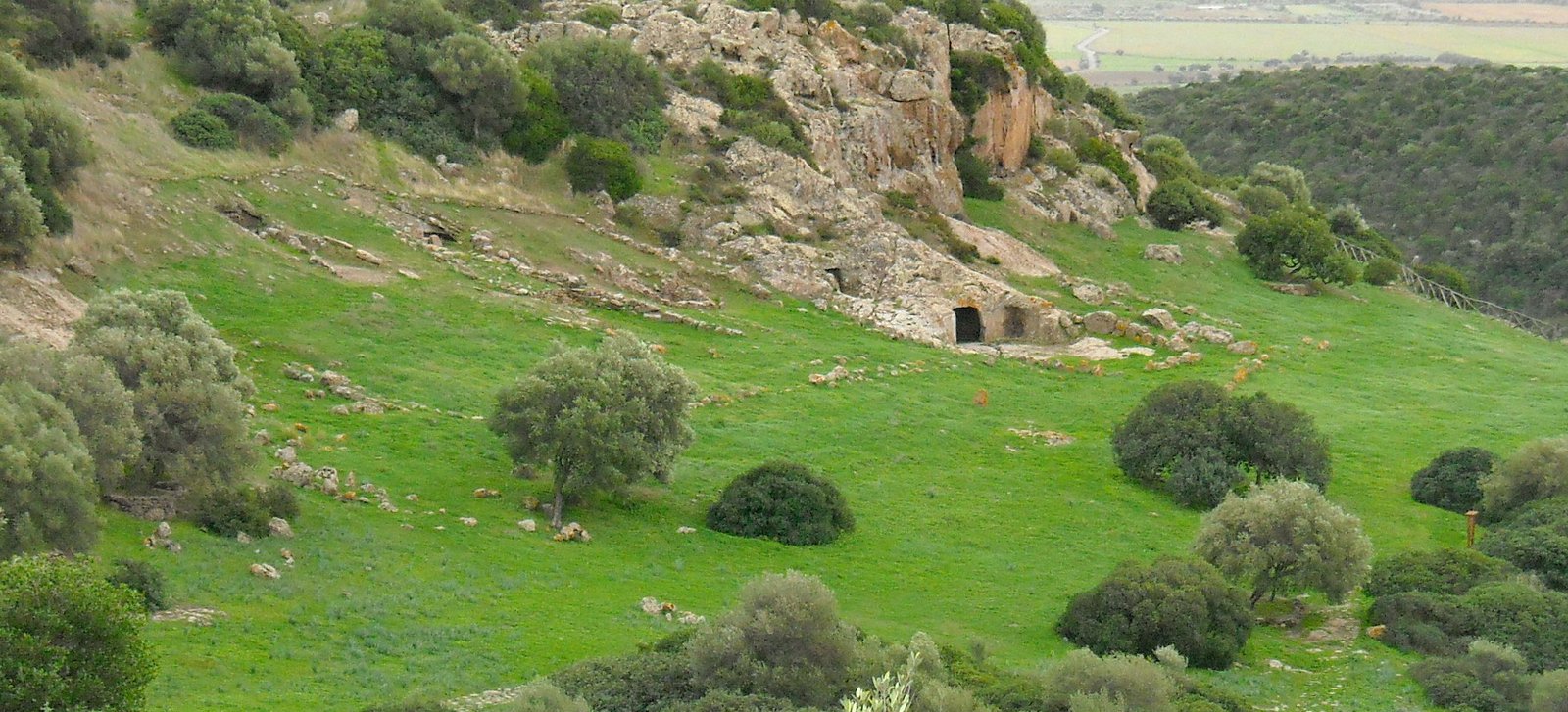
Montessu occupies the southern flank of the hill of Sa Pranedda, a few kilometres north of Villaperuccio, where a horseshoe of rocky outcrops forms a natural amphitheatre overlooking the Rio Palmas plain in the lower Sulcis. The prehistoric builders read that landscape and used it: tombs are cut into the curving rock walls so that the whole semicircle reads as a single sacred space, a “city of the dead” facing inward on its own arena.
The arrangement is not random. Two pairs of larger, monumental tombs sit at the open ends of the semicircle, framing the smaller burials gathered inside. Archaeologists read this as a deliberate design, with the grander chambers acting as sanctuaries that guarded the sleep of the dead. The result is one of the most theatrical funerary sites in the Mediterranean, and the largest concentration of domus de janas in southern Sardinia.
Who Built Montessu, and When?
The necropolis is the work of Sardinia’s pre-Nuragic communities, the islanders who lived and buried their dead long before the stone towers of the Nuragic civilization rose across the landscape. The earliest tombs belong to the Ozieri culture of the Late Neolithic, roughly 3200 to 2800 BC, the same horizon that produced Sardinia’s finest painted pottery and its first great rock-cut cemeteries.
Use of the site did not stop there. Over the following centuries Montessu was reopened, reused and extended by successive cultures: the Abealzu-Filigosa and Monte Claro groups of the Copper Age, the Bell Beaker people, and finally the Bonnanaro culture of the Early Bronze Age, around 1800 to 1600 BC. In all, the cemetery served the living for about a millennium and a half, a continuity of memory and ritual that ties together cultures separated by many generations.
A burial tradition without writing
None of these peoples left written records, so the tombs themselves are the document. Pottery, stone and bone tools, and personal ornaments recovered from the chambers point to skilled artisans and trade contacts, while the communal layout of the burials — many bodies placed in a single chamber over long spans of time — reflects a society organised around ancestry and the collective dead rather than the individual grave.
The Domus de Janas: Houses of the Fairies
A domus de janas — Sardinian for “house of the fairies,” or, in a darker reading, “house of the witches” — is a chamber tomb cut directly into rock. At Montessu the chambers were hollowed out of the volcanic trachyte of Sa Pranedda using stone and, later, metal tools, then entered through a short corridor or antechamber. Plans range from a single oval room to complex multi-chamber tombs whose layouts echo the houses of the living, complete with carved pilasters, false doors and benches.
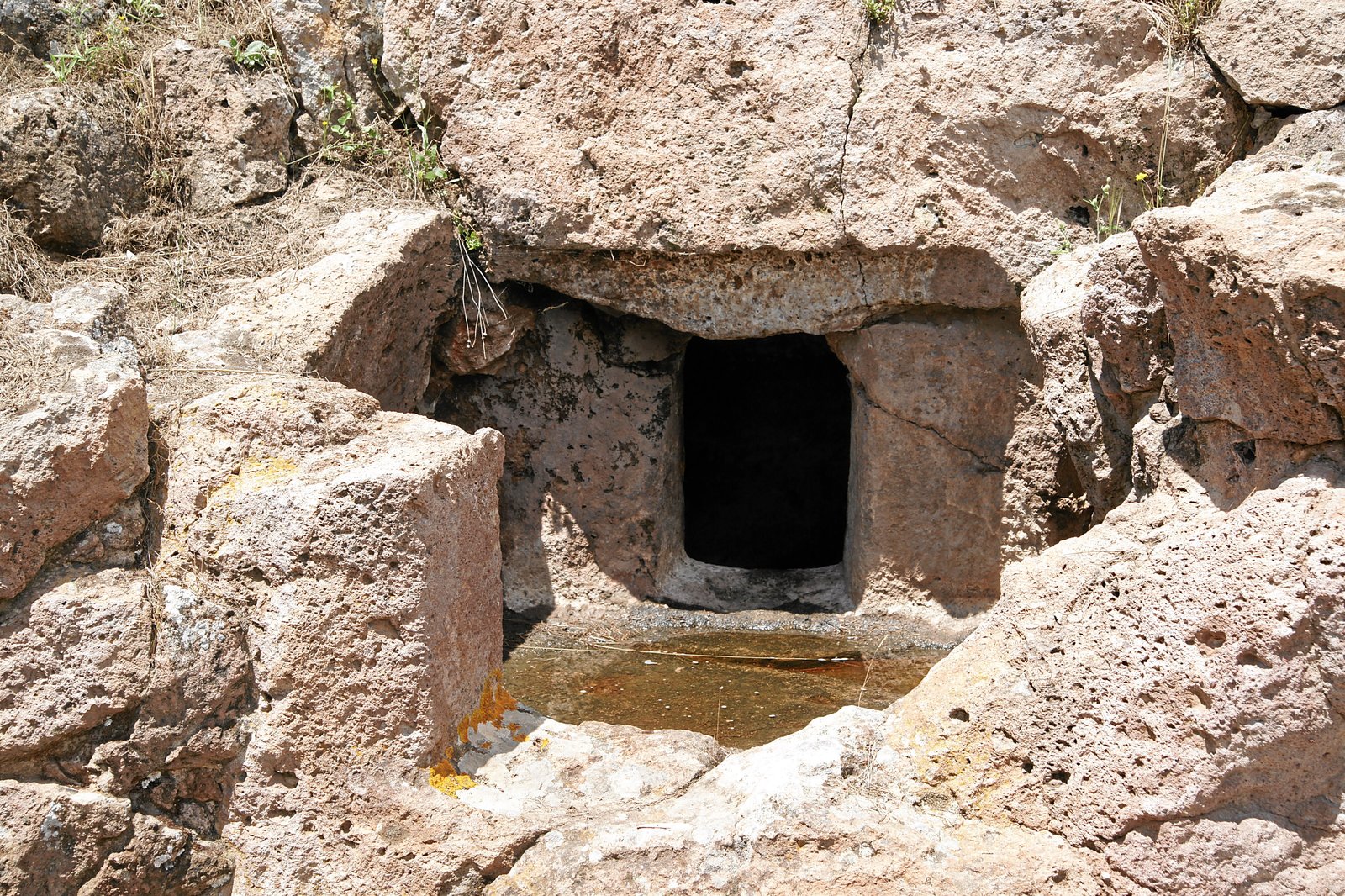
This idea of the tomb as a dwelling for the dead runs right through pre-Nuragic Sardinia, from the menhir-ringed cemetery of Pranu Muttedu to the painted chambers of Santu Pedru. What sets Montessu apart is the sheer scale of the gathering and the survival of its carved symbolism.
The Tomb of the Spirals and Its Bull Protome
The most celebrated chamber at Montessu is the Tomba delle Spirali, the Tomb of the Spirals. Below its threshold, carved in relief, is a bull’s-head protome — a taurine symbol that recurs across Sardinian domus de janas and is usually read as a male, protective deity watching over the dead. Inside, the walls of the sepulchral room are framed with carved horizontal and vertical bands enclosing rows of festoons, semicircles and the spirals that give the tomb its name.
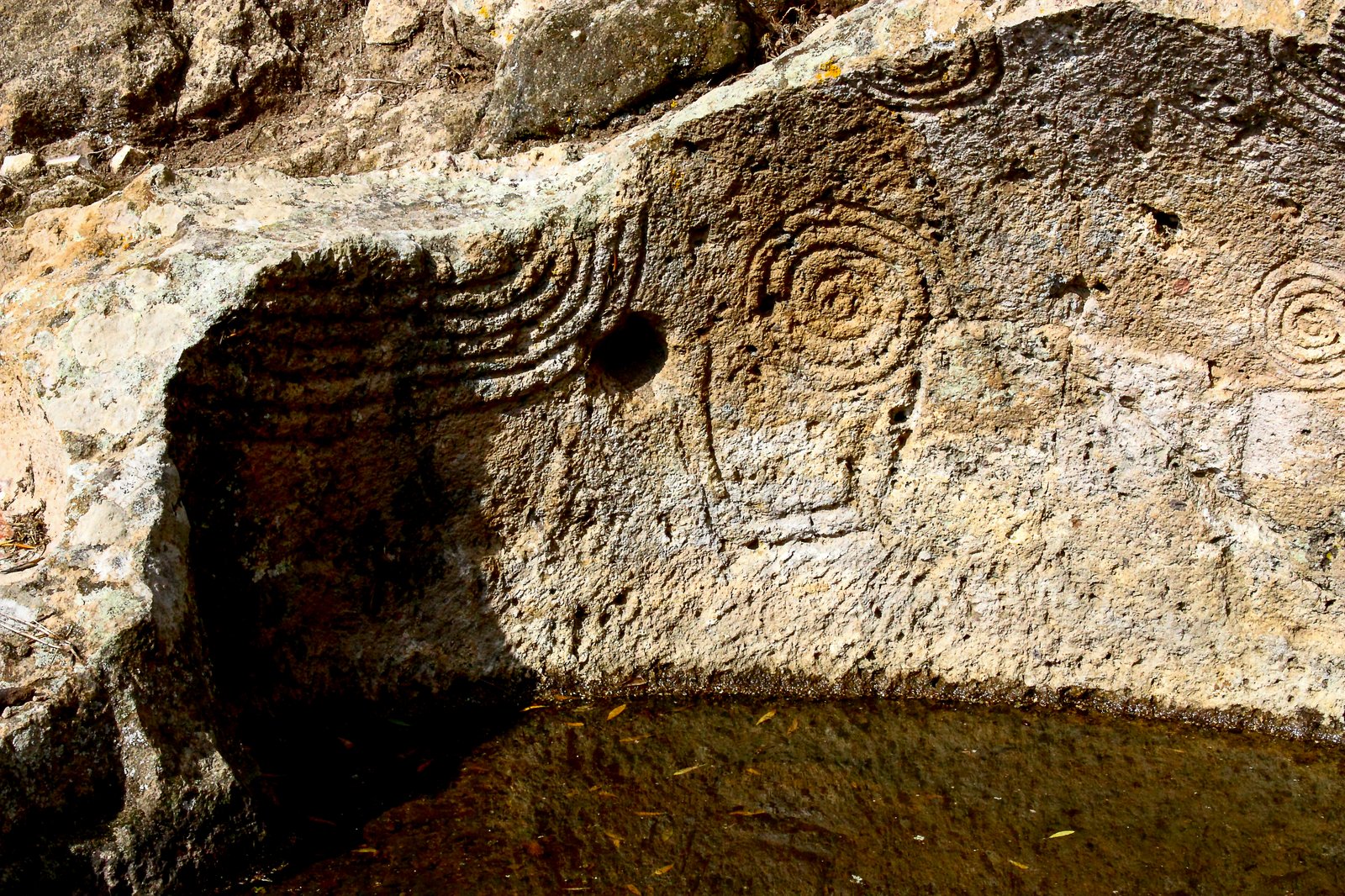
Traces of red ochre survive in the antechamber, the pigment of regeneration and rebirth in Neolithic funerary belief, alongside “wolf-tooth” zig-zag motifs and the festooned bands. Read together, the bull, the spiral and the red colour form a consistent symbolic language of death and renewal — a grammar that the carvers of Montessu shared with the painters of Sant’Andrea Priu and other Sardinian rock-cut tombs. The earlier, discredited idea that the chambers were aligned to mark solar or lunar events has no support in the evidence and is not part of the modern interpretation.
How Was the Necropolis Discovered?
Montessu is a relatively recent discovery in archaeological terms. The first investigations were carried out by Vittorio Pispisa in 1969, focused on the Tomb of the Spirals. Systematic exploration and the valorisation of the wider site followed from 1972 under Enrico Atzeni of the University of Cagliari, whose work established the chronology and the cultural sequence still used today.
That date matters, because older accounts sometimes credit the early-twentieth-century pioneer Antonio Taramelli with the find. Taramelli surveyed many Sardinian sites, but the modern study of Montessu belongs to Pispisa and Atzeni. The necropolis is now an open archaeological park, with walkways and signage that let visitors move through the amphitheatre while the fragile carved chambers are protected.
A UNESCO World Heritage Site Since 2025
In July 2025, UNESCO inscribed “Funerary Tradition in the Prehistory of Sardinia – The domus de janas” on the World Heritage List, a serial site bringing together seventeen necropolises across the island. Montessu is one of the component sites, recognised alongside the great cemeteries of the Ozieri and later cultures as outstanding evidence of a burial tradition that lasted for millennia.
The listing has reframed how Sardinia presents its prehistory, putting the rock-cut tombs on the same footing as the better-known nuraghi. For Montessu it means stronger protection and a wider audience for a site that, despite its scale and its carvings, long sat in the shadow of the island’s Bronze Age towers.
Frequently Asked Questions
What does “domus de janas” mean?
It is Sardinian for “house of the fairies” — or, in some local traditions, “house of the witches.” It refers to the small rock-cut chamber tombs of pre-Nuragic Sardinia, whose doorways folklore imagined as the homes of tiny supernatural women. There are thousands across the island; Montessu holds one of the largest single concentrations.
How many tombs are at Montessu?
More than forty domus de janas are cut into the rock walls of the natural amphitheatre, ranging from simple single chambers to complex multi-room tombs. This makes Montessu the largest domus de janas necropolis in southern Sardinia and one of the most important on the island.
Can you visit the Necropolis of Montessu?
Yes. The site near Villaperuccio is an open archaeological park with marked paths and interpretive signage. Visitors can walk the amphitheatre and view the carved chambers, including the Tomb of the Spirals, while conservation measures keep the most fragile carvings protected.
Sources and Further Reading
- Necropolis of Montessu — Wikipedia
- Domus de Janas — Wikipedia
- Ozieri culture — Wikipedia
- The Neolithic — World History Encyclopedia
- The Stone Age — World History Encyclopedia
- Necropolis of Montessu — Le Domus de Janas (UNESCO nomination site)
For more pre-Nuragic and prehistoric sites, browse our Historical Places archive.