Cut into a basalt spur above the village of Bedse in Maharashtra’s Maval taluka, a narrow rock passage opens onto four of the most celebrated columns in early Indian art: capitals crowned with paired bulls, horses and elephants, each ridden by human figures of, in one scholar’s phrase, “solemn grandeur.” These are the Bedse Caves (also spelled Bedsa), a small group of Buddhist rock-cut monuments carved under the Satavahana dynasty in the 1st century BCE, around 60 BC. With a chaitya prayer-hall (Cave 7) and an unusually shaped vihara monastery (Cave 11), Bedse is the least-visited member of the great Maval trilogy it forms with nearby Karla and Bhaja — and one of the oldest cave complexes in the region. The Mahakali (Kondivite) Caves in Mumbai preserve a rarer and probably earlier arrangement, with the stupa enclosed in a fully circular chamber.
Where Are the Bedse Caves?
The caves sit on a hillside near Bedse village in Maval taluka, in the Pune District of Maharashtra, western India. They lie about 9 kilometres from the Bhaja Caves and a short distance from the far larger and better-known Karla Caves, so that the three sites together bracket the ancient trade route that climbed the Western Ghats between the Konkan coast and the Deccan plateau. An easy hike of roughly 400 steps leads up to the entrance.
Both caves face east, which means the low morning sun rakes across the carvings and throws the reliefs into sharp relief — the reason visitors are advised to arrive early. The surrounding country, ringed by the hill-forts of Lohagad, Visapur, Tung and Tikona around the Pawana Dam, is at its greenest in the monsoon, when small waterfalls run down the basalt. For the wider Buddhist context, see our guides to the Kanheri Caves and the Ghorawadi Caves.
A Chaitya Hall from the 1st Century BCE
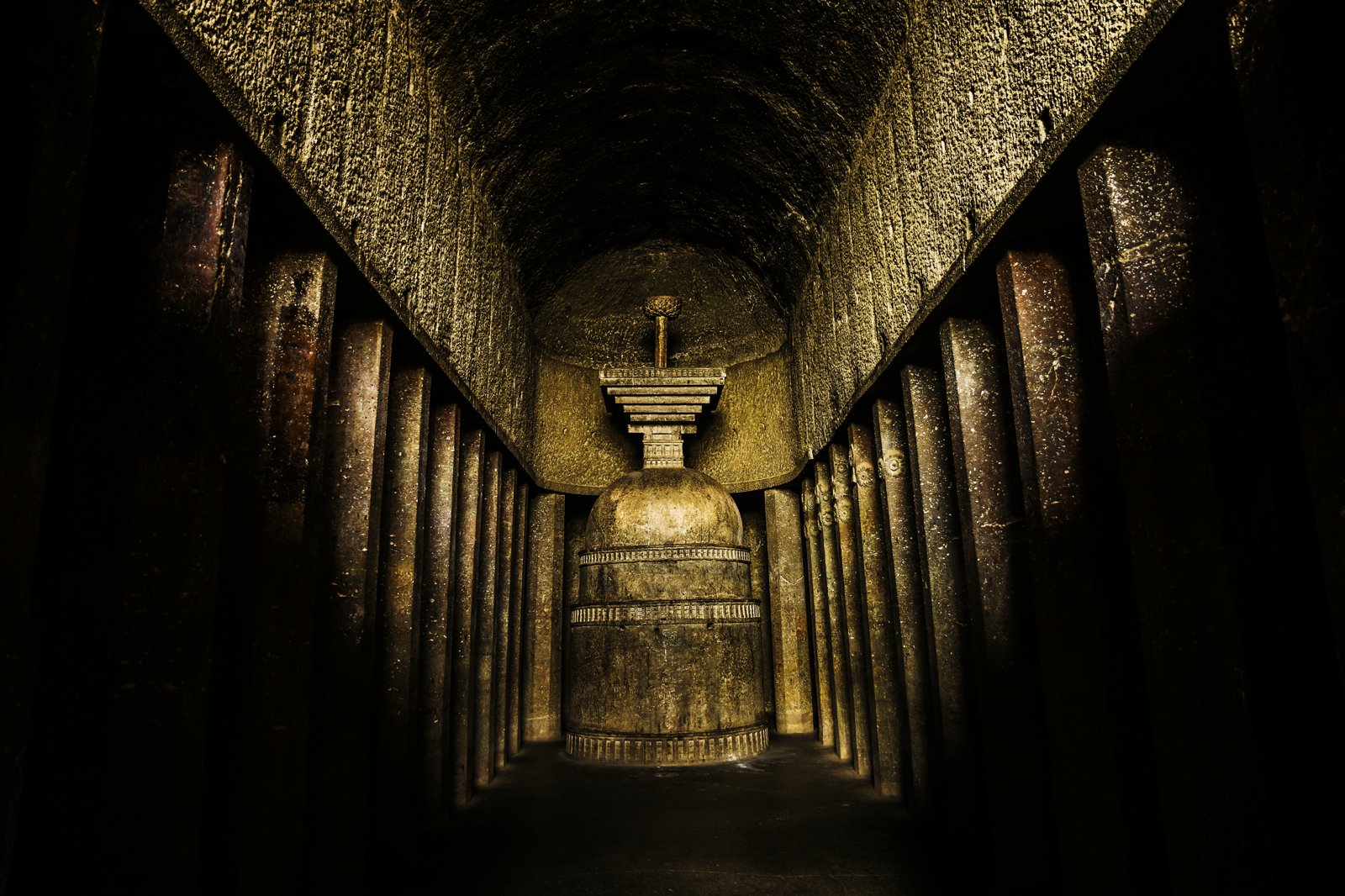
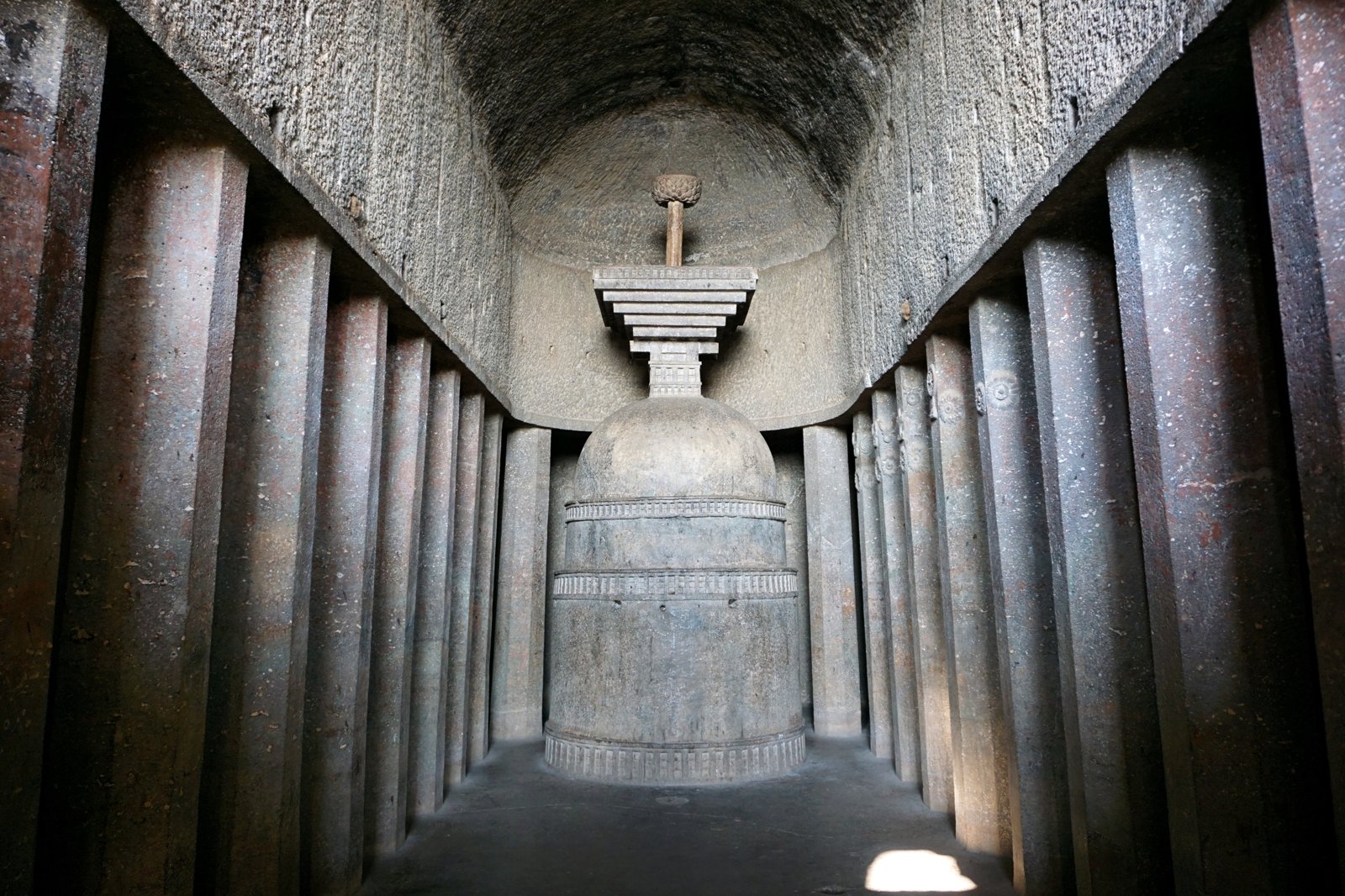
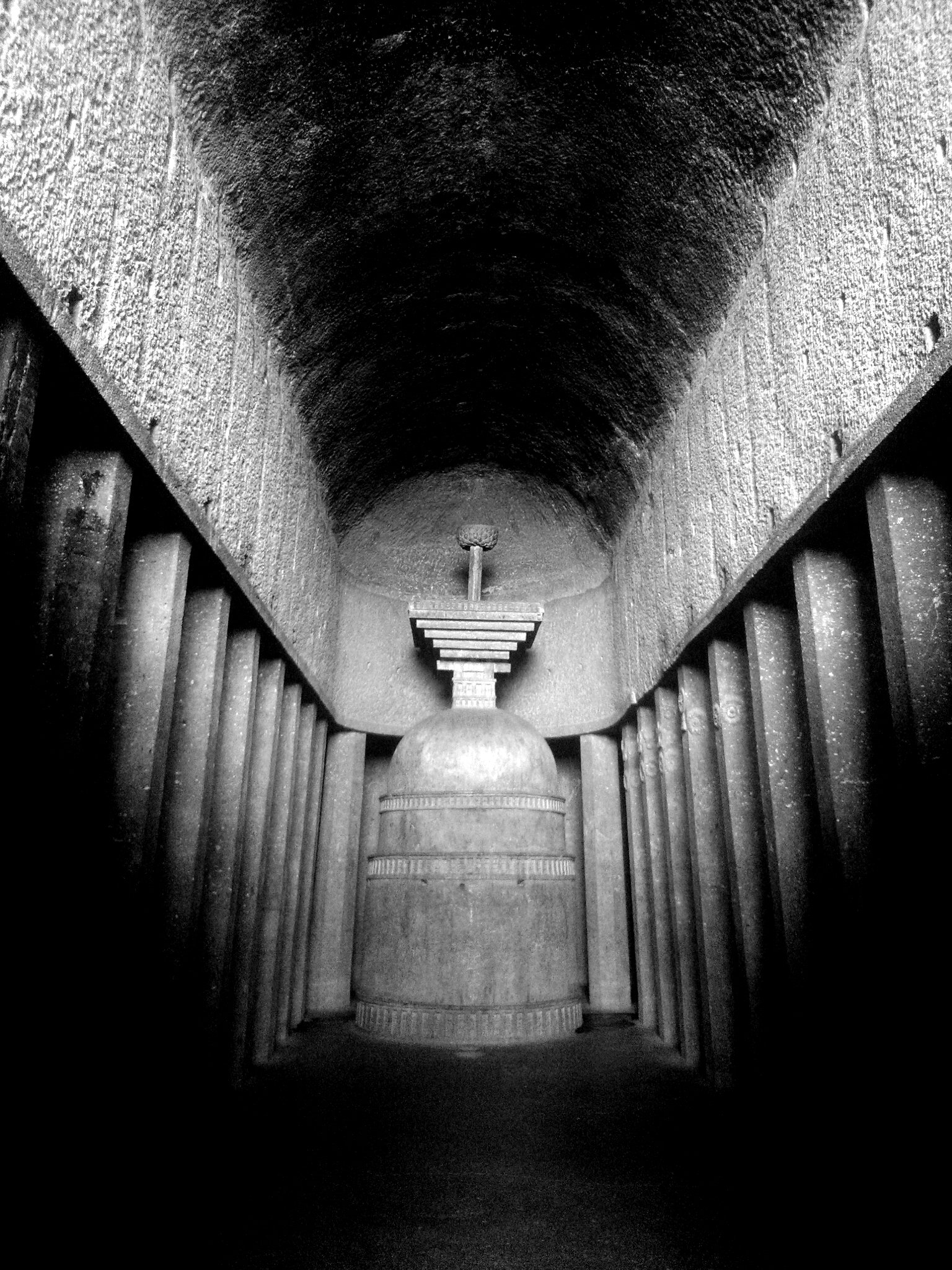
The best-known cave at Bedse is Cave 7, the chaitya or prayer hall, reached by a long, narrow passage bored into the rock. Its history can be traced to the Satavahana period in the 1st century BCE, placing it among the oldest rock-cut monuments in Maharashtra — broadly contemporary with, or slightly earlier than, the celebrated chaitya at Karla. Inside, a comparatively large monolithic stupa stands at the rounded, apsidal far end of the hall, the focus of veneration for the monks who worshipped here.
The hall itself is austere. Its interior colonnade is made up of plain octagonal columns without capitals, and the vaulted roof once carried decorative ribs — but at Bedse those ribs were made of actual wood, imitated in stone at other caves, and they have long since rotted away. What survives is the skeleton of a building designed to look, in stone, like the timber halls that inspired it.
The Columns of “Solemn Grandeur”
All the artistic energy of Cave 7 is concentrated on its front verandah. Here four very elaborate columns rise from pot-shaped bases to bell capitals topped by pairs of kneeling animals — bulls, horses and elephants — each mounted by riders. The art historian J. C. Harle singled out these figures for their “solemn grandeur.” Flanking them, the side walls are covered with low-relief gavaksha (chaitya-arch) motifs and latticework carved to imitate architectural railings, close cousins of the decoration at Karla. The contrast is deliberate: a richly worked threshold giving way to a plain, solemn interior.
What Do the Bedse Inscriptions Say?
Bedse is not a silent monument. Carved in Brahmi script on one of the gateway arches is a donor inscription that reads: “Gift of Pushyanka, son of Ananda Sethi from Nashik.” The word sethi (Sanskrit shreshthin) marks Ananda as a merchant or guild-master, and the reference to Nashik — itself the site of a major Satavahana-era cave group — ties Bedse into the network of trading families whose donations funded the western Deccan’s rock-cut monasteries. Like most early Buddhist cave sites, Bedse was not a royal foundation but the collective work of merchants, artisans and lay devotees who paid for individual pillars, arches and cells and left their names on the stone.
The Unusual Apsidal Vihara
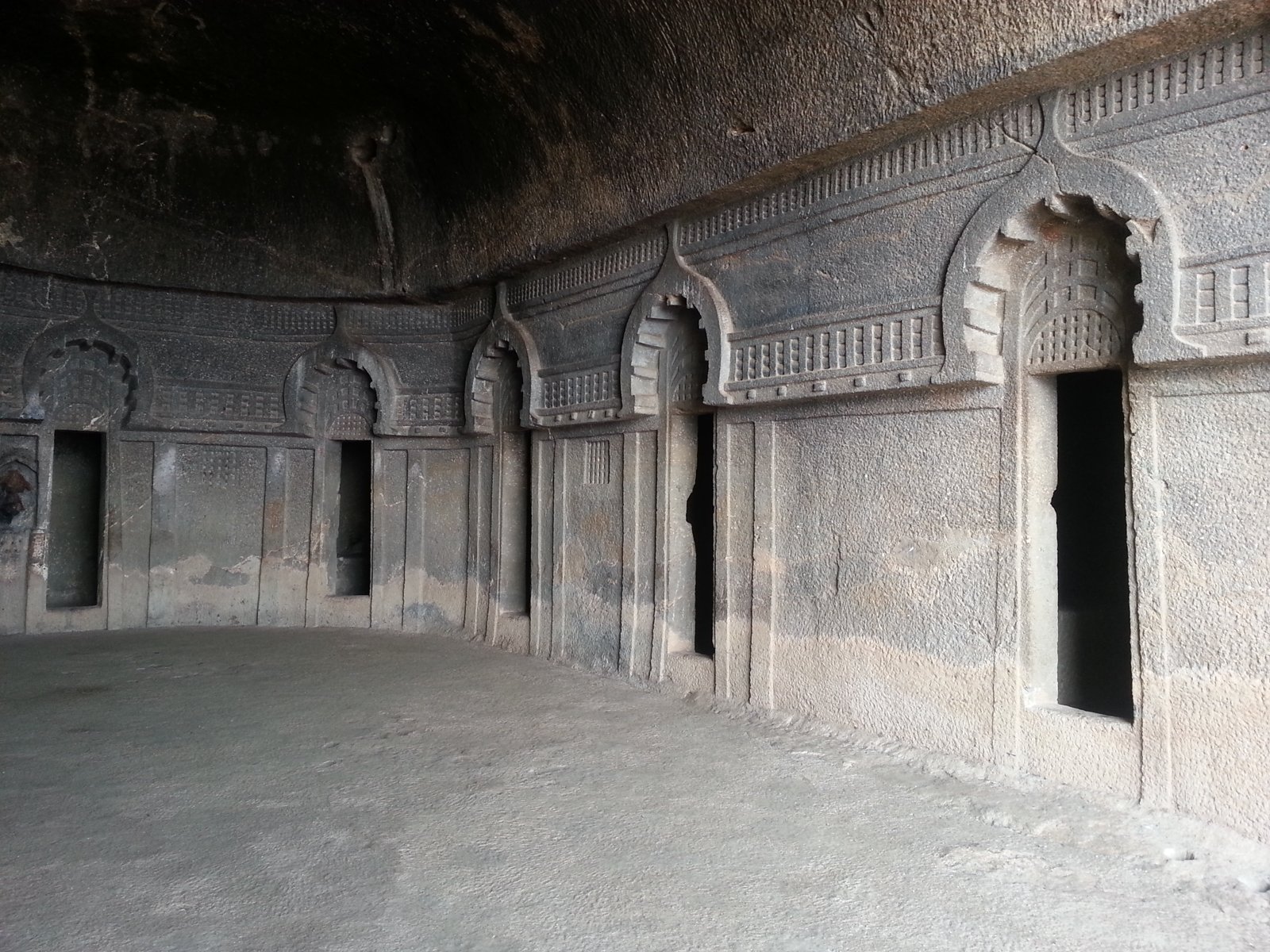
The second main excavation, Cave 11, is the monastery or vihara — and it takes a form rarely seen elsewhere. Instead of the usual square hall with cells around it, the main chamber has a rectangular plan ending in a rounded apse and is covered by a vaulted roof, so that the living quarters echo the shape of a chaitya. That vaulted chamber is now open to the air on one side, where a wooden screen almost certainly once stood.
Around the walls, nine doorways lead to monks’ cells, each framed by a relief chaitya-arch surround, while friezes carved with railing patterns run around the room at two levels. Four further cells stand outside the line where the screen would have closed the space. A small free-standing stupa survives outside, to the right of the two main caves.
Bedse and the Maval Trilogy
Bedse cannot really be understood alone. It belongs to a cluster of Satavahana-period Buddhist caves — Karla, Bhaja and Bedse — strung along the passes of the Maval region, where the trade routes from the Arabian Sea ports climbed into the Deccan. Monasteries like these were more than retreats: sited on busy caravan roads, they offered shelter and merit to travelling merchants, and in return received the donations that paid for their carving. Bhaja is generally reckoned the earliest of the three, Bedse a little later, and Karla later still and grandest of all, its chaitya the largest in India.
Because it is smaller and harder to reach, Bedse escaped both the crowds and much of the later remodelling that reshaped its neighbours, and so preserves the early Hinayana idiom with unusual clarity. For the broader story of the cultures that built such places, see our overview of ancient civilizations.
Rediscovery and Preservation
Bedse never truly vanished, but its modern history has not always been kind. Until around 1861 the caves were regularly maintained — even repainted — on the orders of local authorities keen to please the British officers who liked to visit them. Well-meaning as it was, that repainting stripped away the remnants of the original plaster and whatever murals it may have carried, so that today the reliefs stand bare. The site is now a protected monument under the Archaeological Survey of India, and remains one of the quietest of the great western Indian cave sites — a place where the early architecture of Indian Buddhism can still be read almost undisturbed.
Frequently Asked Questions
How old are the Bedse Caves?
The Bedse Caves date to the Satavahana period in the 1st century BCE, with the chaitya hall usually placed around 60 BC. That makes them among the oldest rock-cut monuments in Maharashtra and broadly contemporary with the nearby caves at Bhaja and Karla. They were excavated during a period when Buddhism flourished along the trade routes of the western Deccan, and were funded not by kings but by merchants and lay donors, one of whom — Pushyanka, son of the merchant Ananda of Nashik — left his name carved on a gateway arch.
What makes the Bedse chaitya famous?
The signature feature of Bedse is the group of four elaborate columns on the verandah of Cave 7. Each rises to a bell-shaped capital crowned by paired kneeling animals — bulls, horses and elephants — carrying riders, carved with what the historian J. C. Harle called “solemn grandeur.” Around them the walls carry low-relief chaitya-arch and railing motifs. Beyond the verandah, the hall is deliberately plain, with unadorned octagonal pillars and a large monolithic stupa at its apsidal end.
Where are the Bedse Caves and how do you reach them?
The caves are near Bedse village in Maval taluka, Pune District, Maharashtra, about 9 kilometres from the Bhaja Caves and close to Karla. They are usually reached from Pune via Kamshet, followed by a hike of roughly 400 steps up the hillside. Both caves face east, so early morning offers the best light on the carvings, and the surrounding hills are greenest during the monsoon. The site is protected by the Archaeological Survey of India and sees far fewer visitors than its famous neighbours.
Sources and Further Reading
- Wikipedia — Bedse Caves
- Incredible India (Ministry of Tourism) — Bedsa Caves
- Wikipedia — Karla Caves
- Wikipedia — Bhaja Caves
- Wikipedia — Satavahana dynasty
- World History Encyclopedia — The Ajanta Caves and the Satavahana rock-cut tradition

Neural Pathways is a collective of seasoned experts and researchers with a profound passion for unraveling the enigmas of ancient history and artifacts. With a wealth of combined experience spanning decades, Neural Pathways has established itself as a leading voice in the realm of archaeological exploration and interpretation.