
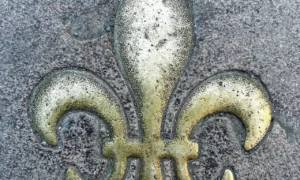
The fleur-de-lis, often associated with the French monarchy and heraldry, is a stylized design of a lily or iris that has been used in numerous symbols and coats of arms across Europe and beyond. Its name, derived from French, translates to “lily flower,” indicating its original association with purity and chastity, which in Christian symbolism is often linked to the Virgin Mary.
Neural Pathways
Neural Pathways is a collective of seasoned experts and researchers with a profound passion for unraveling the enigmas of ancient history and artifacts. With a wealth of combined experience spanning decades, Neural Pathways has established itself as a leading voice in the realm of archaeological exploration and interpretation.
Our team of researchers and scholars provide unparalleled depth of knowledge in deciphering the intricate narratives embedded within ancient artifacts and deciphering the cultural nuances that shaped civilizations of the past. Through meticulous research, rigorous analysis, and a collaborative spirit, Neural Pathways has made and continues to make significant contributions to our understanding of the human past.

The Quimbaya Artifacts (Airplanes)
The Quimbaya civilization, flourishing from 500 BC to 600 AD, was a prominent pre-Columbian culture located in the Middle Cauca River valley and southern Antioquian region of modern-day Colombia. This civilization is renowned for its sophisticated goldsmithing and ceramic works, which have been preserved as significant archaeological finds.
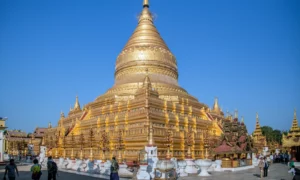
Shwezigon Pagoda
The Shwezigon Pagoda, also known as Shwezigon Paya, stands as a significant Buddhist stupa located in Nyaung-U, Myanmar. Renowned as a prototype of Burmese stupas, it features a circular gold leaf-gilded stupa encircled by smaller temples and shrines. The construction of this iconic structure commenced in 1059 AD during the reign of King Anawrahta, the founder of the Pagan Empire, and was completed in 1102 AD under the supervision of his son, King Kyansittha.
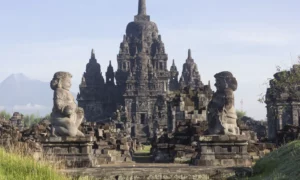
Candi Sewu temple
Candi Sewu is an 8th-century Mahayana Buddhist temple located 800 meters north of Prambanan in Central Java, Indonesia. The term “candi” refers to a Hindu or Buddhist temple in Indonesian, thus the name Candi Sewu. It is the second-largest Buddhist temple complex in Indonesia, following Borobudur. The temple complex, originally known as Manjusrigrha, predates the nearby “Loro Jonggrang” temple at Prambanan and consists of 249 temples, though its Javanese name translates to ‘a thousand temples,’ a figure derived from local folklore.
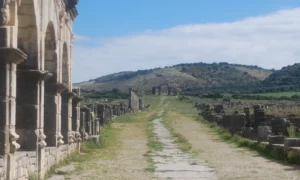
Volubilis
Volubilis, a partly-excavated city located near Meknes, Morocco, represents a significant archaeological site with roots stretching back to the 3rd century BC. Initially a Berber settlement, it later became a proto-Carthaginian city before serving as the capital of the Kingdom of Mauretania under King Juba II. The city’s strategic location in a fertile agricultural area facilitated its development and prosperity, particularly under Roman rule from the 1st century AD.
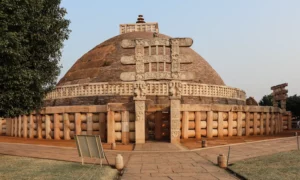
Sanchi Stupa
Sanchi Stupa, located in the Raisen District of Madhya Pradesh, India, stands as a monumental representation of Buddhist architecture and religious heritage. This complex, particularly noted for the Great Stupa, is situated approximately 46 kilometers northeast of Bhopal, the capital of Madhya Pradesh. The site holds immense historical and cultural significance, tracing back to the Mauryan Empire in the 3rd century BC.