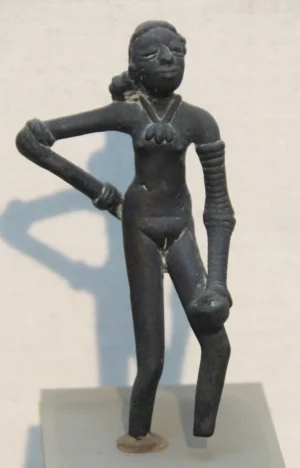
The Dancing Girl of Mohenjo-Daro is a 10.5-centimetre bronze figurine, crafted around 2300 BCE, that is one of the most celebrated artefacts of the Indus Valley Civilization. Cast in copper alloy using the lost-wax method, she stands in a relaxed, almost defiant pose — one arm bent at the hip, the other heavily braceleted from shoulder to wrist. She was unearthed in 1926 by British archaeologist Ernest Mackay during the excavations at Mohenjo-Daro in what is now Pakistan, and remains, four thousand years later, one of the earliest known bronze sculptures of a human figure anywhere in the world.

Discovery and Historical Context
The figurine was found in the so-called “HR area” of Mohenjo-Daro, the largest urban site of the Indus Valley Civilization, during the 1926–1927 season under the supervision of the Archaeological Survey of India. Ernest Mackay published the find in his 1938 report Further Excavations at Mohenjo-Daro, where he identified the piece as evidence of advanced metallurgical practice in the Bronze Age — including sites such as Rupnagar of South Asia. The name “Dancing Girl” was coined by Mackay’s contemporary Sir John Marshall, who interpreted the figure’s pose as suggesting movement. The label has stuck, though most modern scholars consider it a misnomer — there is no concrete evidence that she is dancing.

The Lost-Wax Casting Technique
The Dancing Girl was cast using the cire perdue or “lost-wax” method, in which a clay model is coated in wax, encased in a clay mould, and then heated. The wax flows out, leaving a cavity into which molten metal is poured. Once cool, the outer mould is broken away to reveal the cast figure. The Indus craftsmen at Harappa and Mohenjo-Daro had mastered this technique by 2500 BCE — significantly earlier than was previously thought possible for a culture of that period. The Dancing Girl’s casting is so accomplished that its bracelets, necklace pendant and facial features were all rendered in a single pour.

How old is the Mohenjo-Daro Dancing Girl?
Dating the Mature Harappan phase
Radiocarbon and stratigraphic dating of the layer in which she was found places the figurine in the Mature Harappan phase of the Indus Valley Civilization and the wider ancient artefact tradition, roughly between 2500 and 1900 BCE. The most widely accepted date is approximately 2300 BCE, making her around 4,300 years old. By that estimate, she predates the bronze sculptures of ancient Egypt’s New Kingdom by roughly a thousand years, and the classical Greek bronzes of the fifth century BCE by some eighteen hundred years.
What Her Features Tell Us
The figurine wears no clothing apart from her ornaments: a row of 24 bangles on her left arm running from shoulder to wrist, a necklace with three pendants, and a single bracelet (or, by some counts, a set of 4 bangles) on her right wrist. Her hair is gathered in a long plait. She stands in what art historians call a contrapposto pose — weight on one leg, hip cocked, one arm propped at the waist, the other hanging by her side. It is a naturalistic stance that gives the figure a sense of movement and confidence rarely seen in surviving art of the third millennium BCE. The asymmetry of her ornamentation — heavily decorated on one arm, sparse on the other — mirrors the asymmetry of her pose.
The casting quality and ornaments suggest that bronze portraiture, at least of women, was a luxury craft serving an urban elite. Whether she represents a specific individual, a deity, a temple servant, or a generic stylised figure remains unresolved. The Indus script, which appears on contemporary seals from the same site, is undeciphered, so no inscriptional evidence helps identify her.
What She Reveals About Indus Society
The Dancing Girl carries two pieces of information about Indus society that other artefacts do not. First, the technical sophistication of her casting is itself evidence — by 2300 BCE the Indus metallurgists at Mohenjo-Daro had mastered copper-alloy work to a degree comparable with their contemporaries in the Sumerian cities of Mesopotamia. Second, her confident, almost dancing pose suggests that performance, entertainment and movement-based ritual were part of Indus urban life. A companion piece — a second, similar but smaller bronze figure found in the so-called “DK area” of the same site by the same expedition — reinforces the idea that this was a recognisable visual type, not a one-off oddity. Together, they hint at an artistic tradition we have otherwise lost almost entirely, because most Indus material that survives is utilitarian: pottery, beads, seals, and architecture. The Dancing Girl is one of the few windows we have into the figurative imagination of a civilization whose own written records remain unreadable.
Where She Is Now
The Dancing Girl is held by the National Museum of India in New Delhi, where she has been exhibited since the partition of India and Pakistan in 1947. Pakistan has formally requested her return on several occasions, arguing that she belongs at the Mohenjo-Daro site museum or in the Lahore Museum, but the request has not been granted. A companion piece — a second, similar but smaller bronze figure also discovered at Mohenjo-Daro — is held at the National Museum of Pakistan in Karachi.
Sources and Further Reading
- Britannica — Mohenjo-Daro
- World History Encyclopedia — Mohenjo-Daro
- Wikipedia — Dancing Girl (sculpture)

Neural Pathways is a collective of seasoned experts and researchers with a profound passion for unraveling the enigmas of ancient history and artifacts. With a wealth of combined experience spanning decades, Neural Pathways has established itself as a leading voice in the realm of archaeological exploration and interpretation.