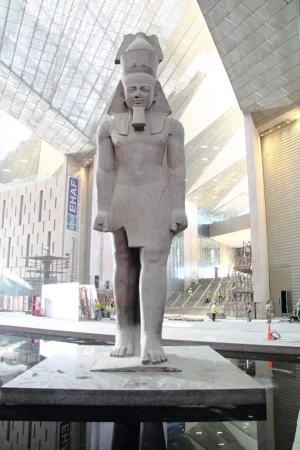
The Statue of Ramesses II represents one of the most iconic symbols of ancient Egypt’s grand pharaonic history. Ramesses II, often regarded as Ramesses the Great, ruled Egypt from 1279 to 1213 BC. Known for his military conquests, extensive construction projects, and lasting influence, Ramesses II commissioned many monuments to solidify his legacy, including several impressive statues across Egypt.
Historical Background of Ramesses II
The Statue of Ramesses II is a 3,200-year-old colossal limestone figure of Pharaoh Ramesses II, carved around 1250 BCE for the Temple of Ptah at the ancient capital of Memphis in Egypt. The statue stands approximately 10 metres (33 ft) tall, weighs about 83 tonnes, and is now the centrepiece of the entrance hall at the Grand Egyptian Museum near Giza. It is one of the largest single-block limestone sculptures to survive from antiquity, and one of the most recognisable depictions of the most powerful pharaoh of ancient Egypt.
In addition to military achievements, Ramesses II was known for his architectural projects. His reign saw the construction of grand temples and statues, including the famous Abu Simbel temples in Nubia. Ramesses wanted these monuments to reflect his power, religious devotion, and lasting impact on Egyptian civilization.Description and Location of the Statue of Ramesses II
Description and Location of the Statue of Ramesses II
The Statue of Ramesses II is a massive depiction of the pharaoh that once stood in the temple complex of Memphis, the ancient capital of Egypt. Carved from a single block of red granite, this statue exemplifies the traditional style of Egyptian sculpture with its rigid, symmetrical form and highly detailed craftsmanship. The statue originally measured about 36 feet in height, although parts of it, including the legs, were damaged over time. Today, the statue lies in the open-air museum in Memphis.
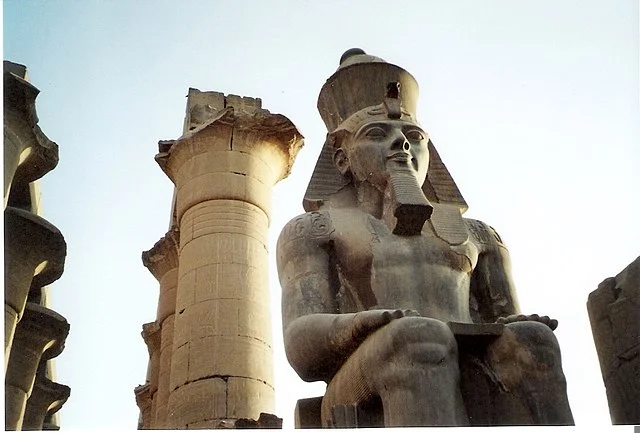
In addition to the Memphis statue, Ramesses II commissioned several other statues of himself throughout Egypt. These statues can be found at key historical sites such as Luxor, Karnak, and Abu Simbel, reflecting the widespread influence of his reign and the pride he held in his identity as Egypt’s ruler.
Artistic Significance of the Statue
The Statue of Ramesses II is a prime example of Egyptian monumental sculpture, symbolizing the power and divine status of the pharaoh. It follows the conventional form seen in pharaonic statues: a highly stylized, idealized image, with a youthful face and muscular physique to project strength and godlike attributes. Egyptian artists aimed to create timeless representations of their rulers. This statue reflects the canonical proportions and design principles that had governed Egyptian art for centuries.
The statue is adorned with symbols of power and authority. Ramesses wears the traditional pharaonic headdress, the nemes, with the uraeus, a cobra emblem signifying kingship and protection from the gods. His figure holds a regal posture, further emphasizing his authoritative presence.
Restoration and Relocation Efforts
Over time, many statues of Ramesses II experienced damage, particularly in the cases where they were left exposed to the elements or subject to looting. The Statue of Ramesses II in Memphis is one such example, suffering damage to its legs and base. During the early 20th century, British and Egyptian authorities worked to restore the statue as much as possible, securing it within the open-air museum in Memphis.
In 1955, another monumental statue of Ramesses II was relocated from Memphis to Ramses Square in Cairo. However, due to pollution and environmental damage, Egyptian authorities decided to move it again in 2006, this time to the Grand Egyptian Museum in Giza, where conservation efforts could better protect it. These moves reflect the importance of preserving ancient artifacts in modern contexts.
Cultural and Religious Importance
The Statue of Ramesses II is more than just a work of art; it serves as a cultural and religious icon of ancient Egyptian civilization. Ramesses II regarded himself as both a political and religious leader, often associating himself with the gods. In particular, he claimed a close connection with the god Amun-Ra, who was the chief deity of Egypt’s New Kingdom. By commissioning large statues, Ramesses intended to display not only his power but also his divine favor, asserting that he was the living representation of the gods on Earth.
These statues would also have served a functional religious purpose, particularly in temple complexes where they stood as representations of Ramesses’s presence, even when he was not physically there. Worshippers who came to these temples could honor the pharaoh, reinforcing his influence across all of Egypt.
Conclusion
The Statue of Ramesses II remains a lasting symbol of ancient Egypt’s monumental artistry and the power of one of its greatest pharaohs. Through his statues, Ramesses II aimed to project his legacy and divine status, ensuring his influence would endure for centuries. The preservation of these statues, from Memphis to Cairo, reflects modern Egypt’s commitment to safeguarding its heritage for future generations. The legacy of Ramesses II, enshrined in stone, continues to captivate those who seek to understand the grandeur of ancient Egypt.
Source:

Discovery and the 1820 Excavation
The statue was rediscovered in 1820 at Mit Rahina, the modern village built over the ruins of the ancient capital of Memphis, by the Italian explorer Giovanni Battista Caviglia. When found, the colossus lay broken into six pieces in the alluvial mud of the Nile delta — toppled, probably by an earthquake, sometime in the first millennium CE and then buried by centuries of silt. It had originally stood outside the southern gate of the Temple of Ptah, Memphis’s great sanctuary of the creator god, one of a pair of colossi flanking the temple’s main approach.
How was the statue carved?
The Memphis colossus is carved from a single block of fine-grained limestone, not granite — a deliberate choice that allowed the very high level of facial detail and the intricate pleated kilt that distinguishes the figure. (A separate, slightly smaller granite colossus of Ramesses II was quarried in Aswan and erected at Memphis at the same period.) The figure depicts the pharaoh in a striding pose, wearing the white crown of Upper Egypt, with two royal children — Prince Khaemwaset and Princess Bintanath — carved at a smaller scale behind his legs.
From Mit Rahina to Bab Al-Hadid Square
After early attempts at on-site restoration failed in the 1880s, the statue lay where it had been found for over a century. In 1955, Egyptian Prime Minister Gamal Abdel Nasser ordered the colossus moved to Bab al-Hadid Square outside Cairo’s main railway station, where it was reassembled and re-erected. The square was renamed Ramesses Square in its honour. For the next 51 years the statue stood in the heart of modern Cairo, exposed to traffic pollution, vibration, and the smog that would, by the early 2000s, threaten to dissolve the limestone surface entirely.
The 2006 Move and the Grand Egyptian Museum
In 2006, Egyptian authorities decided the statue could not survive another generation in Ramesses Square. The colossus was moved on a custom-built road carrier to a temporary protective enclosure at the Giza Plateau, where its surface was painstakingly cleaned and conserved over the following decade. In January 2018, with the statue’s restoration complete, it was relocated again — this time to its permanent home in the soaring entrance hall of the Grand Egyptian Museum at the foot of the Great Pyramid of Giza. The move attracted international media coverage. For the first time in nearly 3,000 years the figure of Ramesses the Great stands as it was designed to: indoors, sheltered from weather, and lit by carefully managed museum light.

Ramesses II: The Pharaoh Behind the Statue
The colossus was commissioned by Ramesses II (r. 1279–1213 BCE), third pharaoh of the 19th Dynasty and one of the longest-reigning rulers in Egyptian history. Over 66 years on the throne he fought the inconclusive Battle of Kadesh against the Hittite Empire (c. 1274 BCE), negotiated the world’s earliest surviving peace treaty, and oversaw the most ambitious building programme in Egyptian history — including the rock-cut temples at Abu Simbel, the great hypostyle hall at Karnak, and dozens of cities, temples and statues across Egypt and Nubia. He fathered over a hundred children. Successive Egyptian kings styled themselves on his image for the next 1,500 years.
Sources and Further Reading
- Grand Egyptian Museum — Colossal Statue of Ramesses II
- Britannica — Ramses II
- Wikipedia — Statue of Ramesses II

Neural Pathways is a collective of seasoned experts and researchers with a profound passion for unraveling the enigmas of ancient history and artifacts. With a wealth of combined experience spanning decades, Neural Pathways has established itself as a leading voice in the realm of archaeological exploration and interpretation.