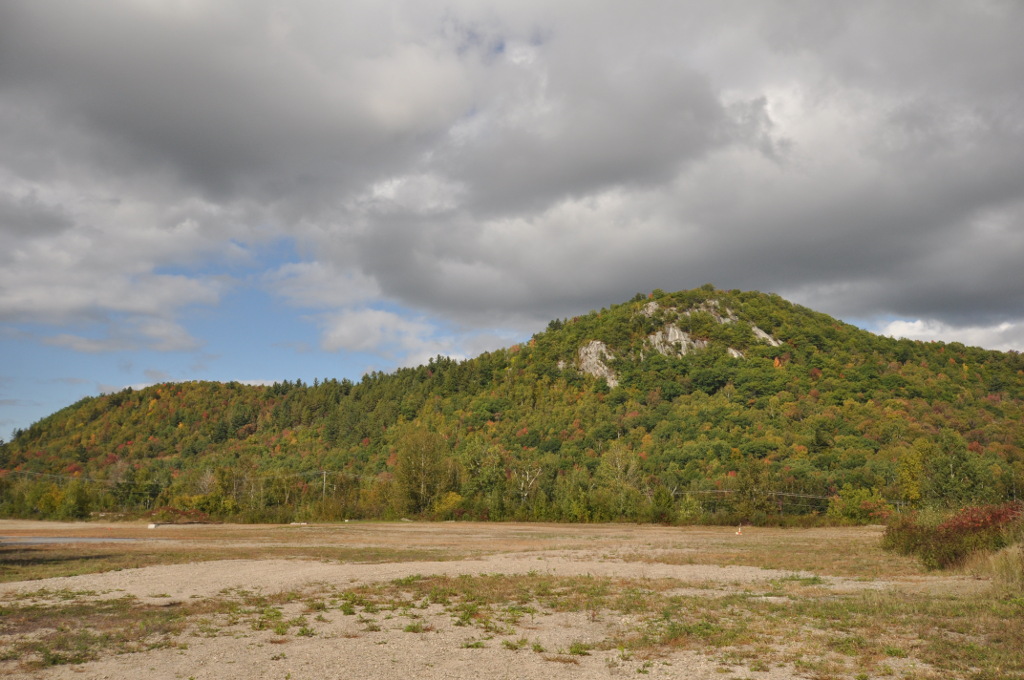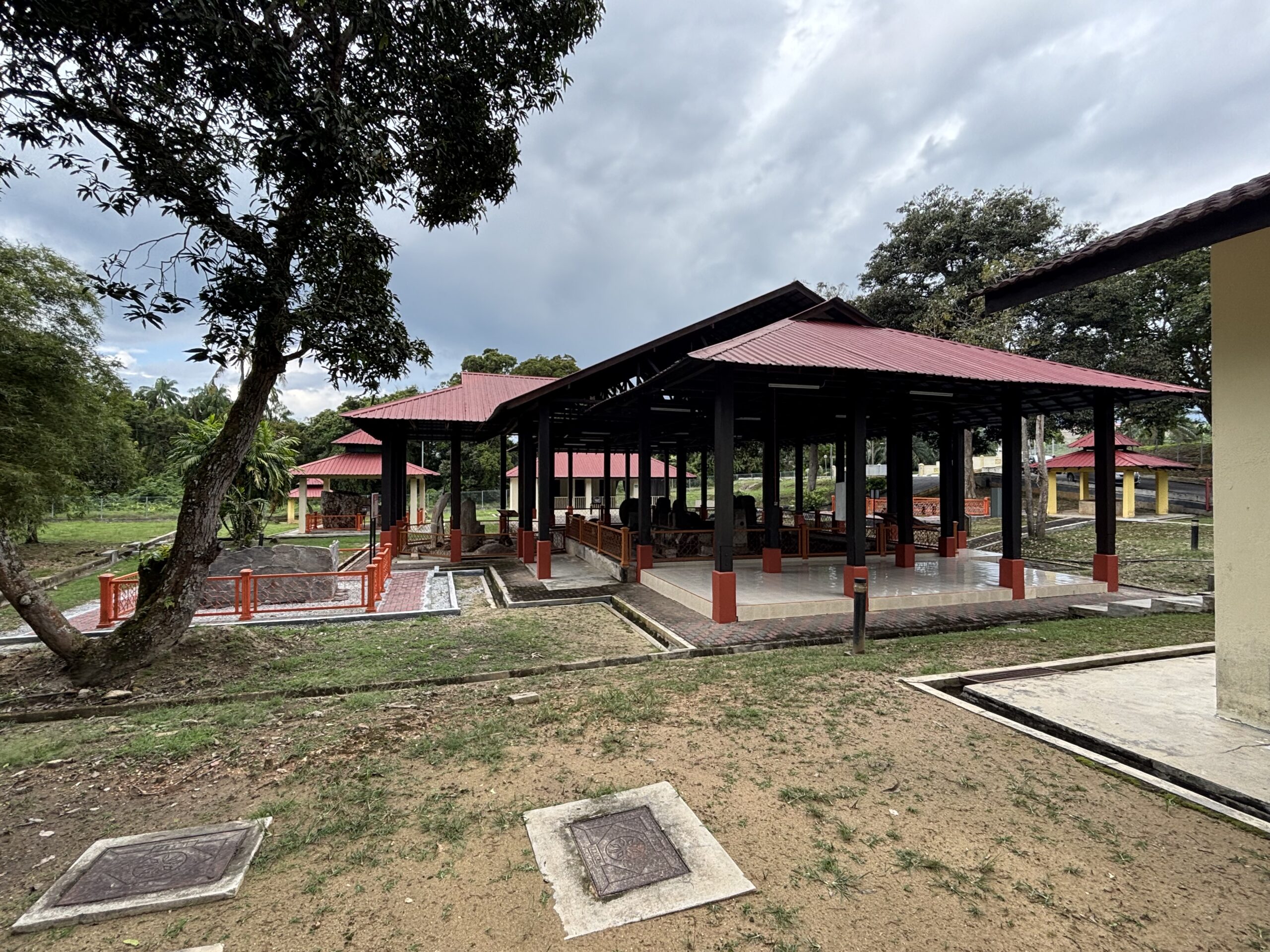
The Pengkalan Kempas Historical Complex is a cluster of carved granite menhirs and a Muslim tomb of the fifteenth century AD, set in a valley beside the Linggi River in Negeri Sembilan, Malaysia. Its three great standing stones — nicknamed the sword, the spoon and the rudder — rise beside the grave of Sheikh Ahmad Majnun, an Islamic missionary said to have died in battle in 1467, during the reign of Sultan Mansur Shah of Malacca. Few places capture the meeting of the Malay Peninsula’s older megalithic world and the arrival of Islam as vividly as this one.
The megaliths of Pengkalan Kempas: sword, spoon and rudder
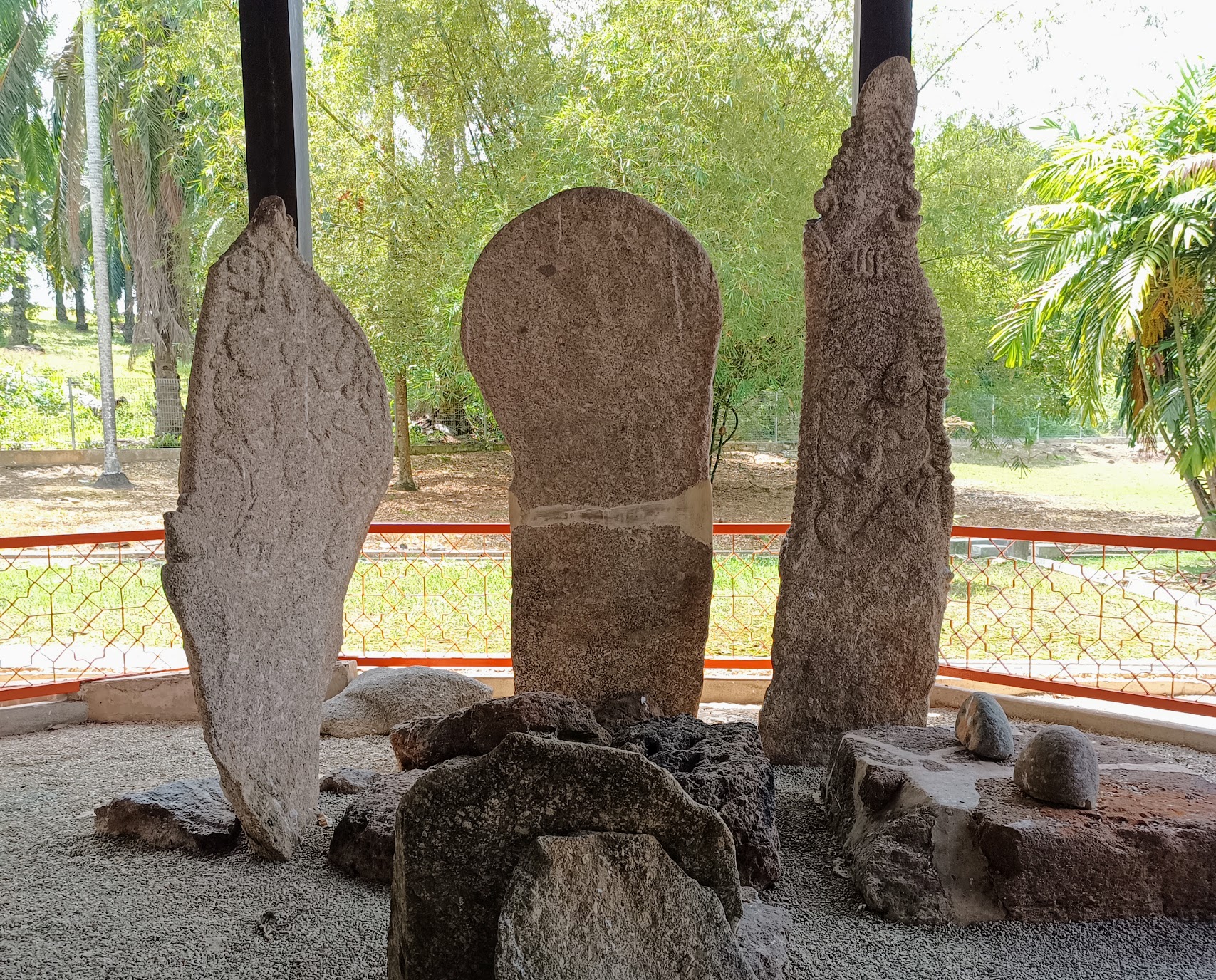
The heart of the complex is a group of three tall granite stones standing close together about 35 kilometres from Port Dickson. Each is named for its silhouette: the pedang (sword), the sudu (spoon) and the kemudi (rudder). They are collectively known as Batu Bersurat — the “inscribed stones” — because several carry worn markings, and they are among roughly 300 megalithic sites scattered across Negeri Sembilan.
Unlike the dressed temple stone of nearby Candi Bukit Batu Pahat in the Bujang Valley, these are rough monoliths, shaped only enough to suggest their nicknames. Their age is genuinely uncertain. Local tradition places them in the second or third century AD, but no excavation has fixed a firm date, and the carved stones may have been raised at very different times. In that ambiguity they sit alongside other enigmatic standing stones, from the menhirs of Cauria in Corsica to the Mzoura stone circle in Morocco.
Why are they called the “living stones”?
To the people of the district the menhirs are batu hidup, or “living stones.” The most persistent piece of folklore holds that they grow an inch or two taller each year, as if slowly rising out of the earth. The belief gives the site a charge of the uncanny that has long outlived any memory of who first set the stones upright, and it is one reason the complex has drawn pilgrims and curiosity-seekers for generations.
Who was Sheikh Ahmad Majnun?
The figure who anchors the complex in recorded history is Sheikh Ahmad Majnun, an Islamic missionary who preached during the era of the Malacca Sultanate. Tradition holds that he was killed in a battle in 1467 against the forces of Sultan Mansur Shah, the ruler under whom Malacca reached its commercial height. His tomb, set among the older pagan stones, is thought to have been raised around that year — making it one of the oldest dated Islamic graves in Malaysia and a marker of how early the new faith reached the peninsula’s interior.
A tomb written in two scripts
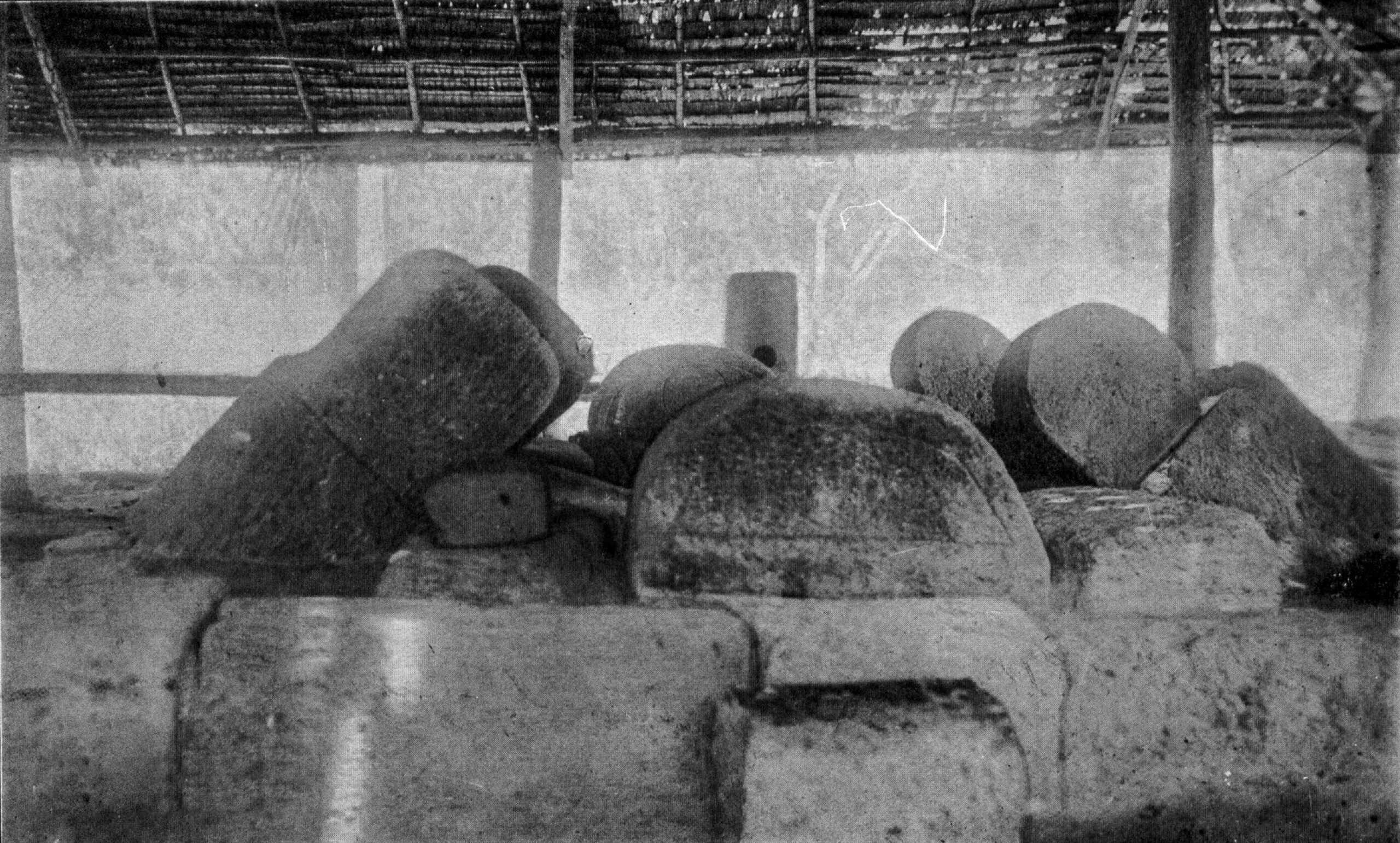
What makes the tomb extraordinary is its inscription. The principal tombstone carries text in raised letters, with an identical Jawi (Arabic-script Malay) inscription cut into both its east and west faces. The Jawi text gives the year 872 in the Islamic calendar — about 1467 — and records that the burial fell during the rule of Mansur Shah. A separate inscription on the stone is written not in Arabic script at all, but in Kawi, the older Indic-derived script of Hindu–Buddhist Southeast Asia.
Kawi and Jawi: a script in transition
The Kawi inscription bears the date 1385 in the Shaka era, roughly 1463 CE, and renders the dead man’s name as “Ahmat Majanu,” while the Jawi version gives it as “Ahmad Maj(e)nun.” A single monument thus speaks in two scripts and two dating systems within a few years of each other — the Indic past and the Islamic future side by side. It is a rare, datable snapshot of the religious change sweeping the fifteenth-century Malay world, the same world that produced the Hindu–Buddhist sanctuaries of the Bujang Valley before Islam took hold.
The oath stone: a medieval lie detector
Near the inscribed tombstone stands one of the complex’s strangest features: a cylindrical stone pierced by a hole. Into the twentieth century, people came here to settle disputes by ordeal. A person swearing an oath would push an arm through the opening, and the stone was believed to tighten its grip and trap the limb if the words were false. This “divine lie detector” turned the site into a local court of last resort, where truth was tested by stone rather than by judge.
Pengkalan Kempas today: from museum to neglect
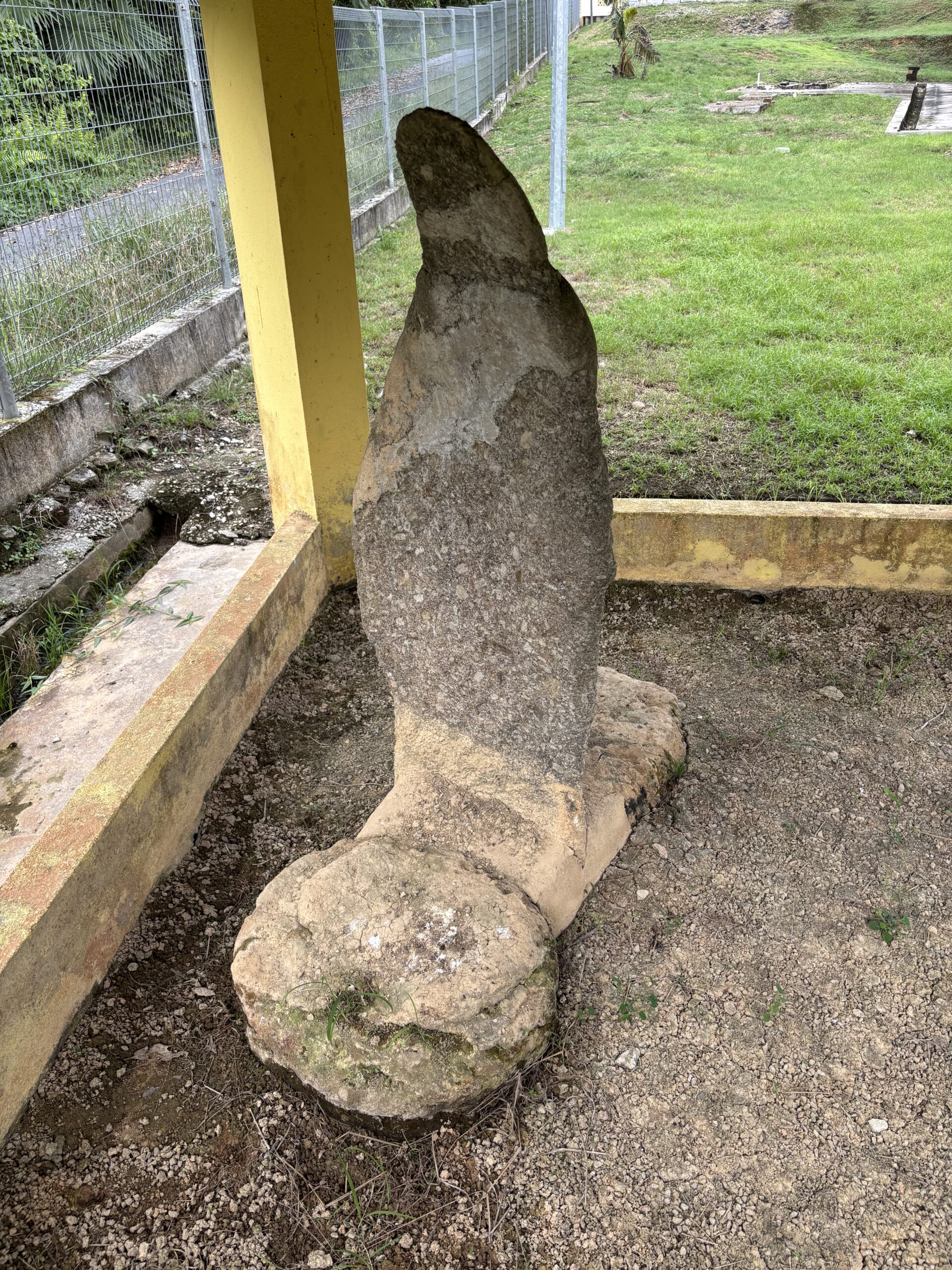
The complex was carefully recorded a century ago: in 1919 colonial-era researchers such as I. H. N. Evans and C. Boden Kloss photographed and drew the stones and the tomb, leaving the earliest detailed documentation of the site. That archive, rather than any astronomical theory or tale of a vanished giant race, is what scholars still build on; the monument’s value lies in its inscriptions and its place in the Malay conversion story, not in invented mysteries.
Its modern custodianship has been less steady. Before 2005 the site was looked after by the Department of Museums and Antiquities, then by the Department of National Heritage, which stopped active maintenance in 2016 for budget reasons. It is now one of five sites overseen by the Negeri Sembilan State Museum Board (Lembaga Muzium Negeri Sembilan). For a monument that joins prehistoric stone-raising to the coming of Islam, it remains far less visited than its significance deserves — a quiet counterpart to better-known historical places and to monumental burials such as Duggleby Howe in England or the great Dolmen de Bagneux in France.
Sources and Further Reading
- Wikipedia — Pengkalan Kempas Historical Complex
- Encyclopaedia Britannica — Negeri Sembilan
- World History Encyclopedia — Malacca
- Universiti Kebangsaan Malaysia — Kompleks Sejarah Pengkalan Kempas (Megaliths of Negeri Sembilan project)
- Wikipedia — Kawi script, the older Indic-derived script on the tomb
- Wikipedia — Mansur Shah of Malacca

Neural Pathways is a collective of seasoned experts and researchers with a profound passion for unraveling the enigmas of ancient history and artifacts. With a wealth of combined experience spanning decades, Neural Pathways has established itself as a leading voice in the realm of archaeological exploration and interpretation.