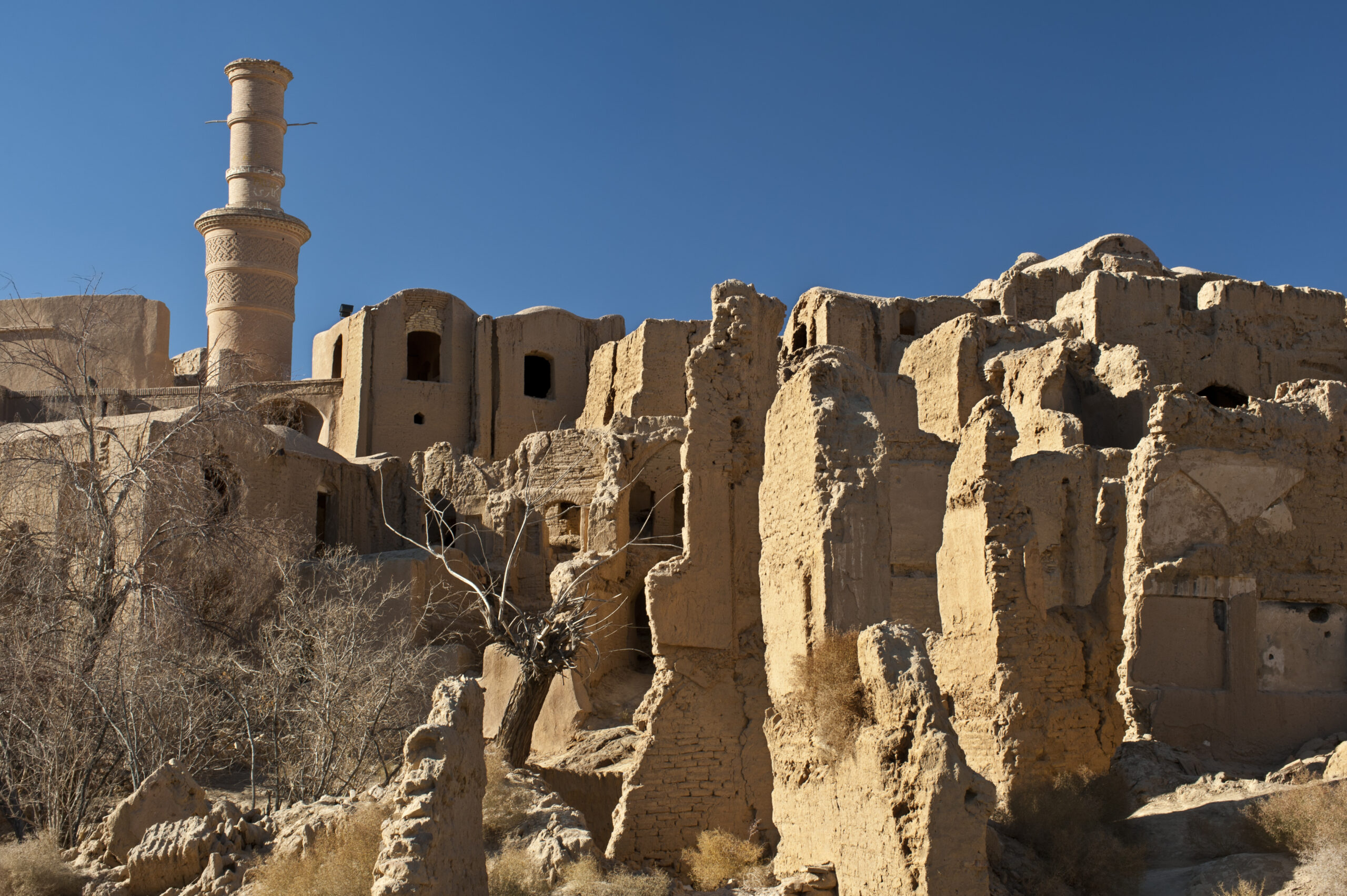
On the edge of Iran’s central desert, about 70 kilometres north of the city of Yazd, the mud-brick town of Kharanaq has stood — and slowly crumbled — for thousands of years. Its name is often translated as “birthplace of the sun,” and local tradition holds that the site has been settled for as long as 4,000 to 4,500 years. The standing ruins are far younger, a dense warren of sun-dried adobe houses, a Seljuk-era minaret that visibly sways, and a Sasanian caravanserai, all left half-empty when the water ran out in the twentieth century.
Who built Kharanaq, and when?
Kharanaq is not the work of a single founder or a single century. The oasis sits on the old caravan route between Yazd and the towns of the northern plateau, and people have farmed its narrow band of arable land for millennia, watered by underground channels. The mud-brick old town that survives today, however, is a layered settlement: its oldest visible fabric is generally placed in the Sasanian period (third to seventh century CE), with the bulk of the standing houses, the mosque and the defensive walls rebuilt and extended through the Islamic centuries and especially under the Qajar dynasty.
Because adobe is constantly repaired, recycled and rebuilt, dating individual buildings is difficult, and the village’s deep history is recorded more in continuity of occupation than in monumental inscriptions. What is clear is that Kharanaq was a working agricultural and trading community rather than a royal or ceremonial centre — its importance lies in showing how ordinary Iranians built and survived in one of the harshest environments on earth. Comparable desert settlements such as Narín Castle at nearby Meybod show the same adobe building tradition stretching back into antiquity.
The shaking minaret and the old town
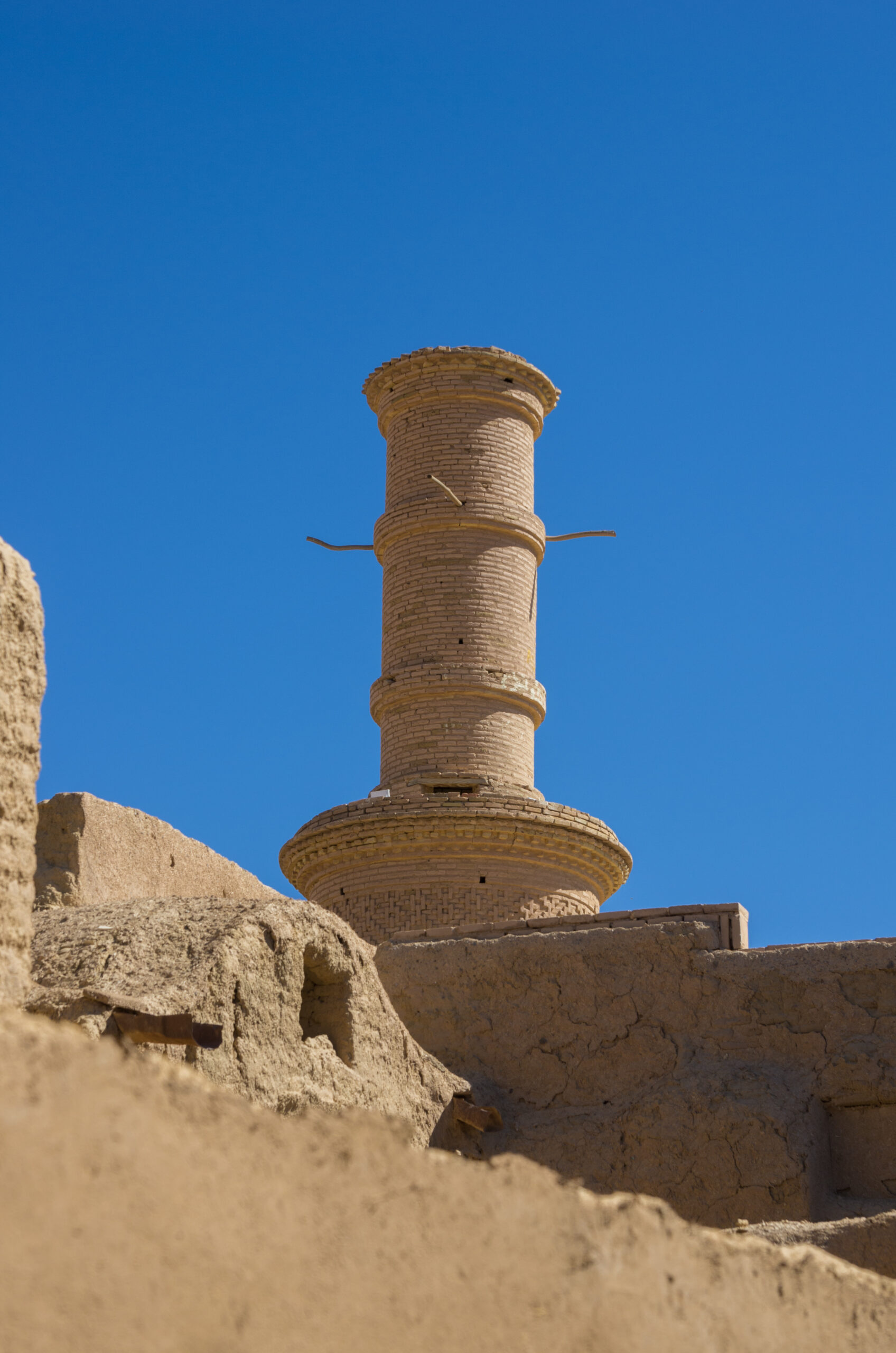
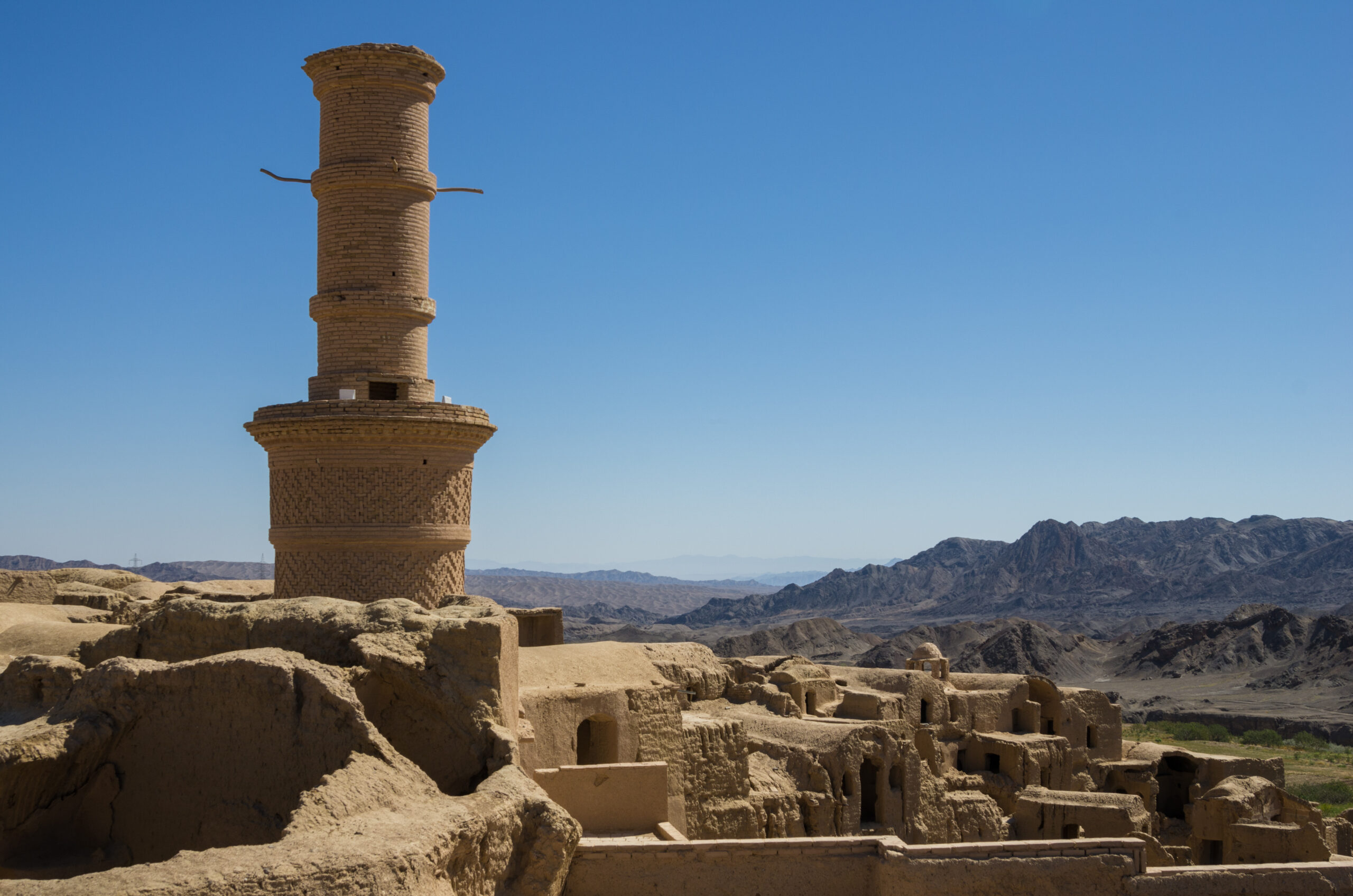
Kharanaq’s most famous structure is its shaking minaret, one of only a handful of “shaking” or moving minarets in Iran. Built in the Seljuk era, the minaret is constructed so that a person standing at the top can set it gently rocking, and the motion carries through the slender tower. Far from being an unexplained mystery, the effect comes from the way the minaret was raised — a tall, flexible shaft built with materials and joints that allow it to flex rather than crack, the same principle that lets the better-known shaking minarets of Isfahan move in tandem.
How a minaret is built to sway
The swaying is a by-product of proportion and material: a high, narrow brick column with enough give in its mortar and timber lacing to oscillate without collapsing. In an earthquake-prone region, this flexibility is also practical, allowing structures to absorb tremors. The same logic runs through the old town as a whole, where wooden beams and straw-reinforced mud brick were used precisely because rigid stone would shatter when the ground moved.
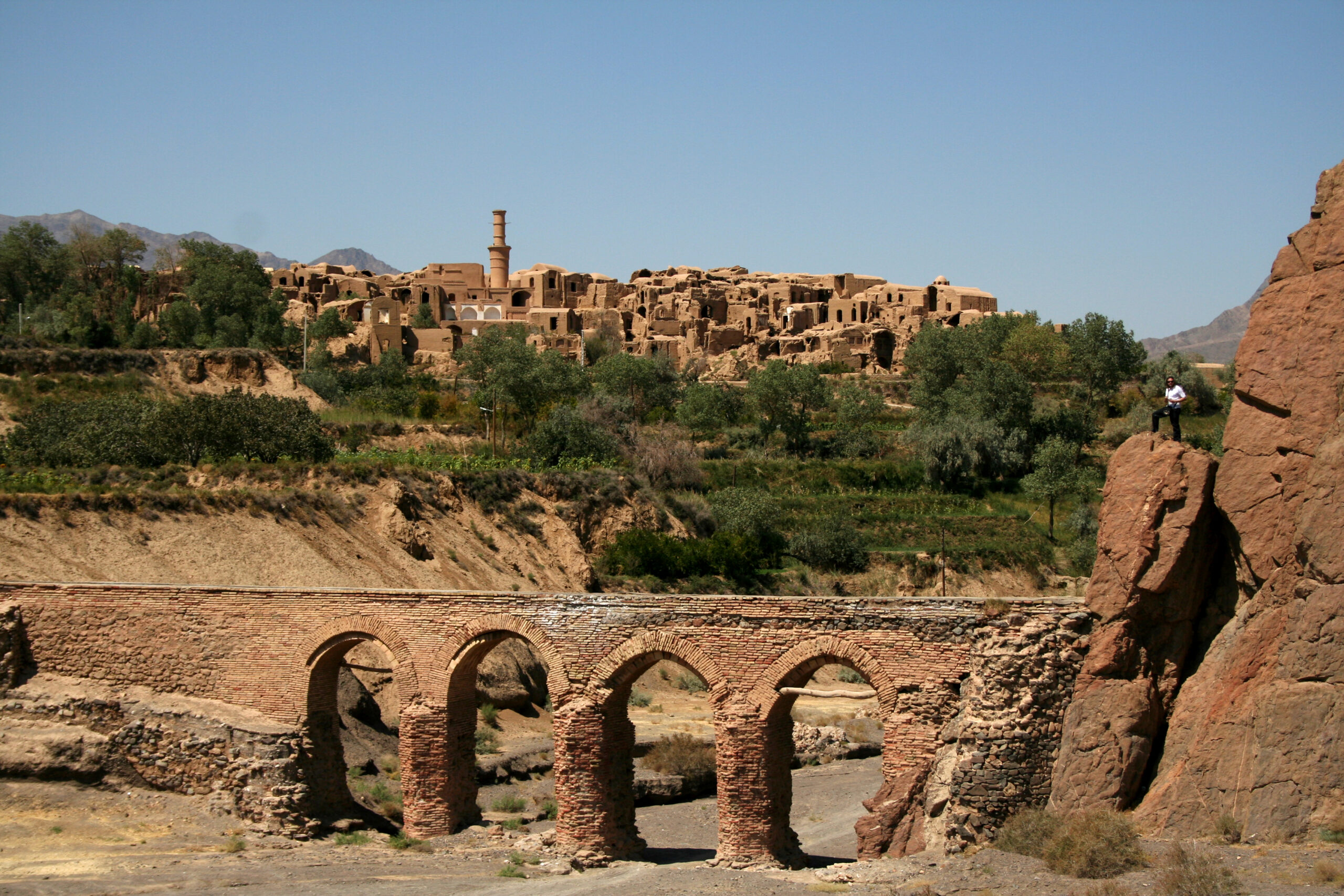
Around the minaret spreads the old town itself: a three-dimensional maze of two- and three-storey houses, covered passageways and shared walls, laid out to trap shade and block the desert wind. It is one of the largest collections of adobe buildings in Iran, and walking its lanes is the closest thing to stepping inside a pre-modern Persian town. The same desert-architecture instincts can be seen across Yazd Province, from the Meybod ice house to the towering mud citadel of Arg-e Bam.
Caravanserai, mosque and qanats
Beyond the houses, three structures anchor Kharanaq’s public life. The caravanserai — a fortified roadside inn for merchants and their animals — has Sasanian origins and was later rebuilt under the command of Muhammad Vali Mirza, a son of the Qajar ruler Fath-Ali Shah. The village mosque, in its present form largely a Qajar-era building, served the community’s religious needs. Both have been restored and can be visited today.
None of it would have existed without water. Kharanaq depended on the qanat, the ancient Persian system of gently sloping underground channels that carry groundwater for kilometres across the desert by gravity alone. The qanat made farming possible in a place with almost no rainfall, and the rhythm of the village — its fields, its population, its very survival — followed the flow of that hidden water. The same engineering sustained desert towns across Iran, including the World Heritage citadel of Bam.
Why was Kharanaq abandoned?
Kharanaq’s decline was not the result of war or catastrophe but of slow environmental and economic change. As the qanat water supply diminished and modern roads, jobs and amenities drew people toward larger towns, families left the old town through the twentieth century. They did not move far: a “new” Kharanaq, where several hundred people still live, sits beside the abandoned core. The old town was simply left to the desert, its empty houses settling into the picturesque ruin visitors see today.
That abandonment, paradoxically, is what preserved it. Unredeveloped and largely untouched, Kharanaq is now a protected heritage site and a magnet for travellers exploring the desert circuit around Yazd — a city whose own historic adobe core is a UNESCO World Heritage Site. Restoration work on the minaret, caravanserai and mosque aims to stabilise what remains. For more abandoned and ruined places across the ancient world, see our historical places archive; Kharanaq sits naturally alongside other Iranian desert monuments such as the Towers of Silence at Yazd.
Sources and Further Reading
- Wikipedia: Kharanaq
- Ancient Origins: The 4,000-Year-Old Abandoned Mud-Brick Town of Kharanaq
- Tehran Times: Kharanaq: a deserted, crumbling but dreamy destination
- World History Encyclopedia: Sasanian Empire

Neural Pathways is a collective of seasoned experts and researchers with a profound passion for unraveling the enigmas of ancient history and artifacts. With a wealth of combined experience spanning decades, Neural Pathways has established itself as a leading voice in the realm of archaeological exploration and interpretation.