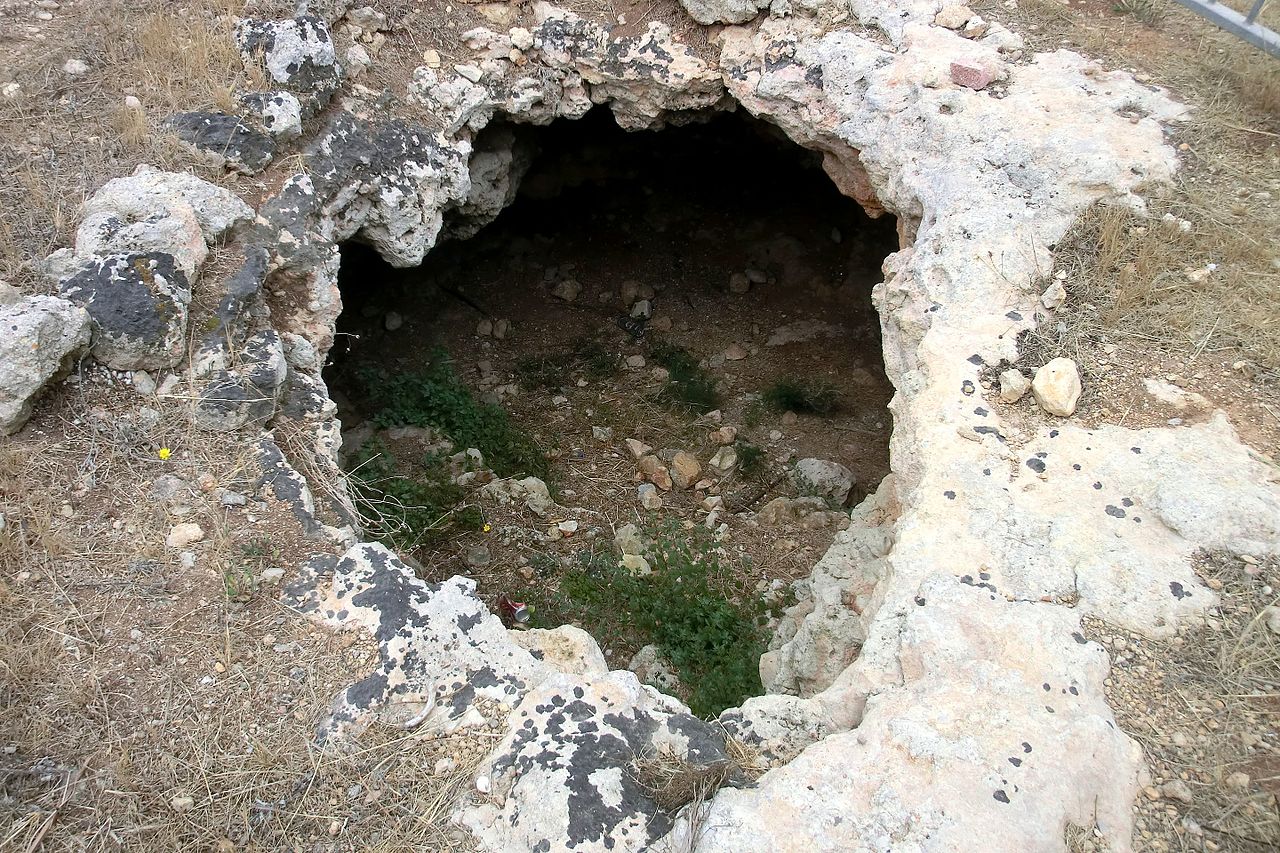
Ta’ Għejżu Cave (Maltese: Għar ta’ Għejżu) is a small but important prehistoric site on the Xagħra plateau of Gozo, Malta. The cave is roughly 13 metres long, cut into a limestone outcrop on which prehistoric builders also erected a dolmen, and was cleared in 1933 when it yielded a deposit of pottery from the Ġgantija phase (about 3600–3000 BCE) of the Maltese Temple Period — most of it covered in red ochre. The site sits within walking distance of two of Malta’s most famous monuments: the Xagħra Circle (Brochtorff Circle) hypogeum just to the south, and the Ġgantija megalithic temples a short distance further. Heritage Malta now manages it as part of the wider Xagħra prehistoric landscape.

Where and What It Is
The cave is set into the limestone of the Xagħra plateau, the high tableland that occupies the centre of the Maltese island of Gozo. The surrounding archaeological landscape is unusually dense: within a few hundred metres of the cave are the Ta’ Kola Windmill (a later baroque-era survival), the Xagħra (Brochtorff) Stone Circle and Hypogeum, and the two-temple Ġgantija complex — one of the oldest free-standing stone structures in the world and a UNESCO World Heritage Site since 1980. Ta’ Għejżu Cave is the smallest of these monuments but tells its own story about how the cave was used as a deposit site by the people who built the temples.
How old is the Ta’ Għejżu Cave?
The cave itself is a natural feature, but its use as an archaeologically visible site falls squarely in the Maltese Temple Period (roughly 3600–2500 BCE). Pottery sherds recovered from the cave’s deposit place its main use in the Ġgantija phase (3600–3000 BCE) — the same cultural phase that built the eponymous Ġgantija temple. This makes Ta’ Għejżu’s deposit roughly 5,500 years old, predating Stonehenge by about a millennium and the Egyptian pyramids by nearly six centuries. Maltese prehistoric chronology recognises five Temple-Period phases — Żebbug, Mġarr, Ġgantija, Saflieni and Tarxien — and the cave’s material sits primarily in the third of these.
The 1933 Clearance and the Red-Ochre Pottery
Ta’ Għejżu was cleared archaeologically in 1933, and the clearance produced large quantities of pottery sherds — many of them covered in red ochre. The red-ochre coating is significant in two ways. First, it is the same pigment that appears widely on the deliberately broken pottery and on certain skeletal elements at the nearby Xagħra Circle hypogeum, suggesting that Ta’ Għejżu’s deposit was part of the same broader ritual practice. Second, ochre-painted ceramics are unusual in Maltese Temple Period assemblages — their concentration here points to deliberate selection of a specific subset of pots for whatever was being done in the cave, rather than the random discard of domestic vessels.
Is Ta’ Għejżu a Burial Cave?
Despite the colloquial label “burial cave” sometimes applied to it, Ta’ Għejżu has produced no significant amount of human skeletal material — that distinction belongs to its much larger neighbour, the Xagħra Circle hypogeum, where excavations from 1987 to 1994 recovered roughly 220,000 disarticulated human bones belonging to between 450 and 800 individuals across the late Neolithic.
The Xagħra Circle, by contrast
The Xagħra Circle is one of the largest known prehistoric burial sites in Europe. Ta’ Għejżu, by contrast, seems to have functioned as a ritual deposit cave — a place where worked pottery, ochre, and probably food offerings were placed, in connection with the broader funerary complex but not as a burial chamber in its own right.

The Dolmen and Above-Ground Structures
Adjacent to the cave’s entrance, on the surface of the limestone outcrop, prehistoric builders erected a dolmen — a small free-standing megalithic structure formed of two or more upright stones supporting a horizontal capstone. Maltese dolmens are usually attributed to the Tarxien Cemetery phase (roughly 2500–1500 BCE), later than the cave’s pottery deposit. This sequencing — Temple Period ceramics inside the cave, post-Temple Period dolmen above — suggests the same outcrop was reused for ritual purposes across at least two cultural phases, before, during, and after the dramatic transition that ended Malta’s Temple Period around 2500 BCE.
How Ta’ Għejżu Fits into Gozo’s Prehistoric Landscape
The Xagħra plateau is one of the densest concentrations of late Neolithic monuments in Europe. Within a single morning’s walk you can move between Ġgantija (the eponymous Temple Period site), the Xagħra Circle hypogeum, the Ta’ Kola Windmill (a baroque survival of later Maltese rural life), and Ta’ Għejżu Cave. The cave’s contribution to this story is not its size or its skeletal material — both modest — but the evidence it carries that small, hidden, ochre-using ritual spaces existed alongside the great public temples. Maltese prehistoric religion clearly operated at more than one scale simultaneously, and Ta’ Għejżu is one of the few preserved examples of the smaller scale.

Visiting Today
Ta’ Għejżu Cave is managed by Heritage Malta as part of the wider Xagħra prehistoric landscape. The cave itself is small and on-site interpretation is limited; most visitors encounter it in combination with the Ġgantija Archaeological Park (which includes the Ta’ Kola Windmill and a small museum displaying objects from the surrounding sites). The site forms part of the broader archaeological landscape of the Maltese islands. Visitors should respect the fragile limestone and never enter cleared cave deposits unaccompanied.
Sources and Further Reading
- Heritage Malta — Ta’ Għejżu Cave (official site entry)
- Wikipedia — Xagħra Stone Circle
- Springer — “Island questions: chronology of the Brochtorff Circle at Xagħra, Gozo” (Archaeological and Anthropological Sciences)
- Wikipedia — Ġgantija (UNESCO context for the Xagħra plateau)
- Heritage Malta — Ġgantija Temples (Xagħra plateau context)