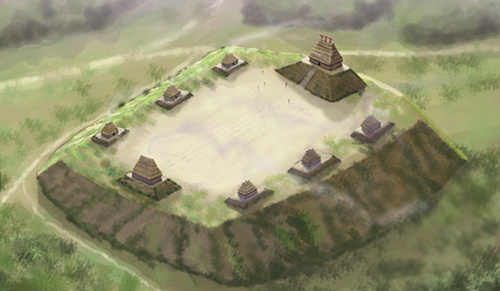
Emerald Mound is a Plaquemine culture ceremonial site near Stanton, Mississippi, and the second-largest pre-Columbian earthwork in the United States, surpassed only by Monks Mound at Cahokia in Illinois. Built between roughly AD 1250 and 1600 on the site of an earlier village, the eight-acre platform rises 35 feet and once carried temples and elite residences on its flattened summit. It was the principal religious center of the ancestors of the historic Natchez people before they shifted their capital downriver.
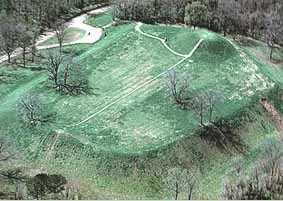
What and where is Emerald Mound?
Emerald Mound sits just off the Natchez Trace Parkway at milepost 10.3, about 10 miles northeast of Natchez in Adams County, Mississippi. The main platform measures roughly 770 feet by 435 feet at the base and stands 35 feet high, covering some eight acres. Two secondary mounds rise from the flat summit — a large one at the western end and a smaller one to the east — lifting the highest point to about 60 feet above the surrounding ground.
Unusually, the ceremonial buildings stood on top of the great mound rather than on separate platforms arranged around a plaza, a layout rarely seen at other mound centers. This makes Emerald Mound one of the clearest surviving expressions of how the Mississippian world fused architecture, religion, and social rank into a single monumental form. For a sense of scale, it dwarfs more modest platform sites such as Pyramid Mound in Indiana.
A Plaquemine culture ceremonial center
Although it belongs to the broader Mississippian tradition, Emerald Mound is specifically a product of the Plaquemine culture, a regional variant centered on the Lower Mississippi Valley. The site is the type site for the Emerald Phase (about 1500 to 1680 CE) of the Natchez Bluffs chronology, meaning archaeologists use it as the defining example against which other sites of that period are measured.
The Plaquemine builders are widely regarded as the direct ancestors of the historic Natchez, a people famous for a rigid social hierarchy headed by a paramount chief known as the Great Sun. Comparable mound-and-plaza centers across the Southeast, such as Ocmulgee Mounds in Georgia and Aztalan in Wisconsin, show how widely this template spread.
Religion and the Green Corn ceremony
Scholars believe Emerald Mound hosted seasonal rituals tied to agriculture and renewal, most likely including the Green Corn ceremony that marked the ripening of the maize crop across the Mississippian Southeast. Temples and a sacred fire would have crowned the summit, attended by elite priests whose authority blended political and religious power — the same world that produced the elaborate elite burials seen at Mound 72 at Cahokia.
How was Emerald Mound built?
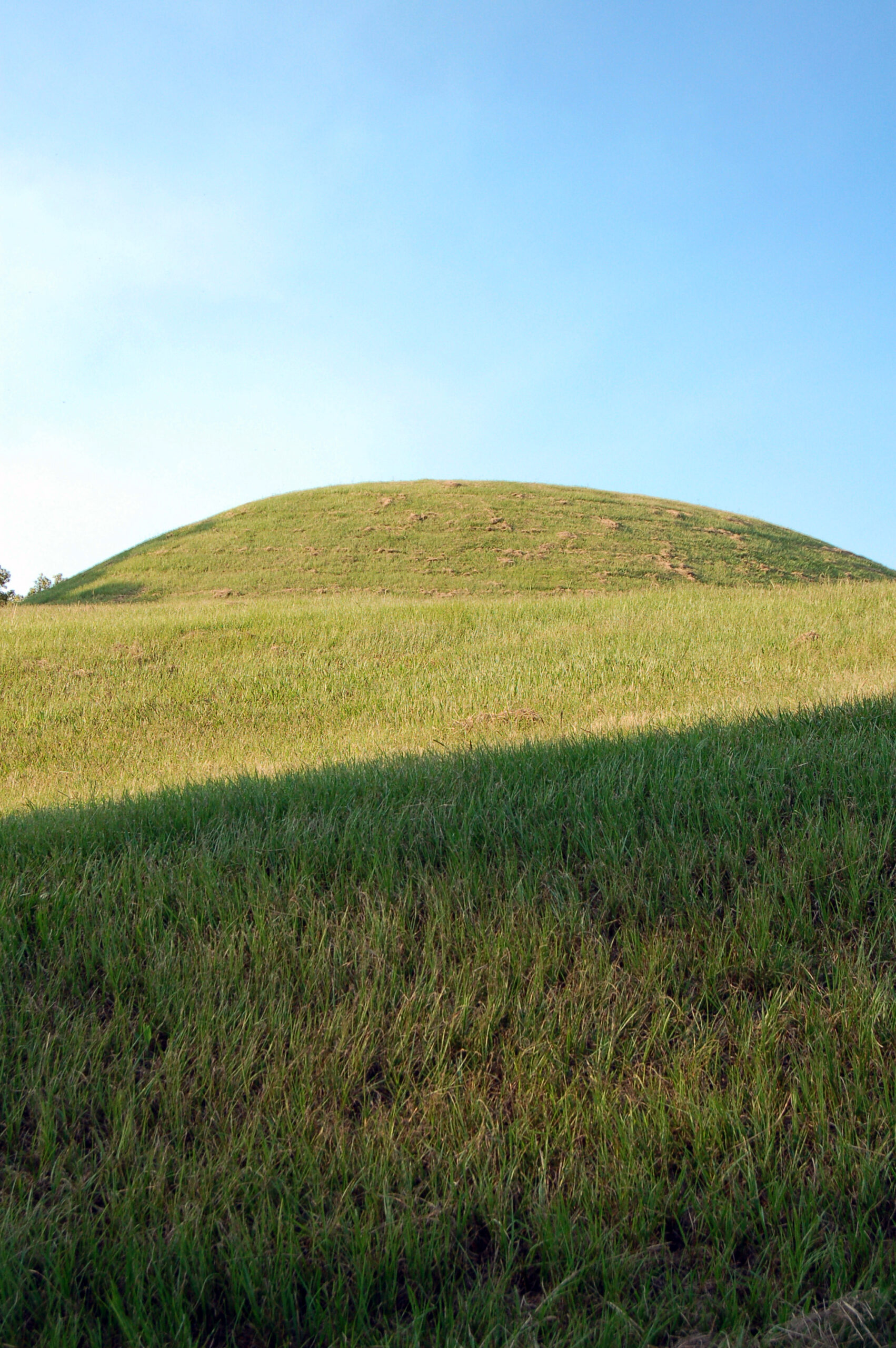
Emerald Mound was not raised on flat ground from scratch. Its builders reshaped a natural loess hill, cutting it down and squaring it off, then heaping basket-loads of earth to enlarge and cap it. The main platform was raised in three distinct construction stages beginning around AD 1350, atop a Mississippian village that had occupied the spot since roughly AD 1200.
Every stage demanded enormous coordinated labor: soil carried by hand in woven baskets, spread in layers, and compacted to keep the slopes stable. The result has endured for six centuries with its essential shape intact, a testament to the engineering knowledge of a society that worked entirely without metal tools, wheels, or draft animals.
The Natchez, De Soto, and abandonment
By the late 1730s the Natchez had abandoned Emerald Mound. The likely trigger was the social upheaval that followed catastrophic population loss from European diseases, introduced to the Southeast by the Hernando de Soto expedition in the 1540s. By the time of the La Salle expedition in 1682, the people’s main ceremonial center had moved about 12 miles southwest to the Grand Village of the Natchez, also called the Fatherland Site.
Emerald Mound therefore captures a civilization on the eve of collapse — a monument still standing after its builders had been scattered by colonization and disease. The Natchez themselves were dispersed following their wars with French colonists in 1729 to 1731.
Rediscovery, the Selsertown name, and preservation
Emerald Mound is also recorded under its older name, the Selsertown Site, after a vanished 19th-century settlement nearby. It was documented during the great Smithsonian-sponsored survey of mounds in the Mississippi Valley in the 1840s, work that first placed monuments like this one in the scientific record. Local Choctaw of the early 1800s associated the land with the mixed-blood chief Greenwood LeFlore, who once held property in the area.
The owners donated the site to the National Park Service in the 1950s. It is now a National Historic Landmark, administered as part of the Natchez Trace Parkway and freely open to visitors who can climb a stairway to the summit. You can browse more sites from this era in our ancient civilizations archive.
Visiting Emerald Mound today
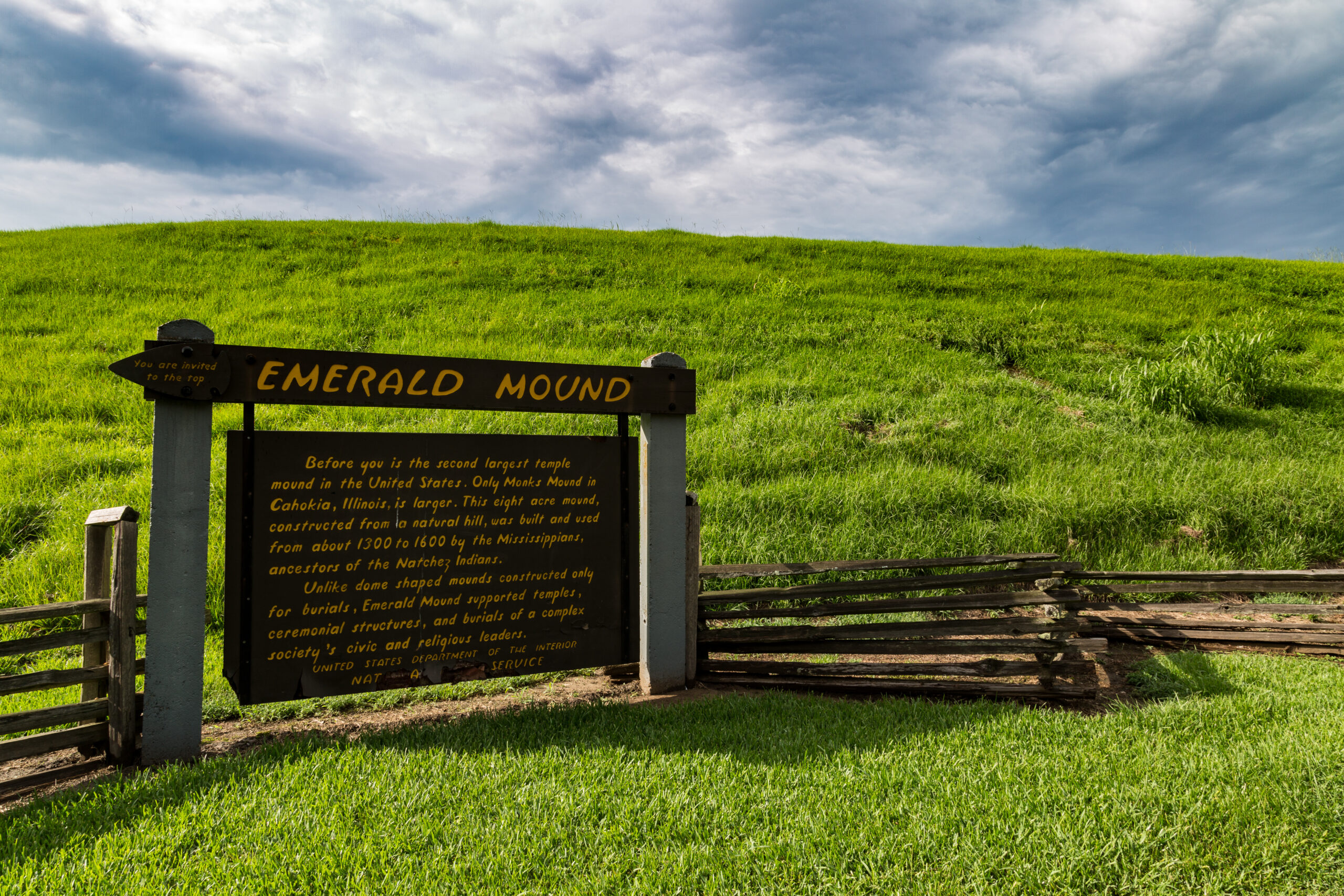
The site is open year-round at no charge, with a small parking area and an interpretive sign. A mowed path and steps lead to the top of the great platform, where the scale of the earthwork becomes clear in a way no photograph quite conveys. Because it remains an actively managed archaeological landmark, visitors are asked to keep to the paths and avoid disturbing the slopes.
Frequently asked questions
How old is Emerald Mound?
The great platform was raised in three stages beginning around AD 1350, but it overlies a Mississippian village occupied from roughly AD 1200. The site stayed in use as a ceremonial center until the Natchez abandoned it in the late 1730s, giving it a working life of more than four centuries before colonization ended its role.
Why is Emerald Mound important?
It is the second-largest pre-Columbian earthwork in the United States after Monks Mound at Cahokia, and the type site for the Emerald Phase of the Plaquemine culture. Its rare arrangement of ceremonial buildings directly atop the main mound makes it one of the best windows into how the ancestors of the Natchez organized religion, labor, and political power.
Can you climb Emerald Mound?
Yes. As part of the Natchez Trace Parkway, Emerald Mound is open to the public free of charge, and a stairway and mowed path allow visitors to walk to the flat summit and the secondary mounds. Visitors are asked to stay on the designated routes to protect the fragile earthwork from erosion.
Sources and further reading
- Emerald Mound site – Wikipedia
- Emerald Mound – Natchez Trace Parkway, National Park Service
- Mississippian Culture – World History Encyclopedia
- Cahokia – World History Encyclopedia
- Mississippian Culture – HISTORY
Last fact-checked: 24 June 2026 by The Brain Chamber editorial team. Spotted an error? Email hello@thebrainchamber.com and we will review it.

Neural Pathways is a collective of seasoned experts and researchers with a profound passion for unraveling the enigmas of ancient history and artifacts. With a wealth of combined experience spanning decades, Neural Pathways has established itself as a leading voice in the realm of archaeological exploration and interpretation.