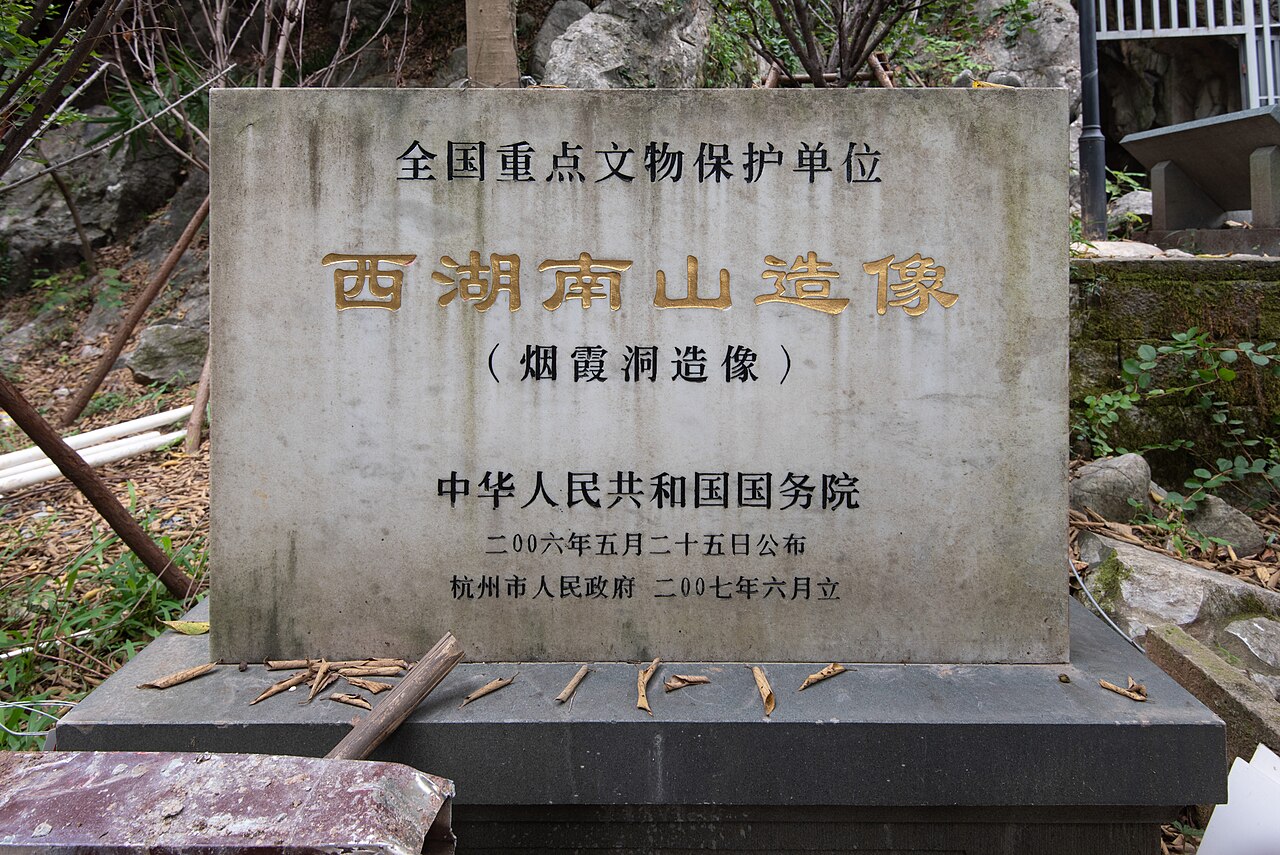
Yanxia Cave (烟霞洞) — its name meaning “smoke and sunset glow”, a description of the dim hazy light filtering through its stalactites — is a small limestone cave on the South Peak of the Yanxia Range, in the western hills above West Lake, Hangzhou, in China’s Zhejiang Province. The cave is famous for one thing in particular: it contains one of the earliest complete sets of “Sixteen Arhats” stone carvings ever found in China, sculpted into its walls during the Five Dynasties period (907–960 CE). Two Song-dynasty Guanyin statues, added a few decades later, include the earliest surviving white-robed Guanyin in China — long celebrated as the “Most Beautiful Five Dynasties Guanyin in Jiangnan”.

Where and What It Is
Yanxia Cave is set into the limestone of the South Peak (南高峰), one of the prominent hills on the south-western shore of Hangzhou’s West Lake, the cultural landscape inscribed as a UNESCO World Heritage Site in 2011. The cave sits near Wengjiashan Village and forms part of an ensemble known as the Yanxia Three Caves (烟霞三洞) — Yanxia, Shiwu (Stone House) and Shuile (Water-fall) Caves — strung along a short footpath through the hill. Of the three, Yanxia is by far the most important culturally, both for the age of its carvings and for the reputation of its Guanyin.
How old is the Yanxia Cave?
The cave itself is a natural limestone formation, but its religious importance dates from the 10th century. The Sixteen Arhats and the earliest carvings belong to the Five Dynasties and Ten Kingdoms period, the fragmented century (907–979) between the Tang and the Song. Hangzhou was then the capital of the Wuyue Kingdom (907–978), a small but unusually wealthy southern state whose rulers — the Qian family — were vigorous patrons of Buddhism. The Wuyue court underwrote new temples, pagodas (most famously the Leifeng Pagoda on the West Lake’s south shore).
The Wuyue stone-carving programme
The court also funded stone-carving projects across the hills around the lake, of which Yanxia is one of the most accomplished surviving examples.
The Sixteen Arhats
In Chinese Buddhist iconography, the Sixteen Arhats (Sanskrit Shodasa-sthavira; Chinese 十六罗汉, Shí Liù Luóhàn) are the principal disciples appointed by the Buddha to remain in the world and protect the dharma until the arrival of the future Buddha, Maitreya. Yanxia’s set is carved directly into the natural rock of the cave walls, with each arhat shown in a distinctive pose — some seated in meditation, some leaning on staffs, some interacting with attendants or with lions. The artistic conventions are recognisably late-Tang in lineage but with the slightly softer, more naturalistic faces that Five Dynasties sculpture in the Jiangnan region became known for.
What makes the set art-historically important is its age. Sixteen-Arhat sculpture groups became enormously popular in later Song and Ming temples, but very few complete Five Dynasties sets survive anywhere in China — Yanxia’s is one of the earliest, and remains the best-preserved example carved in living rock rather than as freestanding statuary.

The White-Robed Guanyin
A few decades after the Sixteen Arhats were carved, two further figures of Guanyin (Avalokiteshvara, the Bodhisattva of Compassion) were added to the cave during the early Northern Song (960–1027). One of them is the carving for which Yanxia Cave is most famous: the earliest surviving white-robed Guanyin in China. Standing, drape-robed and serene, the figure became the template for a recognisable iconographic type — the baiyi Guanyin (白衣观音) — that spread through Song and Yuan painting and sculpture across East Asia, eventually influencing Japanese and Korean Buddhist art. Within the Hangzhou tradition, the carving is known by the soubriquet “Most Beautiful Five Dynasties Guanyin in Jiangnan”, although its actual carving date is early Northern Song rather than Five Dynasties proper.
The Wuyue Kingdom Connection
To understand why a small cave on the outskirts of Hangzhou contains such important Buddhist sculpture, it helps to remember the political geography. The Wuyue Kingdom ruled a wealthy maritime hinterland — modern Zhejiang, southern Jiangsu and parts of Fujian — between the fall of the Tang in 907 and absorption into the Song in 978. While most of north China descended into the violent succession of “Five Dynasties”, the Wuyue court used its 71 years of relative peace to fund a remarkable programme of Buddhist construction. The capital, modern Hangzhou, accumulated temples, pagodas and rock-cut sculpture at a pace unmatched anywhere else in 10th-century China. Yanxia is one of the smaller and lesser-known sites in that programme, but precisely because it was less famous it escaped the periodic destructions that afflicted the bigger urban temples — the cave’s carvings remain remarkably intact.
Discovery, Recognition and Today
Although the cave was never lost — it was part of a local Buddhist landscape continuously visited by Hangzhou residents — its national art-historical importance was formally re-evaluated only in the 20th century, when surveys of Chinese rock-cut Buddhist art identified the Sixteen Arhats as one of the earliest complete sets in the country. Yanxia Cave is now a protected cultural heritage site under the City of Hangzhou’s cultural heritage administration. As part of the wider archaeological landscape of West Lake and its hills, it is open to visitors year-round on a small ticket; the visit combines easily with Lingyin Temple, the Feilai Feng rock carvings and the South Peak walks that line the western shore of West Lake.

Sources and Further Reading
- Lonely Planet — Yanxia Cave, Hangzhou
- Wikipedia — Sixteen Arhats (iconographic background)
- Wikipedia — Wuyue Kingdom (907–978 CE)
- Wikipedia — West Lake Cultural Landscape, Hangzhou (UNESCO context)
- SHINE — Exhibition highlights ancient Buddhist carvings of Hangzhou