The Visvakarma Cave — also written Vishvakarma or Vishwakarma, and locally known as the Sutar Jhopadi (“carpenter’s hut”) — is Cave 10 in the Ellora complex in Maharashtra, India. Carved from the basalt cliff around 650 CE, it is the only chaitya (Buddhist prayer hall) among the twelve Buddhist caves at Ellora and one of the finest examples of rock-cut architecture imitating wooden temple construction anywhere in India. The cave is dominated by an 11-foot colossal seated Buddha in preaching pose, an enormous 27-foot stupa, and a barrel-vaulted ceiling whose ribbed stone “beams” were carved to look exactly like the wooden roof of a free-standing temple.

Where and What It Is
Visvakarma Cave sits roughly 30 kilometres north-west of Aurangabad (officially Chhatrapati Sambhajinagar) at the Ellora cave complex, which is inscribed on the UNESCO World Heritage list. Ellora contains 34 rock-cut monuments arranged in three groups carved between roughly the 6th and 10th centuries CE: Caves 1–12 are Buddhist, 13–29 are Hindu, and 30–34 are Jain. Cave 10 is in the Buddhist group and is unique among them — every other Buddhist cave at Ellora is a vihara (a monastic residence with cells and a small shrine), but Cave 10 is a true chaitya hall, designed for collective worship around a stupa.
How old is the Visvakarma Cave?
Art-historical evidence places the Visvakarma Cave around 650 CE, in the late 7th century. The architectural detailing — the proportions, the style of the seated Buddha frontispiece, and the treatment of the pillar capitals — places it within the Kalachuri idiom, the late-Vakataka rock-cut tradition that flourished in the Deccan before the Rashtrakuta dynasty took over the region. The cave therefore predates the Rashtrakuta-era Kailasa Temple (Cave 16) by roughly a century, and was carved under the patronage of local Buddhist communities rather than royal commission.
The Chaitya Hall and the Imitated Wooden Roof
Walking into the hall, the most arresting feature is the ribbed, barrel-vaulted ceiling. The whole roof is carved to imitate the curved wooden beams of a free-standing chaitya — a building tradition that pre-dated rock-cut architecture in India by several centuries and that, by 650 CE, was already being preserved in stone because the wooden originals had decayed.
The 28 octagonal pillars and circumambulation path
The hall is divided into a nave and two side aisles by 28 octagonal pillars, each roughly 14 feet (4.3 m) tall, allowing worshippers to walk around the central stupa in the prescribed circumambulation (pradakshina). The whole layout follows the canonical chaitya plan that earlier sites such as the chaitya at Karla had established centuries before.

The Stupa and the Seated Buddha
At the far end of the hall stands a monumental stupa nearly 27 feet (8.2 m) high and 16 feet (4.9 m) in diameter. Fixed to the front of the stupa is a 17-foot frontispiece carrying an 11-foot colossal seated Buddha in dharmachakra mudra — the gesture of “turning the wheel of the law”, representing the Buddha’s first sermon at Sarnath. This Mahayana arrangement — a worshipped Buddha figure literally attached to the stupa — marks the cave as a Mahayana foundation, contrasting with earlier Theravada chaityas (such as Karla and Bhaja) where the stupa was the sole object of veneration and figural representations of the Buddha were avoided.
Why “Carpenter’s Cave”?
The local name Sutar Jhopadi, “the carpenter’s hut”, reflects two things at once. First, the rock-cut imitation of wooden roof beams is so accurate that the cave looks like the inside of a wooden building — visitors and local craftsmen for centuries assumed real wood lay behind the stone. Second, the cave became associated in popular Hindu tradition with Vishvakarma, the divine architect and patron deity of carpenters and craftsmen, who in mythology built the homes of the gods. Local carpenters and craftsmen still visit Cave 10 and venerate the Buddha figure as Vishvakarma — a folk syncretism that gave the Buddhist hall its Hindu-sounding name without changing its religious origin.
The Façade and the Upper Storey
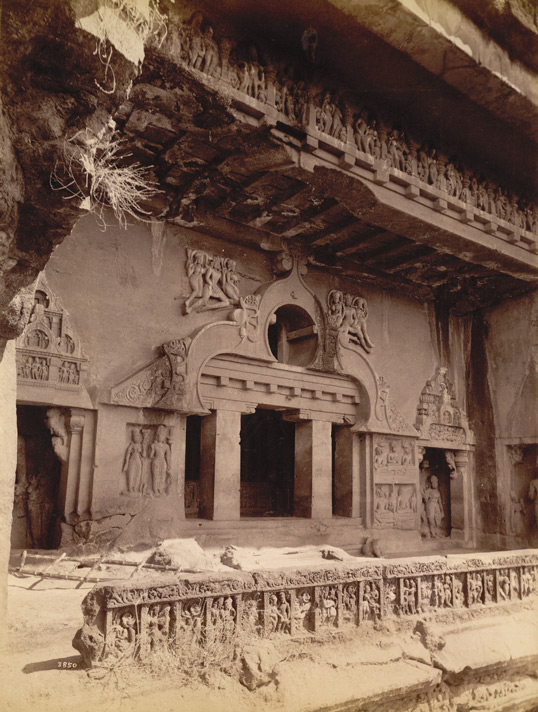
Visvakarma Cave is unusually tall for a chaitya. The façade is multi-storied: an upper gallery with a row of musicians and dwarf attendant figures runs above the main entrance, and a large window above that admits daylight directly onto the seated Buddha — an effect that turns the statue into a focal point at certain hours of the day. The upper-storey carvings depict bodhisattvas, female attendants, and small panels showing scenes from the Buddha’s life. The entire entrance arrangement, including the porch and the courtyard in front, demonstrates how late-Buddhist rock-cut design at Ellora was reaching for the scale and presentation of a free-standing temple while remaining entirely subtractive — every line is carved out, not added.

Where Cave 10 Fits in Ellora’s Story
The Buddhist caves at Ellora (1–12) belong to the last great phase of rock-cut Buddhist architecture in the western Deccan, dating from roughly the late 5th to mid-7th century. Cave 10 is one of the most ambitious projects of that phase: by the time it was completed, Buddhism in central India was in decline, and the Hindu caves carved on the same cliff just decades later (12–29) reflect the religious shift that would dominate the rest of Ellora’s history. The juxtaposition is striking — within a few hundred metres at the same site, you can see the final ambitious chaitya of Indian Buddhism, the colossal monolithic Hindu Kailasa temple of the 8th-century Rashtrakutas, and the precise Digambara Jain caves of the 9th–10th centuries.
Discovery, Preservation and Visiting Today
Unlike the nearby Ajanta Caves — which were genuinely lost and rediscovered by a British hunting party in 1819 — Ellora was never forgotten. Travellers including the Arab geographer Al-Masudi described it in the 10th century, and Mughal-era accounts confirm continuous local awareness of the site. The Archaeological Survey of India today designates Cave 10 as monument N-MH-A51 and manages the site. Together with the rest of Ellora it forms part of the broader archaeological landscape of Maharashtra and is open to visitors year-round on a paid-ticket basis; Friday is the weekly closure day. Photography is allowed but flash is not — the basalt walls bear delicate paint and pigment traces still being studied.
Sources and Further Reading
- Wikipedia — Ellora Caves
- Encyclopaedia Britannica — Ellora Caves
- Impart — Seated Buddha, Vishvakarma Cave, Ellora
- Trawell.in — Cave 10 / Viswakarma Cave, Ellora Caves

Neural Pathways is a collective of seasoned experts and researchers with a profound passion for unraveling the enigmas of ancient history and artifacts. With a wealth of combined experience spanning decades, Neural Pathways has established itself as a leading voice in the realm of archaeological exploration and interpretation.