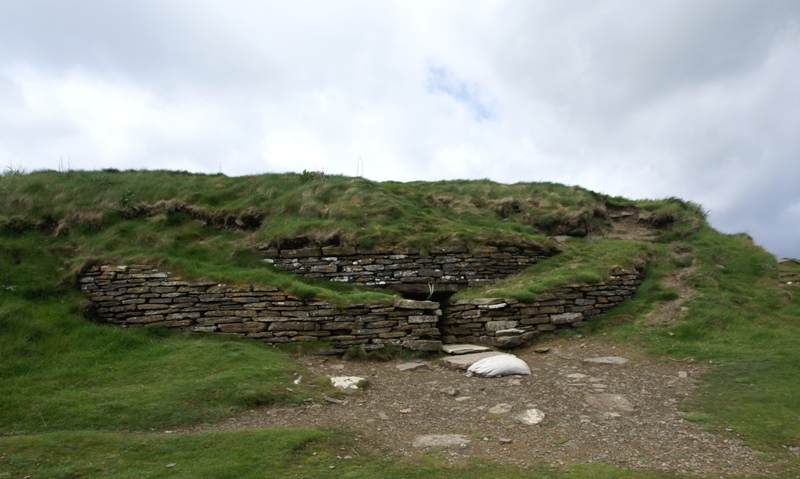
The Tomb of the Eagles — formally the Isbister Chambered Cairn — is a Neolithic stalled cairn on a cliff edge at Isbister, South Ronaldsay, in the Orkney Islands of Scotland. Constructed around 3000 BC, it became one of the most important Neolithic discoveries in the British Isles when a local farmer stumbled across it in 1958. Excavation eventually yielded the remains of more than 340 individuals represented by roughly 16,000 disarticulated human bones, alongside 725 bird bones from at least 14 white-tailed sea eagles (Haliaeetus albicilla) — the assemblage that gave the cairn its popular name.
Discovery: a farmer with a cigarette lighter, 1958
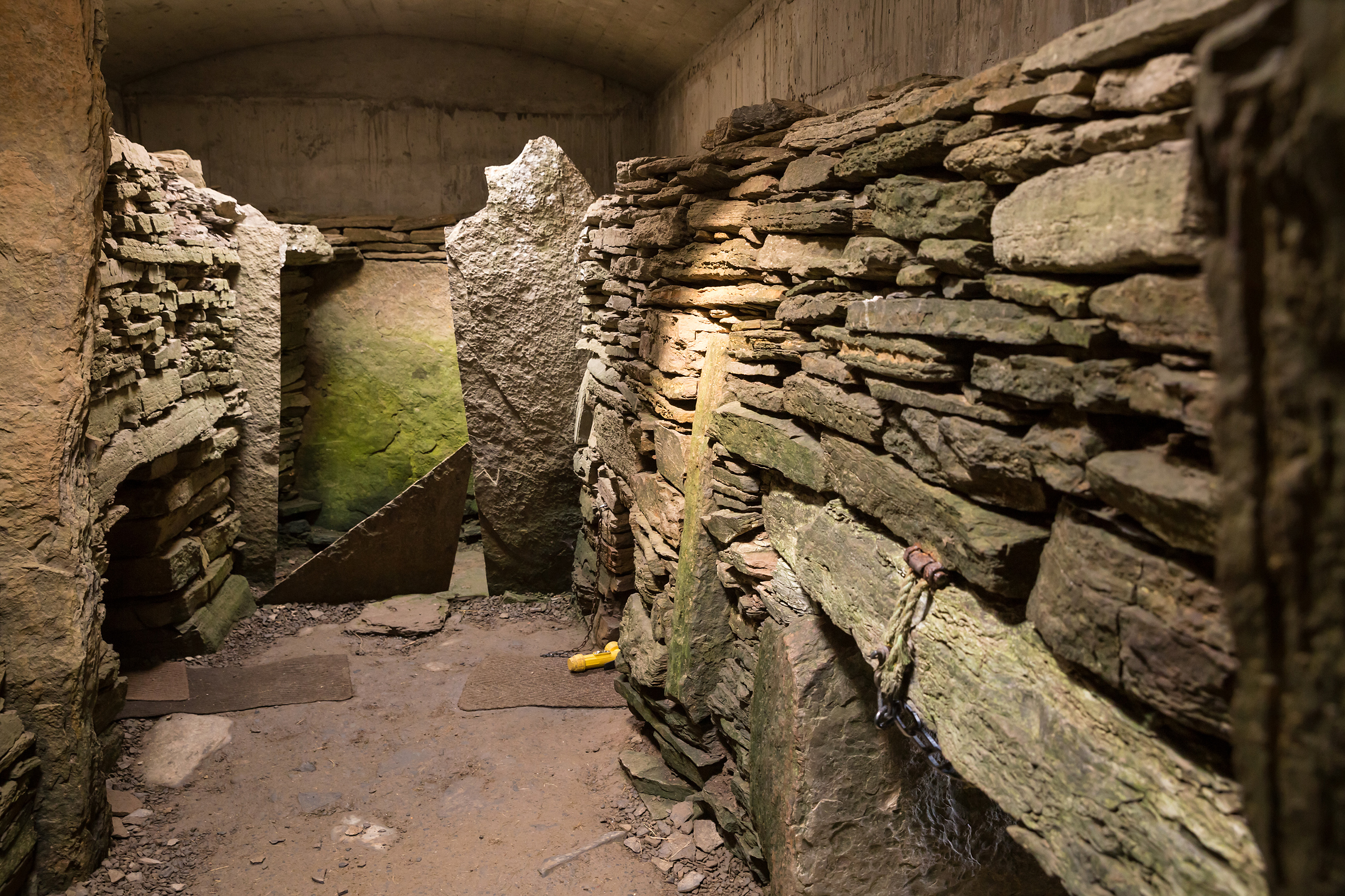
The cairn was found in 1958 by Ronald (Ronnie) Simison, a farmer at Liddle, while he was quarrying flat stones to make corner posts for a fence. Digging beside a drystone wall, he uncovered polished objects — a mace head, three stone axe heads, a black “button” and a small chert knife — and then a dark cavity. Using a cigarette lighter for illumination, he peered inside and saw a small chamber stacked with around 30 human skulls. Simison reported the find to the authorities, but when official excavation was deferred he carried out his own informal investigation of part of the chamber over the following years, recovering large quantities of bone and pottery.
The Hedges excavations, 1976–1982
Full scientific excavation was eventually carried out by the archaeologist John W. Hedges between 1976 and 1982, working under the then–Scottish Development Department. Hedges’ team systematically recorded the contents of the chamber and adjoining cells, lifting bones, pottery, flint and bird remains in stratigraphic order. The resulting bone assemblage — published in his 1983 monograph Isbister: A Chambered Tomb in Orkney — was described as the largest and best-preserved single assemblage of Neolithic human bone in the British Isles. The bones represented at least 342 individuals and showed evidence of excarnation — the practice of allowing bodies to decompose in the open air before the cleaned bones were deposited in the tomb.

How was the cairn built?
Isbister belongs to the Orkney–Cromarty group of chambered cairns. It is a stalled cairn: an elongated rectangular main chamber roughly 3.5 metres high, divided by upright slabs into five “stalls”, with three small side cells set into the walls. The whole structure sits within an oval-shaped cairn of stone rubble, accessed by a low entrance passage that forced anyone entering to crouch. Construction used locally quarried Old Red Sandstone slabs, dressed and laid in regular drystone courses. The position — at the very edge of a sea cliff overlooking the Pentland Firth — is characteristic of Orcadian tomb-builders, who repeatedly placed their cairns on prominent boundary landscapes between sea, sky and pasture. The two-storey Taversöe Tuick on Rousay is a closely related Orcadian example.
Why is it called the Tomb of the Eagles?
The nickname comes from the 725 bird bones recovered alongside the human remains, the great majority belonging to at least 14 white-tailed sea eagles (Haliaeetus albicilla), Britain’s largest bird of prey. For decades the find was read as evidence of an eagle totem clan: a Neolithic community whose identity was bound up with the sea eagles soaring over the Pentland Firth. That reading has since been complicated. Direct radiocarbon dating of the eagle bones, published in 2016 by a team including Tom Higham, returned dates centring on 2450–2050 BC — roughly 500 to 1,000 years after the cairn was first built. The eagles, in other words, were placed in an already ancient monument by later Bronze Age people, evidence — discussed in detail by the Ness of Brodgar Project — that Orcadian chambered tombs remained in active ritual use for many generations.

What was found inside?
Beyond the eagles, Isbister produced one of the richest Neolithic finds assemblages from any Orcadian cairn. The main chamber and side cells contained around 16,000 human bones representing at least 342 individuals of all ages, large quantities of Unstan Ware pottery (a finely decorated late Neolithic style first identified at the nearby Unstan cairn), flint and chert tools, polished stone axes, and the remains of sheep, cattle, deer, otter and fish. The bones were highly disarticulated and selectively grouped — skulls in one area, long bones stacked elsewhere — confirming that bodies were first excarnated outside and then introduced to the cairn as cleaned, sorted remains rather than as complete burials.
Where does Isbister sit in Neolithic Orkney?
The cairn is part of the broader Neolithic Orkney cultural landscape, a Late Stone Age society that also produced the village of Skara Brae, the Standing Stones of Stenness, the Ring of Brodgar, the Maeshowe passage tomb and the ongoing excavation at the Ness of Brodgar — together inscribed by UNESCO in 1999 as the Heart of Neolithic Orkney World Heritage Site. Isbister is not part of that inscription, but it is recognised as a Scheduled Monument by Historic Environment Scotland and is one of the most-studied chambered cairns in Britain. For wider context on the islands themselves, see the Britannica entry on the Orkney Islands.
Can you visit the Tomb of the Eagles today?
The Simison family operated a small private museum and visitor centre at the site for many years following the excavations. The centre closed in 2020, and the cairn itself has been inaccessible to the public since. In September 2025, ownership of the site and its associated collections transferred to the South Ronaldsay and Burray Development Trust (SRBDT), which has since launched a community crowdfunder to fund the work needed to safely reopen the tomb and visitor centre to the public. As of 2026 the cairn remains closed pending those works.
At a glance
- Country: Scotland (Orkney Islands)
- Location: Isbister, South Ronaldsay, Pentland Firth coast
- Type: Neolithic stalled chambered cairn (Orkney–Cromarty group)
- Built: c. 3000 BC
- Excavated: 1958 (Ronnie Simison); 1976–1982 (John W. Hedges)
- Key finds: ~16,000 human bones (342+ individuals), 725 bird bones (≥14 white-tailed sea eagles), Unstan Ware pottery, polished stone axes
- Significance: Largest single assemblage of Neolithic human bone in the British Isles
Sources & further reading
- Wikipedia — Tomb of the Eagles (Isbister Chambered Cairn)
- Ness of Brodgar Project — The Isbister stalled cairn
- Britannica — Orkney Islands
- Archaeology Orkney — Crowdfunder to reopen the Tomb of the Eagles (2025)

Neural Pathways is a collective of seasoned experts and researchers with a profound passion for unraveling the enigmas of ancient history and artifacts. With a wealth of combined experience spanning decades, Neural Pathways has established itself as a leading voice in the realm of archaeological exploration and interpretation.